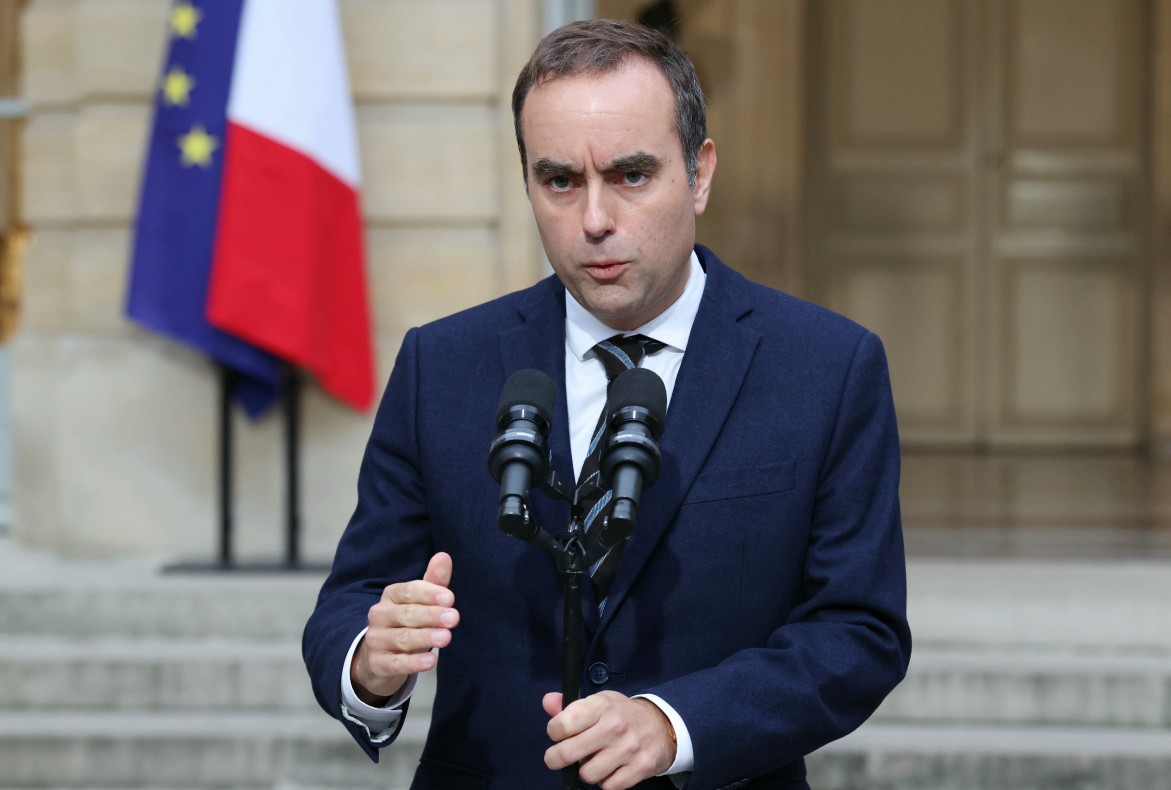

French Prime Minister Sébastien Lecornu survived a duo of no-confidence votes in Parliament on Oct. 16, amid an ongoing political crisis in the country.
Lecornu survived the votes, known as motions of censure, thanks to backing from the Socialist Party due to his promise to suspend President Emmanuel Macron’s pension reforms until after the 2027 presidential election.
The two motions were brought by both the leftist faction La France Insoumise and the right-wing Rassemblement National (RN).
They secured just 271 and 144 votes respectively, short of the 289 votes needed to bring down Lecornu’s government, which is only a few days old.
“Let’s get to work!” Lecornu told the press as he left the National Assembly, Le Monde reported.
“The debates had to start, and they will start.”
He was referring to the upcoming discussions on the 2026 budget.
RN president Jordan Bardella criticized the government after his party’s motion failed.
“A majority of bargaining succeeded today in saving their seats, at the expense of the national interest,” he wrote on X.
“The great absentees from these political maneuvers are the French people, who are preparing to endure the social and fiscal slaughter of a punitive budget. All those who today refused censorship will be responsible for the country’s forthcoming suffering.”
La France Insoumise called for “popular and parliamentary resistance” following its defeat.
“This illegitimate government promises blood and tears for the country. Its budget would be a catastrophe for the country. It would hit workers, retirees, young people, the unemployed, and the sick. No one would be spared,” the party said in a statement.
“It is a series of cuts to essential budgets for the daily lives of the French, to public services and social security. Mr. Lecornu’s policy remains that of a tough and uncompromising Macronism, soft on the rich, hard on everyone else.”
Yaël Braun-Pivet, the National Assembly president and an ally of Macron, said the outcome left her “reasonably optimistic” about the chances of building consensus for the 2026 budget in Parliament, despite its deep divisions.
“I am sure that there’s a path,” she said.
In the wake of the votes, France’s bond market held steady.
If Lecornu had lost either of the votes, he and his government would have been forced to immediately resign, and Macron would have come under even greater pressure to call a snap parliamentary election, as he did in 2024 after Michel Barnier was ousted as prime minister after losing the confidence of the National Assembly.
Lecornu himself already resigned from the post once on Oct. 6, after less than a month in the job. He was reappointed four days later.
He acknowledged on Oct. 11 that there were not “a lot of candidates” for his job and that he might not last long in the post, given the country’s deep political divides.
“If the conditions were no longer met again, I’d leave,” Lecornu told La Tribune Dimanche. “I’m not going to just go along with whatever.”
He is France’s fourth prime minister in barely a year and was initially appointed by Macron on Sept. 9.
As a condition of supporting the government, the Socialist Party previously stated that it wants Lecornu to roll out a wealth tax on top of repealing the pension reforms, but such measures will face opposition from parties on the right.
France has been plunged into crisis in recent years, as a series of minority governments have struggled to pass deficit-reduction measures through Parliament, which is split between three ideological blocs.
The eurozone’s second-largest economy faces a mounting debt crisis that has worried domestic businesses, global financial markets, and European Union partners.
Rachel Roberts contributed to his report.
 Friends Read Free
Copy
Facebook
Tweet
Friends Read Free
Copy
Facebook
Tweet