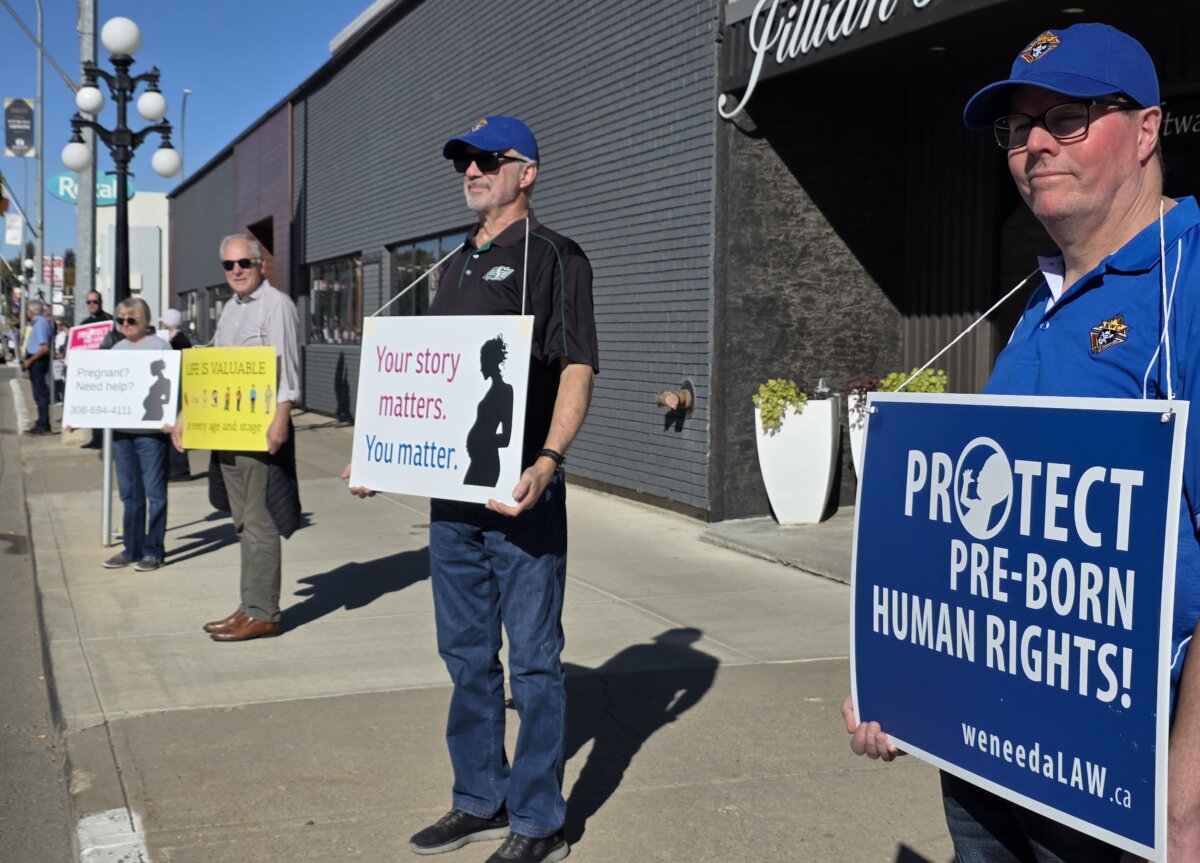

MOOSE JAW, Sask.—With three children under the age of 4, and another on the way, Reagan King brought his young family to “Life Chain” on Oct. 4—one of the country’s largest pro-life demonstrations.
The Moose Jaw gathering was one of hundreds of Life Chain events held across Canada, drawing thousands of participants. Now in its 36th year, Campaign Life Coalition introduced the event to Canada in 1991, four years after it began in the United States.
King was among about 100 people who participated in the event in Moose Jaw, where demonstrators spent an hour praying and holding signs opposing abortion. Participants also expressed opposition to medical assistance in dying (MAID).
King told The Epoch Times that he attended because he wanted to advocate for unborn babies who could not speak for themselves.
“I have my own children and seeing them, I couldn’t imagine a world without them,” he said.
Explaining the demonstration to his children required “a tough conversation,” King said. He and his wife adjusted their explanation to the children’s ages, telling them they were praying for “babies who are in their mommies’ tummies” and grandparents “who are sick and need support.”
King said his family encountered mixed reactions. Some passersby made obscene gestures and shouted at his children, while he said many more people—“the silent majority”—waved and smiled.
 Participants in this year’s Life Chain pro-life rally gather in downtown Moose Jaw, Sask., on Oct. 4, 2026. (Jason G. Antonio/The Epoch Times)
Havanka said the event’s messaging had expanded to include opposition to MAID because of its growing prominence in Canada. She said for her, opposition to abortion and assisted suicide reflected the same belief about the value of human life.
The federal government legalized MAID in 2016 and expanded eligibility in 2021 by removing the requirement that a person’s natural death be reasonably foreseeable. Eligibility for people whose sole underlying medical condition is a mental illness was set to come into force in 2027 after repeated delays, but the Liberal government now says it will table legislation this fall to indefinitely exclude people who solely suffer from mental illness.
According to the latest available data, 16,499 people received MAID in Canada in 2024, accounting for approximately 5.1 percent of all deaths that year, Health Canada says.
Havanka said her opposition to MAID stems partly from her religious belief that God should determine when a person dies. She added that society needs to value life more and support people who needed help.
 Participants in this year’s Life Chain pro-life rally gather in downtown Moose Jaw, Sask., on Oct. 4, 2026. (Jason G. Antonio/The Epoch Times)
Casamayor identified several approaches she believed could help end abortion, including providing sufficient resources to women, introducing laws protecting pre-born children, and persuading people to reject abortion for any reason.
She said advocates should seek better solutions to the difficulties women face rather than treating abortion as the answer to those problems. Casamayor added that advocates should approach people who disagree with them in a “compassionate and compelling” manner.
 Friends Read Free
Copy
Facebook
Tweet
Friends Read Free
Copy
Facebook
Tweet