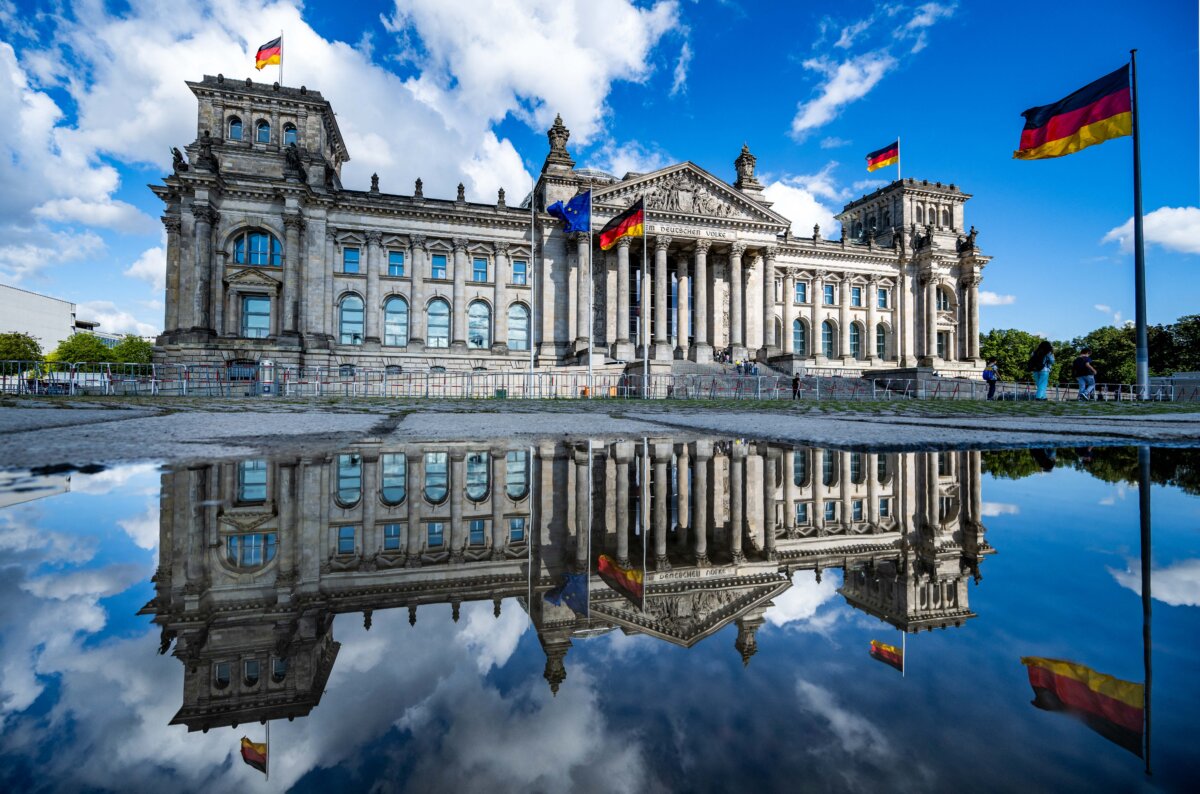

The German Council of Economic Experts cut its growth forecast for the country’s economy on May 27, highlighting the impact of the ongoing war in Iran, higher energy prices, and large welfare costs.
The group, known as the “Five Sages” in Germany, said they now expect just 0.5 percent growth this year, down from a November forecast of 0.9 percent, according to their spring report to the government.
For 2027, the panel forecasts growth of 0.8 percent.
The body is made up of five experts recommended by the German finance minister and appointed by the German president for five-year terms.
The council’s report comes on the heels of Berlin’s finance ministry cutting its growth forecasts for 2026 and 2027 in April and raising its inflation projections.
The government now expects 0.5 percent growth for 2026, down from an earlier projection of 1.0 percent, and has cut its 2027 growth outlook to 0.9 percent from 1.3 percent.
“With the outbreak of the Iran war on Feb. 28, 2026, the economic environment for the global economy has deteriorated,” the council’s report said.
“The significant negative energy supply shock has led to a sharp rise in energy prices since March 2026. This is likely to cause consumer price inflation to rise significantly,” it added.
These higher energy prices are reducing household purchasing power and weighing on consumption, the economists said. Inflation in Europe’s largest economy is expected to average 3.0 percent in 2026, up from 2.2 percent in 2025, before easing off to 2.8 percent in 2027.
In a riskier scenario, which sees oil prices rise to $120 per barrel and remain elevated until October 2026, the council said, German growth could slow even further, to 0.2 percent in 2026 and 0.5 percent in 2027, while inflation would then rocket to 3.5 percent in 2026 and remain at 3.2 percent in 2027.
They further found that Germany’s traditional strength in international trade is also on the wane, with the current account surplus expected to fall from almost 6 percent of GDP in 2024 to around 3 percent in 2027, in what Council member Gabriel Felbermayr called “a dramatic deterioration in a very short period of time,” Süddeutsche Zeitung reports.
He attributed this fall to increasing competition from China, saying that “Chinese exports are becoming increasingly similar to German ones.”
Felbermayr said the problem is that while the global economy and world trade continue to grow quite robustly, German companies—unlike in previous periods of economic expansion—are hardly reaping any benefit.
“The German export sector is not growing at this pace.” Felbermayr continued. “It is stagnating.”
German Economy Minister Katherina Reiche said on May 27 during a visit to Beijing that a modern economic relationship requires both cooperation and competition.
“Competition makes us stronger, cooperation creates stability, and innovation creates shared progress,” Reiche said on her first trip to China.
The council also said that in addition to these global economic issues, Germany continues to grapple with many domestic problems, particularly in pensions, health insurance, and long-term care.
The increase in costs and contributions in these sectors, combined with higher energy prices, is making production in Germany increasingly expensive and dampening consumer spending, according to the report.
“Higher contribution rates dampen overall economic growth. They make labor costs more expensive for companies and reduce the net incomes of private households—and therefore their consumption,” a press release accompanying the report said.
Monika Schnitzer, chair of the council, said that “the foreseeable increase in social security expenditures should be slowed. At the same time, it is essential to stabilize the revenue base and benefit levels of the social security system.”
The council also warned that Germany’s long-running economic weakness reflected weaker industrial competitiveness and demographic pressures.
“The weakness of the German economy, which has persisted for seven years, is not only cyclical but also has structural causes,” said Veronika Grimm, another member of the council.
“The pressure to act is immense,” Schnitzer said.
Reuters contributed to this report.
 Friends Read Free
Copy
Facebook
Tweet
Friends Read Free
Copy
Facebook
Tweet