

Supporting Ukraine in its war against Russia is important for Australia because China is paying close attention, said Germany’s federal Defence Minister Boris Pistorius.
The minister is in the country on an official visit and signed an agreement to advance military exchange and expand both nations’ space capabilities while in Canberra.
“China is careful not to be directly involved in these wars [in Ukraine and the Middle East], but it certainly draws conclusions from them for its own ambitions and aspirations,” he told the National Press Club on March 26.
“It is paying very close attention to how the United States and its allies [act], especially to Russia’s war against Ukraine. So the question [of whether] to support or not to support Ukraine can also have an impact on Taiwan and the security situation in the Indo-Pacific.”
Business as Usual is Off the Table: Minister
The minister said Beijing continued to trade with Moscow in everything from natural resources to dual-use goods including products, software, and technology designed for commercial/civilian purposes that can also be used to develop or produce military systems.
“China helps Moscow mitigate the effects of Western sanctions and consequently continue its war effort,” Pistorius said.
“What happens in Europe doesn’t stay in Europe and vice versa. What happens here also affects Europe. This interconnectedness is in the global trade of commodity markets and energy prices for domestic consumption.”
Pistorius also warned that “business as usual” was not the way forward.
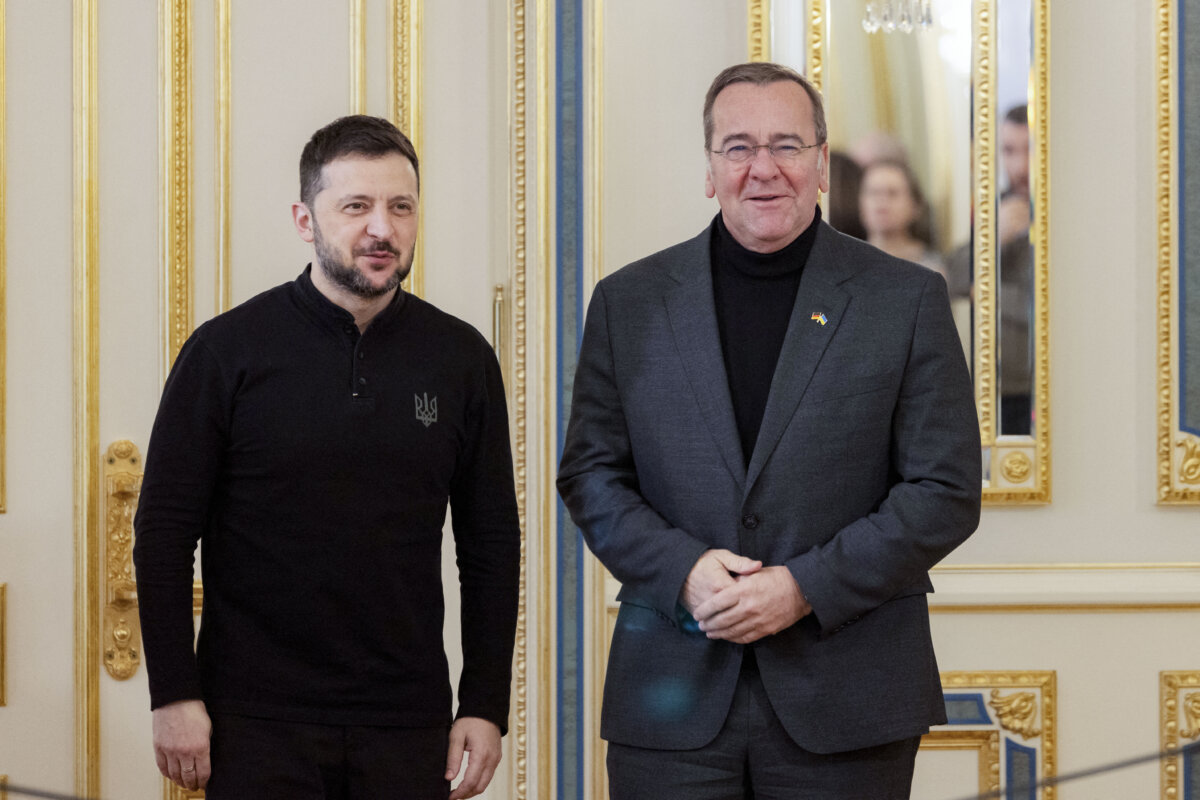
The minister also commended Australia’s support for Ukraine.
“From day one, you have supported our side of NATO [in the Ukraine conflict]. You took a stance and made it very clear to Russia [that] the international community does not accept this illegal war,” the minister said.
“Looking at the other side of the coin, we as Germans and Europeans understand that a failure to address the challenges in the Indo-Pacific will embolden authoritarian regimes and undermine the credibility of the international order.”
That was one of the primary reasons for his visit to the region, Pistorius said, having been to Japan and Singapore before coming to Australia.
In 2021/22, Germany deployed the frigate Bayern to the Indo-Pacific—the first time a German warship had navigated the region in nearly two decades—in what Pistorius called “a visible sign of Germany’s willingness to contribute to maintaining the freedom of navigation.”
As part of its renewed engagement in the region, Germany has participated, together with Australia, in the multinational RIMPAC exercises, including by crossing the Taiwan Strait, and is participating in the Pacific security maritime exchange to enforce U.N. sanctions against North Korea.
Germany’s Effort to Re-arm and Recruit
Like Australia, Germany is increasing its defence spending, but at a far more rapid pace. This year, it will reach approximately 108 billion euro (AU$181 billion), driven by a 100 billion euro special fund being used to modernise the armed forces following Russia’s invasion of Ukraine.
This makes Germany the fourth-highest-funded military globally. It also met the 2-percent-of-GDP NATO spending target in 2024.
Australia is currently at 2 percent and aims to reach 2.3 percent by 2033/34.
“We have drastically increased our [spending on] defence,” Pistorius said, explaining that Germany needed to amend its Constitution to do so. “This speaks volumes about how serious we are.”
Late last year, the Bundestag (German Parliament) voted to also send a questionnaire to all 18-year-olds asking whether they are interested and willing to join the armed forces.
Completing the form is mandatory for men and voluntary for women. While joining the armed forces remains voluntary for now, conscription remains an option.
“We are all determined to defend these principles [of international law] because they help us protect our freedom, our sovereignty, our territorial integrity, and, in the end, our prosperity,” Pistorius said.
 Friends Read Free
Copy
Facebook
Tweet
Friends Read Free
Copy
Facebook
Tweet