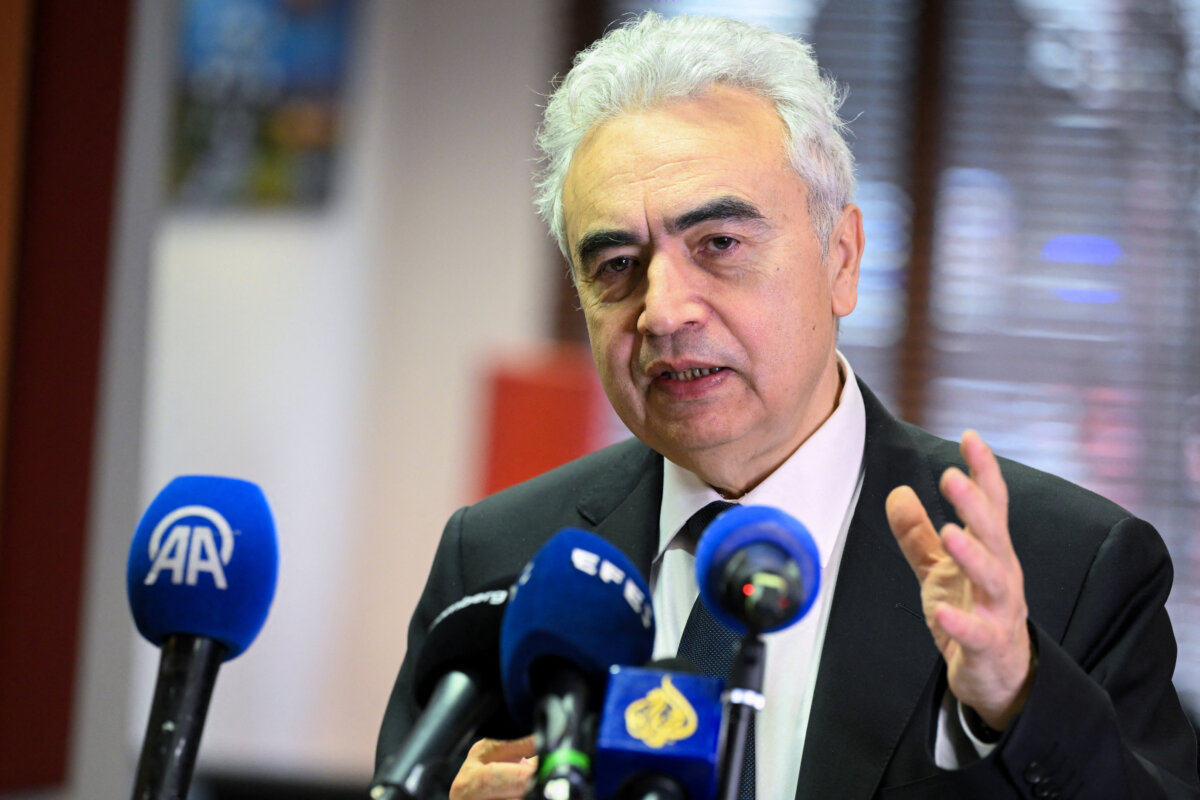

The chief of the International Energy Agency (IEA) said on March 23 that the global economy faces a “major, major threat” as a result of the Iran war.
“No country will be immune to the effects of this crisis if it continues to go in this direction,” IEA Executive Director Fatih Birol said at Australia’s National Press Club in Canberra.
Birol said that world leaders had still failed to fully grasp how dire the energy crisis facing the planet due to the conflict is, saying that even if peace were reached immediately, the level of damage means there would still be pain to come.
Calling the situation “very severe,” he said its impact had already outstripped the oil shocks of the 1970s and the turmoil caused by the outbreak of the war between Russia and Ukraine in 2022.
The oil crises of 1973 and 1979 caused a combined loss of 10 million barrels per day, Birol said, causing “major economic problems around the world, the recessions.”
“And today, only as of today, we lost 11 million barrels per day—so more than two major oil shocks put together,” he said.
After Russia’s invasion of Ukraine, the gas markets, especially in Europe, “lost about 75 billion cubic meters, 75BCM. And as of now, as a result of this crisis, we lost about 140BCM, almost twice [as much],” Birol added.
Birol said 40 energy assets in nine countries across the Middle East were “severely or very severely damaged” at this moment.
“Some of the vital arteries of the global economy, such as petrochemical, such as fertilizers, such as sulfur, such as helium—their trade is all interrupted, which would have serious consequences for the global economy,” he said.
Birol said the IEA, “in order to comfort the markets,” had already released 400 million barrels of oil, which is historic.
“We have never released so much oil to the markets. … The single most important solution to this problem is opening up the Hormuz Strait as things stand now,” he said.
Birol added that he was now consulting with governments in Europe, Asia, North America, and the Middle East about the prospect of unleashing further stockpiled oil.
“We will see, we will look at the markets,” he said. “If it is necessary, of course, we will do it, but we will look at the conditions, we will analyze, assess the market, and discuss with our member countries.”
His comments follow a March 20 IEA report that called on people to work from home, shift from cars to public transportation, and avoid air travel to cut fuel use amid turmoil in the oil market.
Birol’s comments were made on the same day that the United Nations warned that the war has a “far-reaching” impact on millions of people, particularly in developing countries in Asia and Africa.
U.N. Office for Project Services Executive Director Jorge Moreira da Silva explained the impact of the war, including “exponential price hikes in oil, fuel, and gas.”
“Developing countries in Asia and the African continent are likely to bear the heaviest brunt,” he said, adding that disruptions in the Strait of Hormuz would impact fertilizer markets, “threatening food security in countries where famine or food insecurity are highest, including Sudan, South Sudan, Afghanistan, Yemen, and Somalia.”
“During the course of the year, the number of people living in hunger around the world is likely to increase by tens of millions. A widening war in the Gulf could also threaten remittance flows, primarily to South Asia,” he said.
Da Silva said there is no military solution to the conflict.
“The only way to end this mayhem and people’s suffering is through a diplomatic and peaceful solution and the implementation of all U.N. Security Council resolutions,” he said.
The Associated Press contributed to this report.
 Friends Read Free
Copy
Facebook
Tweet
Friends Read Free
Copy
Facebook
Tweet