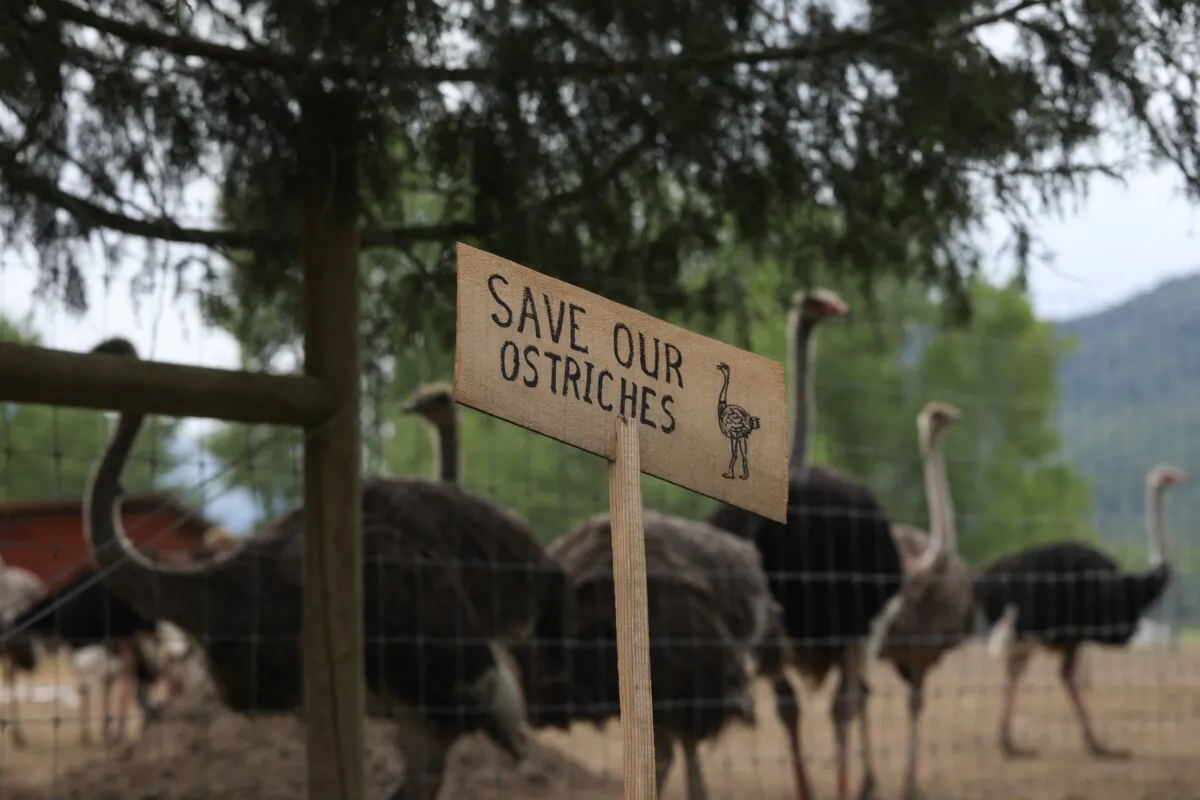

EDGEWOOD, B.C.—The smell of sizzling bacon fills the farmhouse of Katie Pasitney and her mother Karen Espersen at Universal Ostrich Farms in Edgewood, B.C., as supporters come in to have breakfast and discuss strategy.
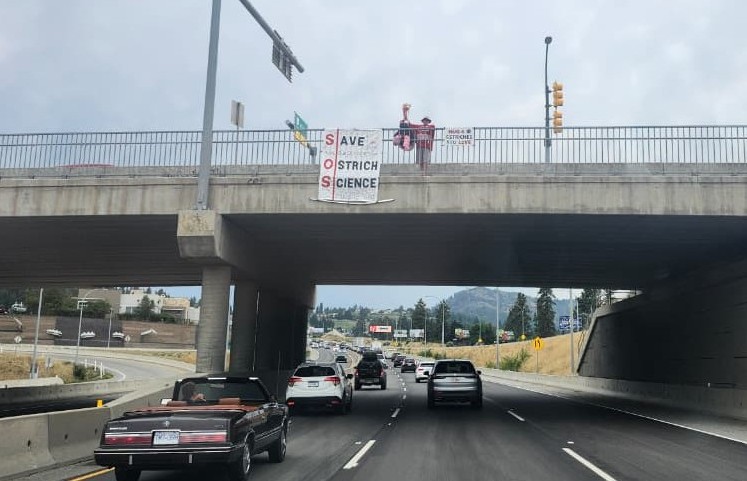
Since being served with a cull order by the Canadian Food Inspection Agency (CFIA) at the beginning of this year, the farm has become the centre of international debate over the rights of farm owners and the process to deal with agricultural livestock diagnosed with diseases.
Pasitney, the daughter of one of the co-owners who has been acting as the farm’s de facto spokesperson, sits at the dining room table on the morning of Aug. 27, joined by supporters Jeff Gaudry and Rob Wilkinson, who discuss the next steps after the farm lost its final court appeal to stop the cull order in August. Pasitney’s dogs Shiloh and Bear watch on from the floor.
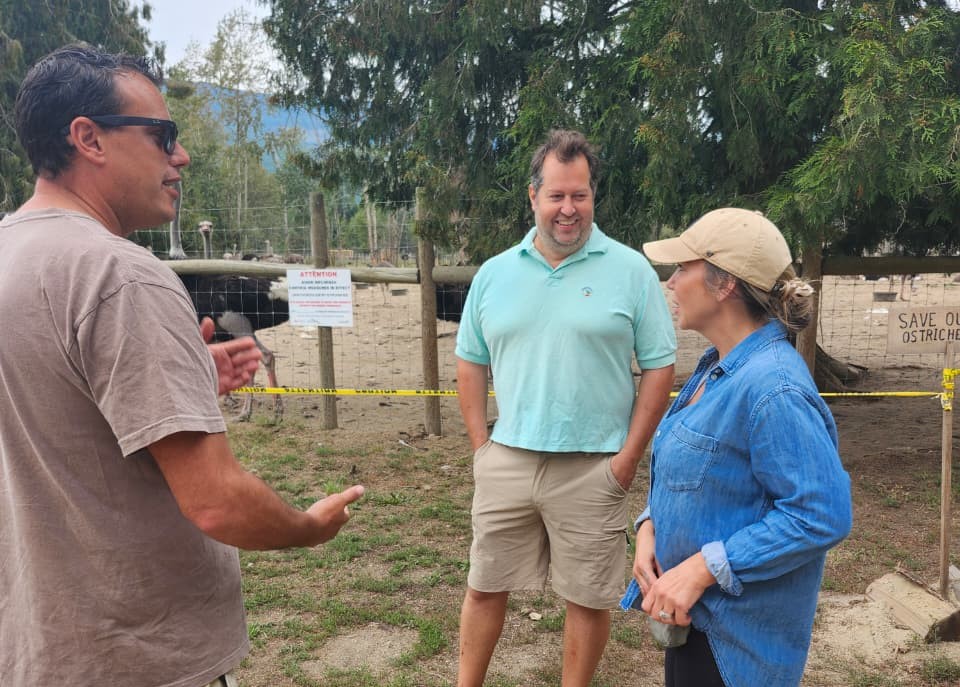
“I don’t think they [CFIA] thought that we would get the U.S. backing us. Then we get our largest trading partner saying, ‘let’s collaborate,’” Pasitney told The Epoch Times, referring to support from senior members of the Trump administration such as Centers for Medicare & Medicaid Services head Dr. Mehmet Oz and Health Secretary Robert F. Kennedy Jr. to stop the cull order and study the ostriches further.
“It’s the tyranny and the pushback and the government overreach of saying, ‘Well, now you can’t play Christian music, now you can’t travel, you know, now you can’t—you have no land rights. You have no animal rights,” she added.
The CFIA says the cull order is needed in accordance with the World Organization for Animal Health’s “stamping-out” policy. “Stamping-out is the internationally recognized standard and is a primary tool to manage the spread of HPAI [highly pathogenic avian influenza] and mitigate risks to animal and human health as well as enable international trade,” the organization says.
Crowd of ‘Regulars’
Gaudry, who participated in the trucker convoy protests in Ottawa in 2022, is passionate about protecting small farms and developing the scientific potential behind the ostrich eggs.
“I’ve been a supporter of this since the original cull order and I’ve been coming out since kind of the end of April,” Gaudry said in an interview with The Epoch Times, adding that he’s especially concerned about international organizations like the World Organization for Animal Health and the World Health Organization and what he calls their “influence” in guiding Canadian federal policy.
The farm is located in a remote area of the Inonoaklin Valley in B.C.’s Interior, about 175 kilometres west of Kelowna, and has drawn supporters from all over Canada who come to camp out, including James Semple of St. Thomas, Ont., Rob Wilkinson from Kelowna, and dozens of others.
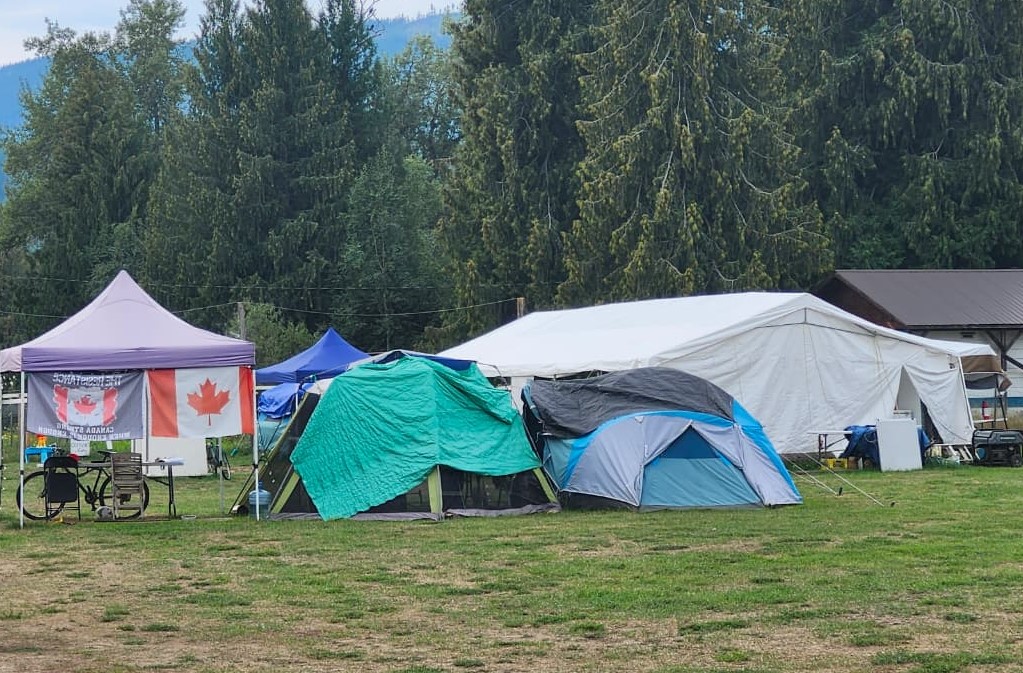
Across from the farmhouse, a large field contains a dozen or so tents and a cooking area and fire pit, the fence lined with various flags and slogans in support of the ostriches and farmers’ rights. Pasitney said the “regulars” occasionally eat with the family at the farmhouse and then cook for themselves at other times or when there is a larger gathering of supporters.
Gaudry, 43, said that there is a core group of several dozen supporters who camp out at the farm regularly, along with a jump to about 100 people for a period at the end of May, 50 for the Aug. 23 and 24 weekend after the farm lost its last appeal, and large crowds for special events such as a July music festival in support of the farm at which Freedom Convoy leader Tamara Lich performed music.
“We were essentially establishing this thriving network of people in defence of the birds who were taking care of everything—they were cooking and cleaning and security, and everyone was just working together,” Gaudry said.
Wilkinson, 68, has been coming out from Kelowna to camp out at the farm whenever possible since February. He believes that if the farm’s ostriches are culled, it will start a domino effect that damages farms across Canada.
“They’re going to try and destroy the farmers. They’re going to take away the livestock. They’re going to try and corral their own food source into a small little area controlled by government,” he said.
The Scientific Potential of Ostrich Eggs
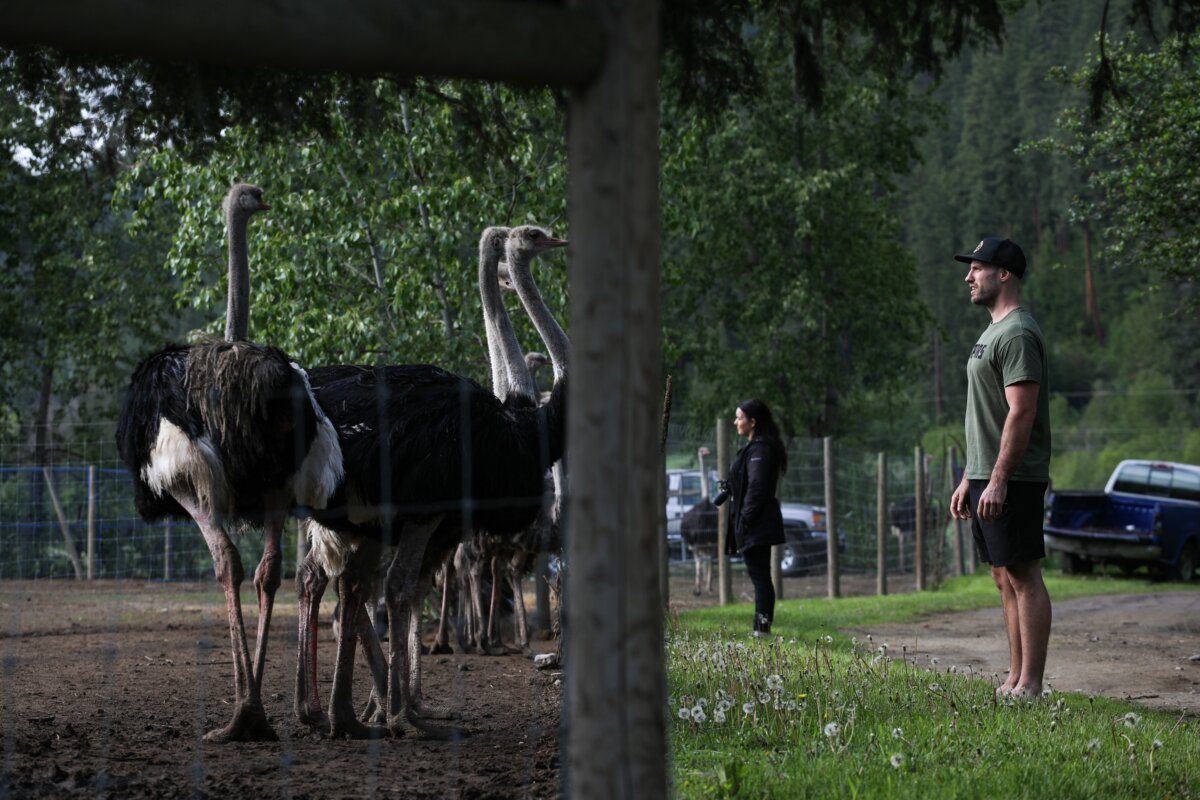
The ostrich enclosure is located several hundred metres further down a dirt road from the farmhouse, surrounded by yellow tape with an advisory posted announcing it as a site of the detection of avian influenza.
Next to the enclosure is a large sign that reads “Stop the Murder of 399 Ostriches!” in front of an old red pickup truck with an ostrich rag doll sticking its head out the window, while a small kiosk on the other side of the road is festooned with Canadian flags and manned by a middle-aged volunteer from Texada Island, B.C.
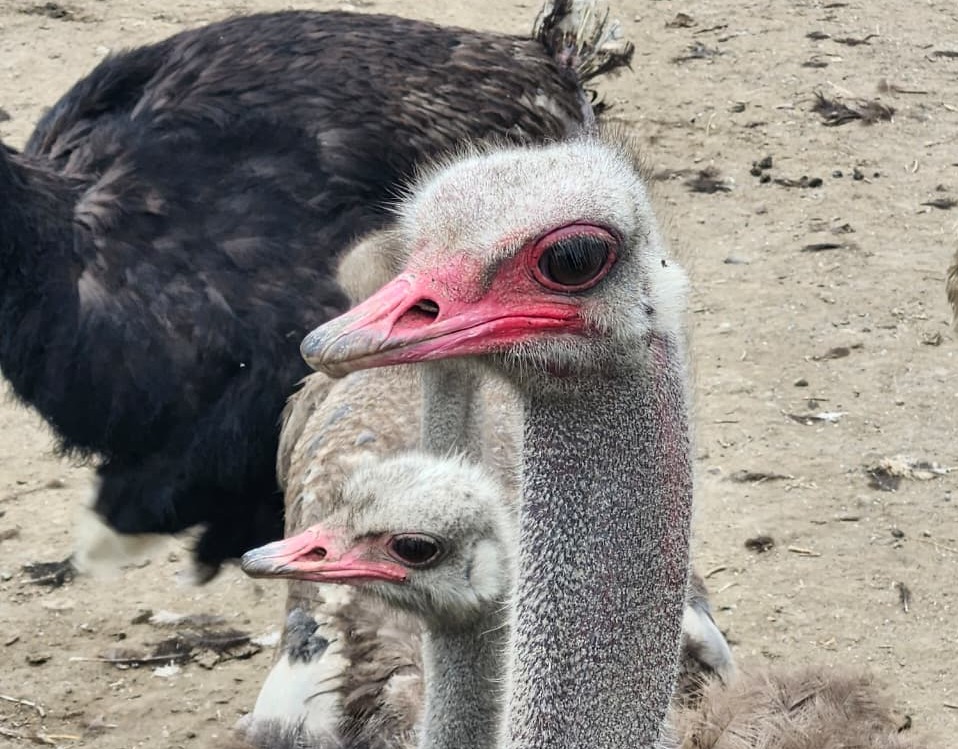
Scientists such as Dr. Steven Pelech of the University of British Columbia and Yasuhiro Tsukamoto of Kyoto Prefectural University in Japan say ostrich eggs are a rare source of valuable antibodies, which could be key in diagnosing and treating H5N1 and COVID in animal and human populations. Pelech said in an Aug. 29 interview with The Epoch Times that the CFIA’s cull order is not based on sound science and would ruin enormous research potential.
The CFIA, meanwhile, says the ostriches are a danger to human and animal health, stating in its latest Aug. 21 update that killing the remaining 399 ostriches is part of “necessary disease control measures to protect public health” and safeguard Canada’s poultry industry.
This is echoed by some others such as virologist Angela Rasmussen of the University of Saskatchewan, who says the animals have “minimal value to scientific research,” and that the cull order should proceed.
‘It’s Not Really a Liberal, Conservative Thing Anymore’
Semple, Wilkinson, and Gaudry said they aren’t there to represent a particular partisan point of view but rather to stand against what they perceive as broader infringements on Canadian sovereignty and citizens’ rights, though Wilkinson agreed there is a broadly libertarian-leaning view to many supporters as well as many whose traditionalist faith guides them to dedication to the cause.
Various flags around the farm also reflect Christian messaging, and Pasitney noted that Pastor Artur Pawlowski, who was jailed for rallying protesters during COVID protests, baptized 30 people in July in the nearby creek.
Many supporters on the farm report becoming politically active during the COVID pandemic and the trucker convoy protests, repelled by what they regarded as government overreach in terms of vaccine requirements and travel restrictions.
“It’s not really a Liberal, Conservative thing anymore. It becomes a common sense ethics thing. The Liberal ministers cannot deny the reality, the fact, like a policy is designed to provide fruitful results—that’s why we have a policy,” Gaudry said.
Semple, who’s been camped out at the farm for months, says a key concern for him is the danger of illegal hunting if Canada’s food supply collapses, which he believes could be the end result of the precedent set if the ostriches are culled.
“If the food supply collapses, … people just could start hunting illegally and poaching, right? Which I’d be very sad if that happened,” said Semple, who’s a member of the Mohawk First Nation. “They only have a few conglomerates providing us with what we need, and we’re at the beck and mercy of [the conglomerates].”
Farm Plans Path Forward
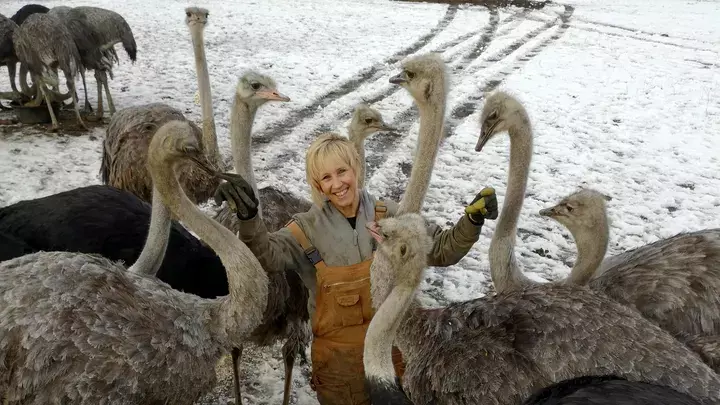
The farm has been in operation for about 35 years but switched from selling the red meat of ostriches to focusing on scientific research from the animals. Pasitney said that the CFIA’s stamping out policy would hurt public health in this case and feed into a pattern of disempowering people to make their own choices about what they eat and what medicines they take.
“If we lose our natural immunity, all of us are going to be absolutely just reliant on vaccinations for survival. So now Big Pharma just grows, and then we’re eating lab-grown meat, because they just go, at the end of the day, go, ‘oh no, there’s a food security shortage and it helps the environment,’” Pasitney said.
As Pasitney, her mother, and co-owner Dave Bilinski walk out with Gaudry and various supporters to the ostrich enclosure, they reflected on the ongoing fight and their refusal to back down. Despite unanimously losing their recent appeal, they plan to apply for an emergency stay, and local MP Scott Anderson has said he intends to bring the farm’s concerns forward in a caucus meeting with fellow Conservatives.
They recall the 1967 flooding of a nearby area that is now the Arrow Lakes in order to power hydro. Residents were paid by the government and forced to leave their homes in the flood zone, with a boat now running a 24-hour service between the Edgewood side and Fauquier, B.C.
Pasitney recalled a past wildfire evacuation order in their area four years ago, when she and her family refused to leave their farm despite the order. Although the fire was safely contained without any damage to the farm, Pasitney reflected on the determination they all feel to stand by their ostriches and their farm.
“The government must be thinking these people won’t abandon their animals no matter what,” Pasitney said.
 Friends Read Free
Copy
Facebook
Tweet
Friends Read Free
Copy
Facebook
Tweet