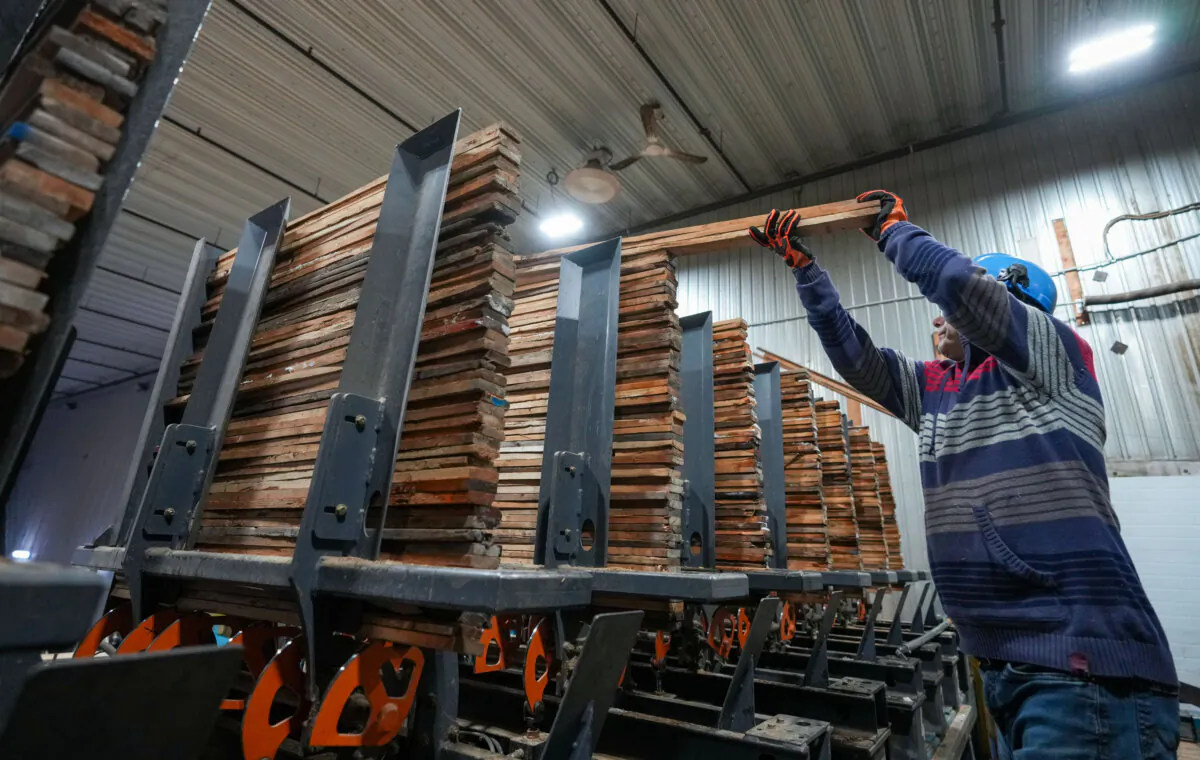

U.S. President Donald Trump has released details on a new series of tariffs, including levies on softwood lumber that could have serious effects on Canada’s lumber industry.
Trump signed a proclamation on Sept. 29 that puts 25 percent tariffs on kitchen cabinets, bathroom vanities, and upholstered furniture, building on a promise he made last week. The proclamation also puts 10 percent tariffs on imports of timber and lumber, and does not mention any exemptions as part of the United States-Mexico-Canada Trade Agreement (USMCA).
The new tariffs, when combined with existing anti-dumping and countervailing rates, would push the average tariff rate for lumber products from 35 percent to more than 45 percent, according to the Forest Products Association of Canada (FPAC).
“This broad action further undermines a deeply integrated North American supply chain that supports housing affordability, infrastructure, manufacturing, and shared prosperity and security on both sides of the border,” the association said in a statement.
Rideau Potomac Strategy Group president Eric Miller said the new U.S. tariffs address the issue of the country only producing roughly 70 percent of the softwood lumber that it consumes. He said these tariffs could lead to a negotiated agreement between Canada and the United States on lumber, which could be “part of the bigger discussion around USMCA renewal.”
History of Forestry Dispute With US
Trump imposed an average of 20 percent tariffs on Canadian softwood lumber during his first term in 2017, citing unfair trade practices. Washington has argued for years that Ottawa has an unfair advantage over U.S. companies because Canadian forest lands are typically owned by the government, and provinces subsidize their industries by charging low royalty rates for cutting down trees. Ottawa formally requested consultations before the World Trade Organization due to those softwood lumber duties in 2017, arguing they were “unwarranted.”
The tariff rate for lumber on Canada has fluctuated over the years. Tariffs on Canadian softwood lumber were lowered from 17.99 percent to 8.59 percent in 2022 under U.S. President Joe Biden. But the U.S. raised tariff rates on imports of Canadian softwood lumber products in 2024, from 8.05 percent to 14.54 percent.
Trump had signalled in early 2025 that he would impose even more tariffs on softwood, saying several times that the United States does not “need” Canadian lumber.
The Canadian government dropped two legal challenges in September 2025 of U.S. softwood lumber anti-dumping duties, which dated back to the previous decade. Then in August, the U.S. Department of Commerce increased countervailing and anti-dumping duties on Canadian softwood lumber to a total of 35.1 percent.
The presidential proclamation Trump signed on Sept. 29 states that the United States has “ample” raw materials and industrial capacity to meet domestic demand for wood products, but “foreign subsidies and unfair trade practices” have prevented those industries from fully maturing.
The proclamation said this is a threat to national security, which allows Trump to justify the duties under Section 232 of the Trade Act of 1974. The U.S. Supreme Court is currently ruling on whether Trump’s broader “reciprocal” tariffs on various countries are legal.
The proclamation also says U.S. tariffs on wood products from the United Kingdom will be capped at 10 percent, and those from the European Union and Japan will be capped 15 percent.
Trump also recently said he will put 25 percent tariffs on heavy trucks, 100 percent tariffs on branded and patented pharmaceuticals, and 100 percent tariffs on foreign movies. Additionally, Trump has signalled his intent to put tariffs on semiconductors. Presidential proclamations for these tariffs have yet to be released.
Economic Impacts of Tariffs
Trump’s new lumber tariffs are expected to lead to further economic strife and job losses to Canada’s economy, which has already struggled under U.S. tariffs on steel, aluminum, copper, vehicles and auto parts, oil, energy, and fertilizer.
The lumber tariffs will hammer a forestry sector that contributes $27 billion to Canada’s economy and employs approximately 200,000 people. Roughly $4.8 billion of that number is made up of forestry and logging, $13.3 billion is in wood product manufacturing, and $8.8 billion is pulp and paper manufacturing.
When broken down by province, the vast majority of forestry and logging employers are located in British Columbia and Quebec at 1,310 and 1,149 respectively, with smaller numbers in Ontario (467), New Brunswick (323), and Alberta (269).
The United States received the 78 percent of Canadian forestry exports in 2022, while 8 percent went to China, 4 percent went to Japan, and 2 percent to India.
Softwood lumber exports, valued at $4.5 billion, were B.C.’s second most valuable export in 2024, of which 74.8 percent went to the United States. According to a recent report from Deloitte Canada, U.S. tariffs in 2025 have already led to more than 7,000 job losses as “tariffs work their way through the construction and forestry sectors.”
Federal Energy Minister Tim Hodgson said in a statement on Sept. 30 that the executive order on lumber and derivative products will “continue to make homebuilding and furniture more expensive for Americans.” He also challenged the narrative that lumber imports represent a national security risk to the United States, noting that the U.S. Chamber of Commerce has argued to the contrary.
Hodgson said Ottawa remains committed to negotiating a “mutually acceptable resolution” to the long-standing lumber dispute. He added that the federal government has announced measures to invest in domestic production, including the “Buy Canadian Programme” ensuring that the government and third-parties receiving federal funding build with Canadian lumber.
The federal government announced in August that it would give up to $1.2 billion in financial aid to help softwood lumber producers deal with U.S. countervailing and anti-dumping duties, which includes $700 million available in loan guarantees and $500 million to assist with product development and market diversification.
Industry Minister Melanie Joly recently said Ottawa will continue to help Kap Paper in Kapuskasing, Ont., to continue surviving through financial supports. The paper mill, which employs 420 people and supports 2,500 jobs in the region, has been offered $50 million in support through the Strategic Innovation Fund and other targeted programs.
Joly told reporters on Oct. 1 that Ottawa can support companies and workers affected by tariffs with its $5 billion Strategic Response Fund.
“We already have a plan to support the lumber industry,” she said. “We know that the tariffs are really hurting, and it’s the lumber industry, but it’s also other types of derivative products.”
Ontario Forest Industries Association president and CEO Ian Dunn said in a statement to The Epoch Times that Washington’s decision to put Ontario’s forestry sector under the “false flag of national security is a disturbing abuse of Presidential power that will come at the expense of American businesses and consumers.”
The British Columbia Lumber Trade Council also said it was disappointed in the decision, and that Canadian lumber exports “simply fill the gap that U.S. production cannot cover.” The Council said the new tariffs would drive up lumber costs and make housing even less affordable while “undermining the integrated trade relationship that benefits both our countries.”
 Friends Read Free
Copy
Facebook
Tweet
Friends Read Free
Copy
Facebook
Tweet