
At least 25 were killed after Hurricane Melissa unleashed devastation in Jamaica and drenched Haiti, and an estimated 735,000 Cubans remained in shelters while the powerful hurricane completed its crossing of eastern Cuba and began accelerating towards the Bahamas on Oct. 29.
The storm reentered the Caribbean Sea as a Category 2 with sustained winds of 100 mph by 11 a.m. ET.
By 5 p.m. ET, it began accelerating northeastward over the Bahamas, increasing its speed to 16 mph. It also weakened to a Category 1 storm, with sustained winds of 90 mph.
Tropical storm-force winds (39 mph–73 mph) still extend 185 miles away from the storm’s center, and hurricane-force winds (74 mph and greater) extend out 60 miles.
Alex Storr, executive chairman of the Bahamas’ Disaster Management Authority, announced that dozens of people had been evacuated on five flights, with four more planned later that day.
Evacuation orders for Acklins, Crooked Island, Long Cay, Inagua, Mayaguana, and Ragged Island were issued by the government of the Bahamas on Oct. 27.
“Hurricane conditions are occurring within the warning area in the southeastern and central Bahamas and should continue through tonight,” the National Hurricane Center said in its 5 p.m. advisory. “Tropical storm conditions are ongoing in the Turks and Caicos Islands and should continue through tonight.”
The archipelago was still expected to receive 5 to 10 inches of rainfall through Thursday morning, as well as four to seven feet of storm surge.
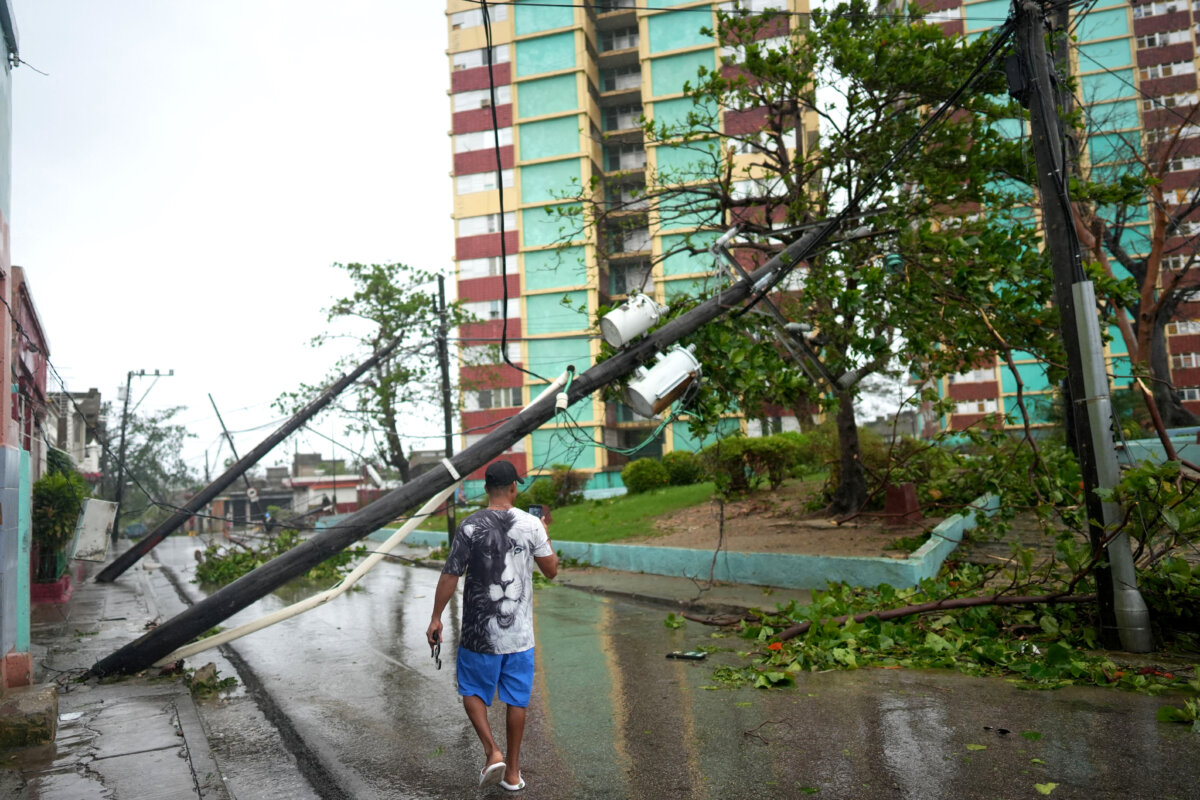
Meanwhile, Cuban officials began to assess their damage, reporting collapsed homes, blocked mountain roads, roofs blown off, and uprooted trees.
“It has been a very complex early morning,” President Miguel Díaz-Canel wrote on X. “As soon as conditions allow, we will begin the recovery. We are ready.”
The island nation was expected to get a total of 10 to 20 inches of rain, with some areas getting as much as 25 inches, and a storm surge reaching eight to 12 feet above normal tide levels.
Accompanying the tidal surge are destructive waves and minor coastal flooding.
In Granma province, one of the first areas to be hit, reservoirs were overflowing, and its governor, Yanetsy Terry Gutiérrez, said that as of Wednesday morning, several areas were “underwater.”
Several eastern areas were evacuated in advance of the storm’s arrival, including Santiago de Cuba. But many people stayed despite the warnings.
“That was hell,” Santiago resident Reinaldo Charon, 52, said on Oct. 29. “All night long, it was terrible.”
The extent of the damage remains unknown.
The Cuban government has discontinued all hurricane and tropical storm warnings.
Hurricane conditions are expected to reach Bermuda by Oct. 30, and local authorities issued an official warning.
The hurricane center noted that Melissa will have a chance to regain some strength over the next 12–24 hours, but only slight intensification is expected.
By the time the storm is in the Atlantic on its way toward Bermuda on Oct. 30, it could return to Category 2 strength, with sustained winds of 105 mph.
A hurricane warning is in effect for Bermuda.
The Associated Press contributed to this report.
 Friends Read Free
Copy
Facebook
Tweet
Friends Read Free
Copy
Facebook
Tweet