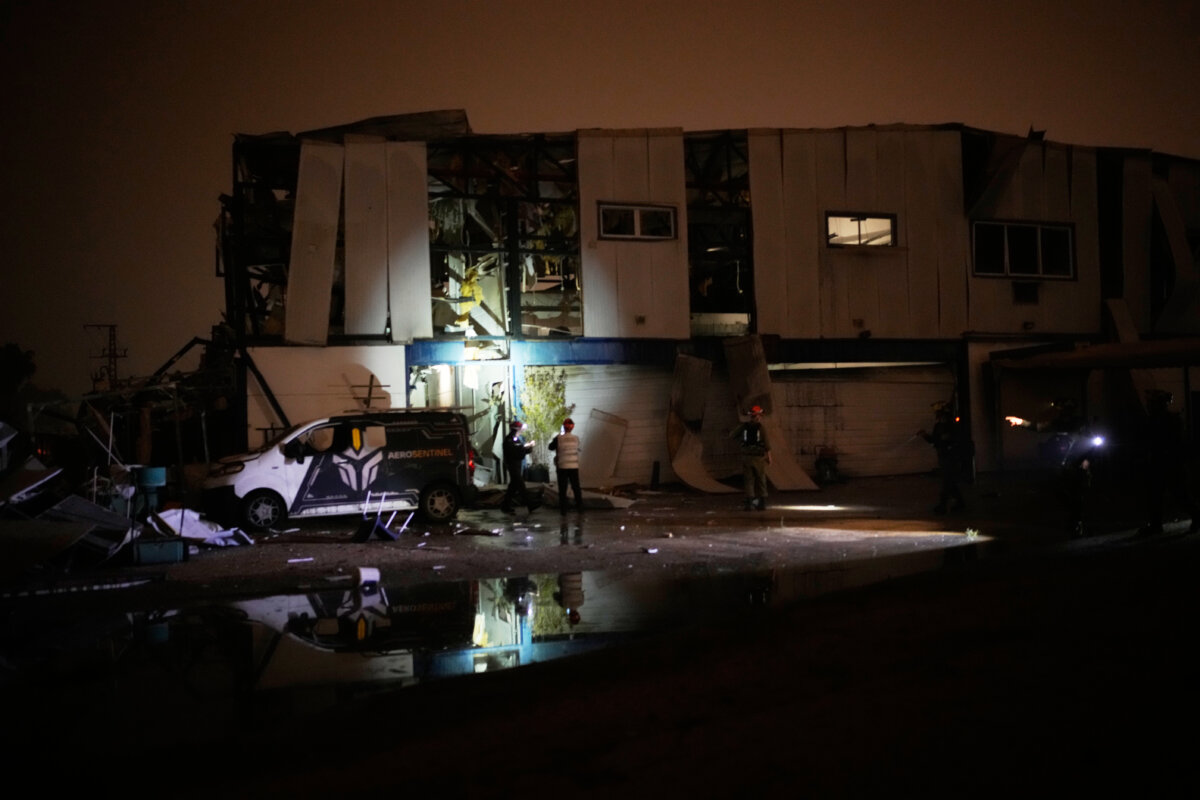

More Iranian drones and missiles were fired at targets across the Middle East on April 3, while U.S. and Israeli forces continued striking Iran, as the conflict intensified ahead of an ultimatum set by U.S. President Donald Trump and as fears grew of a broader escalation.
The ultimatum set by Trump for Iran is expected to expire on April 6.
Senior officials in Jerusalem told Epoch Magazine Israel that the negotiations the United States is conducting with Iran, through Pakistan’s army chief, have so far been faltering and, as of this hour, have not produced any meaningful progress.
According to those sources, if no breakthrough is achieved in the negotiations over reopening the Strait of Hormuz, Trump may order a significant escalation in the fighting.
The U.N. Security Council is set to meet on April 4 to discuss Tehran’s hold over the Strait of Hormuz, a vital oil shipping route that has become a flashpoint in the conflict.
The Iranian threat to shipping in the Strait of Hormuz—through which 20 percent of the world’s oil and natural gas passes—has driven up oil and gas prices, affecting the economies of many nations.
An Iranian drone hit the Mina al-Ahmadi oil refinery in Kuwait early on April 3. The state-run Kuwait Petroleum Corp. said firefighters were tackling several blazes at the refinery.
Iranian attacks also triggered air raid warning sirens in Bahrain, while Saudi Arabia said it had destroyed incoming drones.
Israel and the United Arab Emirates also reported coming under attack.
An Iranian attack also damaged a desalination plant in Kuwait and caused “material damage” to some of the plant’s components.
About 90 percent of Kuwait’s drinking water comes from desalination.
Targets in the Iranian capital, Tehran, and the city of Isfahan were hit overnight, activists reported, although an internet blackout in Iran means few details and images are emerging.
Israeli Prime Minister Benjamin Netanyahu said in an April 3 statement that strikes on Iran will continue.
“In full coordination between President Trump and me, we will continue to pound Iran. This regime is weaker than ever; Israel is stronger than ever. In recent days, the air force has destroyed 70 percent of Iran’s steel production capacity,” he said.
“This is a tremendous achievement that deprives the Islamic Revolutionary Guard Corps of both financial resources and the ability to manufacture large quantities of weapons.”
Iranian media said on April 3 that two containers at a Red Crescent relief warehouse in the Choghadak area of Bushehr province had been destroyed. Bushehr hosts an Iranian nuclear power facility.
In a post on X, U.S. Central Command (CENTCOM) said Iran’s Islamic Revolutionary Guard Corps (IRGC) has falsely claimed to have downed a fighter jet over Qeshm Island in the Strait of Hormuz.
“FACT: All U.S. fighter aircraft are accounted for,” CENTCOM said. “Iran’s IRGC has made the same false claim at least half a dozen times.”
In a post on X on April 2, the Israel Defense Forces (IDF) said they had eliminated Makram A’thimi, commander of a ballistic missiles unit in Kermanshah in western Iran.
“A’thimi was responsible for the unit’s operations in the Kermanshah area in western Iran and carried out dozens of ballistic missile launches toward the State of Israel,” the IDF said.
In a post on X, the Israeli air force said it had struck dozens of ballistic missile launch sites and storage sites in Iran in the previous 24-hour period.
Brent Crude Hits $109
The price of Brent crude was $109 on the morning of April 3, up 50 percent from Feb. 28, when Trump launched Operation Epic Fury with the support of Israel.
U.S. West Texas Intermediate crude futures rose by 11 percent to $111.54 per barrel, their highest figure since 2020.
In a prime-time address on April 1, Trump vowed to intensify strikes against Iran.
“Never in the history of warfare has an enemy suffered such clear and devastating large-scale losses in a matter of weeks,” Trump said in his White House speech.
“We are going to hit them extremely hard over the next two to three weeks. We’re going to bring them back to the stone ages, where they belong.”
The U.N. Security Council is expected to vote on April 4 on a proposal from Bahrain, which would authorize defensive action to ensure shipping can pass through the Strait of Hormuz.
Russia and China both have the power to veto U.N. Security Council resolutions.
Trump has said it is not the responsibility of the United States to get the Strait of Hormuz reopened, and said countries that rely on the oil and gas from it should “build some delayed courage” and “take it.”
Several NATO allies, including France and Germany, and some Persian Gulf States attended a video meeting to discuss the Strait of Hormuz on April 2, which was chaired by British Foreign Secretary Yvette Cooper.
After a meeting in Seoul, South Korean President Lee Jae Myung and French President Emmanuel Macron said they would “cooperate to ensure safe passage.”
Macron had earlier said a military operation, as suggested by Trump, “would take an infinite amount of time and would expose anyone passing through the strait to coastal threats from [the Iranian] Revolutionary Guard.”
He said reopening of the strait “can only be done in coordination with Iran.”
Last week, U.S. special presidential envoy Steve Witkoff said he has relayed a 15-point proposal—through Pakistani intermediaries—to end the ongoing armed conflict with Iran.
Pakistan has increasingly emerged as a diplomatic broker in the conflict, relaying messages between the two sides and promoting frameworks for talks.
Iranian Foreign Minister Abbas Araghchi said in a March 31 interview with Al Jazeera that Tehran is receiving messages—some direct, others via regional intermediaries—but does not consider this a negotiation process.
The Associated Press and Reuters contributed to this report.
 Friends Read Free
Copy
Facebook
Tweet
Friends Read Free
Copy
Facebook
Tweet