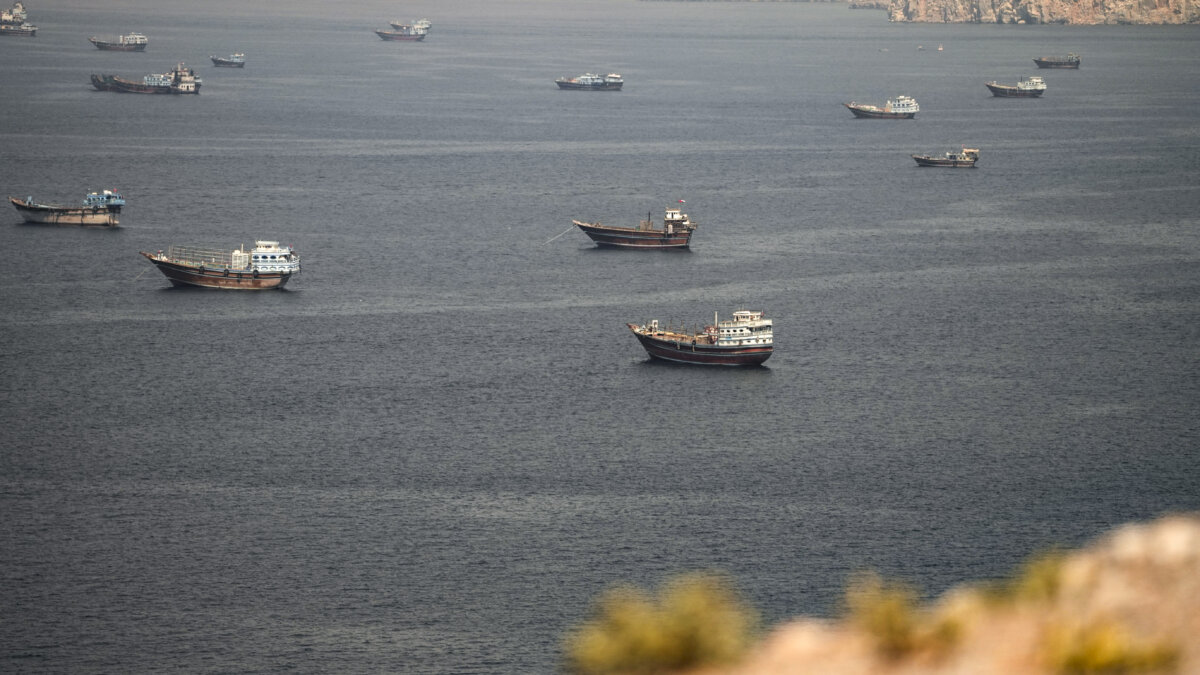

Iran and Oman said they are exploring future arrangements for administering navigation through the Strait of Hormuz, including possible maritime services and “associated costs,” with U.S. Secretary of State Marco Rubio later clarifying to reporters that no country would be allowed to impose tolls on an international waterway.
In a joint statement following high-level talks in Muscat on June 23 between Iranian and Omani officials, the two Gulf countries pledged to maintain the Strait of Hormuz as a “secure and open waterway for international navigation” while also insisting that their “sovereign rights” over their respective territorial waters in the strategic passage must be respected.
“The two sides emphasized the importance of continued cooperation to promote maritime safety, freedom of navigation, and regional stability,” they said in the joint statement, issued after a meeting between Iranian Foreign Minister Abbas Araghchi, Iranian parliament speaker Mohammad Bagher Ghalibaf, Omani Sultan Haitham bin Tariq, and Omani Foreign Minister Badr Albusaidi.
In the statement, Iran and Oman did not signal any intention to interfere with freedom of navigation in the Strait of Hormuz, citing the recently signed U.S.–Iran memorandum of understanding that extends a fragile ceasefire for 60 days to give room for negotiations on the terms of a potentially permanent peace deal.
However, the two countries also indicated plans for coming up with an arrangement on “the future administration of navigation” in the strait, along with “the services that will be provided in this regard and the costs associated with them in accordance with international standards.” They added that other Gulf countries and other “relevant parties” would be involved in further discussions on the matter, slated to take place within a newly established joint working group for this purpose.
The joint statement appears to broadly align with the language in point five of the framework agreement between Washington and Tehran, which states that Iran and Oman would “conduct dialogue” that would define the “future administration and maritime services” in the Strait of Hormuz. The point additionally states that the two countries will involve other Gulf littoral states in related discussions, and that the future administration of navigation in the strait will take place in a way that respects both international law and the “sovereign rights” of coastal states in the strategic waterway.
Rubio Rejects Hormuz Transit Tolls
The memorandum makes no mention of any tolls or fees in exchange for passage of vessels through the strait, a matter that Rubio highlighted in remarks to reporters on June 23, when asked whether “freedom of navigation” would be guaranteed in the Strait of Hormuz under the terms outlined in the U.S.–Iran preliminary deal.
“Well that’s the law,” Rubio replied. “It’s an international waterway. No country is allowed to charge tolls or fees on an international waterway. That’s existing international law. That’s the way it is in international waterways all over the world, and that’s the way we expect it will be here. So I don’t think we have anybody to convince around here in that regard—I think all the countries in this region would agree with us.”
The language of the joint Iran–Oman statement—as well as future discussions within the joint working group—is likely to draw scrutiny, given that U.S. officials have repeatedly rejected any suggestions that Iran could levy charges on international shipping through the narrow waterway, which is a critical chokepoint for maritime transport of crude oil and other key commodities.
U.S. President Donald Trump weighed in on the issue on June 20, insisting that there would be “no tolls” in the Strait of Hormuz during the 60-day ceasefire period and suggesting that any future charges would be unacceptable unless imposed by the United States itself as compensation for security services.
While the Iran–Oman statement discussed future navigation services and associated costs, Omani officials separately issued a statement indicating that freedom of navigation remains a central principle in the strait.
A June 23 notice to mariners issued by Oman’s National Hydrographic Office stated that Muscat remained committed to ensuring “freedom of navigation in the strait without imposing any tolls.”
The notice was issued as part of a joint effort with the United Nations-affiliated International Maritime Organization (IMO) on temporary traffic-management measures in the Strait of Hormuz and evacuation routes for commercial shipping.
The operation, which the IMO said is being taken in “close cooperation” with Oman, Iran, other coastal Gulf countries—as well as the United States—is being carried out to help evacuate some 11,000 seafarers who have been stranded in the region amid the U.S.–Iran conflict.
Meanwhile, signs of recovery of shipping flows through the Strait of Hormuz have already begun to emerge.
According to MarineTraffic and Kpler data, confirmed crossings increased from 32 vessels during June 12–14 to 93 vessels during June 19–21, nearly tripling week over week.
“Vessel activity through the Strait of Hormuz has rebounded sharply across two consecutive weekends, pointing to a clear shift in traffic patterns through one of the world’s most critical maritime chokepoints,” MarineTraffic said in a June 23 post on X.
The largest increase occurred on June 20, when crossings surged to 42 vessels from just three during the comparable period a week earlier, according to the maritime tracking service.
Guy Birchall contributed to this report.
 Friends Read Free
Copy
Facebook
Tweet
Friends Read Free
Copy
Facebook
Tweet