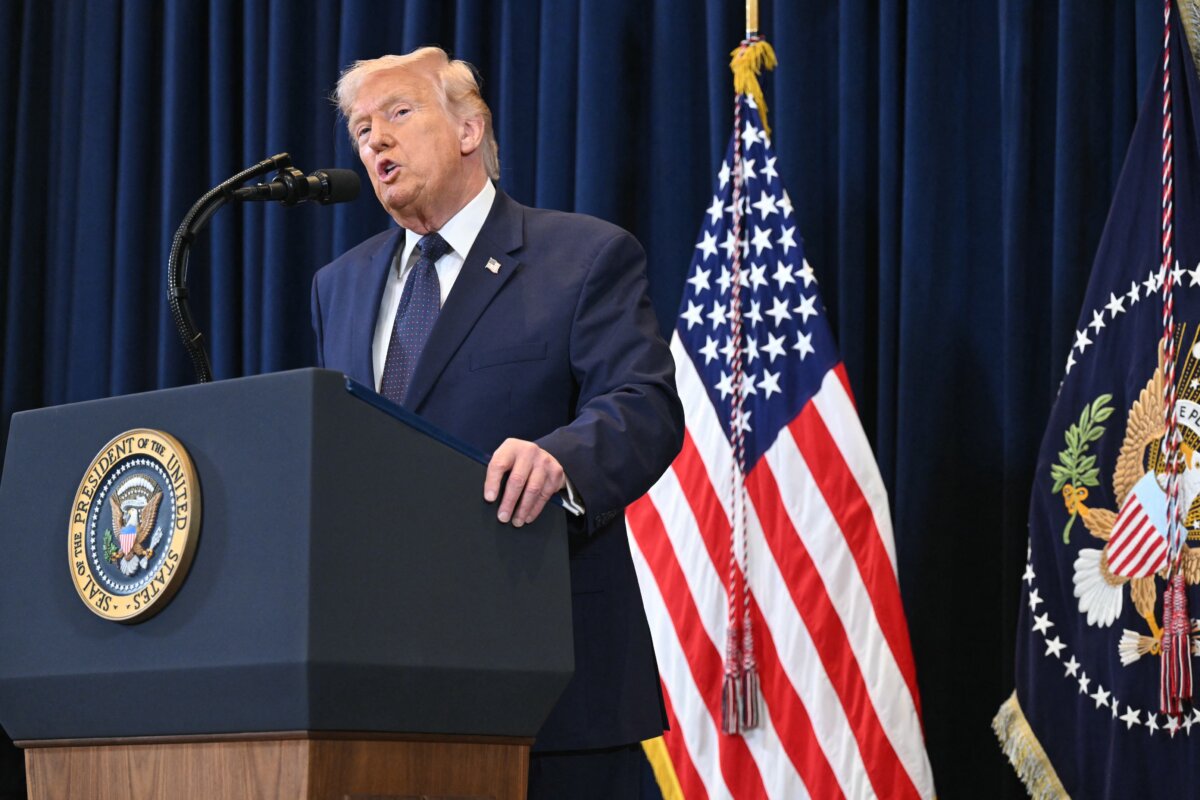

Iran turned down a U.S. offer of unlimited, free nuclear power for civilian purposes prior to the ongoing war, President Donald Trump said Monday in Doral, Florida.
The statement sheds light on Trump’s decision to preemptively attack Iran, which he said is “ahead of our initial timeline by a lot” and was needed to prevent the regime from successfully developing its first nuclear weapon.
After the U.S. military obliterated some of the Iranian regime’s key nuclear sites last summer, the regime continued pursuing nuclear capabilities at levels that were unacceptable, Trump said, accusing the regime of never negotiating in good faith.
“They even turned down an offer for unlimited, free nuclear fuel forever for civilian purposes,” the president said. “They weren’t interested in that because they wanted to build a nuclear weapon.”
If the United States hadn’t knocked out the nuclear sites nearly a year ago, Iran would already have had a nuclear weapon, Trump said Monday, adding that the regime would have used it too.
“At a minimum, Israel would have been annihilated,” Trump said. “It was very lucky that we had the courage to do that.”
Operation Midnight Hammer targeted three Iranian nuclear facilities overnight on June 21–22, 2025. It was a highly intricate, practiced, surprise attack involving more than 125 U.S. aircraft and warships and layers of deception, Secretary of War Pete Hegseth said in a briefing following the strikes last summer.
“Initial battle damage assessments indicate that all three sites sustained extremely severe damage and destruction,” Hegseth said.
The operation was carried out a week after Israel launched its own series of surprise airstrikes, aimed at dismantling Iran’s nuclear and military capabilities.
Before the strikes, Israel said Iran was only weeks away from obtaining a nuclear weapon. Trump had said the regime was weeks to months away.
“The Iranian regime has been attacking Americans and spreading terror for 47 years, and despite these countless opportunities to renounce their nuclear ambitions … they actually said, ‘We want to keep building,’” Trump said Monday.
Following the U.S. airstrikes in Operation Midnight Hammer, Vice President JD Vance said he was confident Iran’s nuclear program was substantially delayed.
“I think that we have really pushed their program back by a very long time. I think that it’s going to be many, many years before the Iranians are able to develop a nuclear weapon,” Vance said on NBC’s “Meet the Press” on June 22.
Trump had said the three nuclear facilities that were targeted were rendered useless, but that the regime had restarted work at different sites.
Meanwhile, Iran was building up its ballistic missile capabilities, threatening U.S. bases and allies in the region, Trump said in the press conference Monday.
“The regime’s intention was to use this exponentially growing ballistic missile threat to make it virtually impossible to prevent them from obtaining a nuclear weapon,” the president said.
Most of Iran’s Navy—51 ships—have been sunk, Trump said Monday. The regime’s missile launches have declined more than 90 percent, and drone launches have dropped 83 percent since the start of the war.
“In 2015, I said, quote, ‘I will stop Iran from getting nuclear weapons,’ and all I’m doing is keeping my promise,” Trump said.
 Friends Read Free
Copy
Facebook
Tweet
Friends Read Free
Copy
Facebook
Tweet