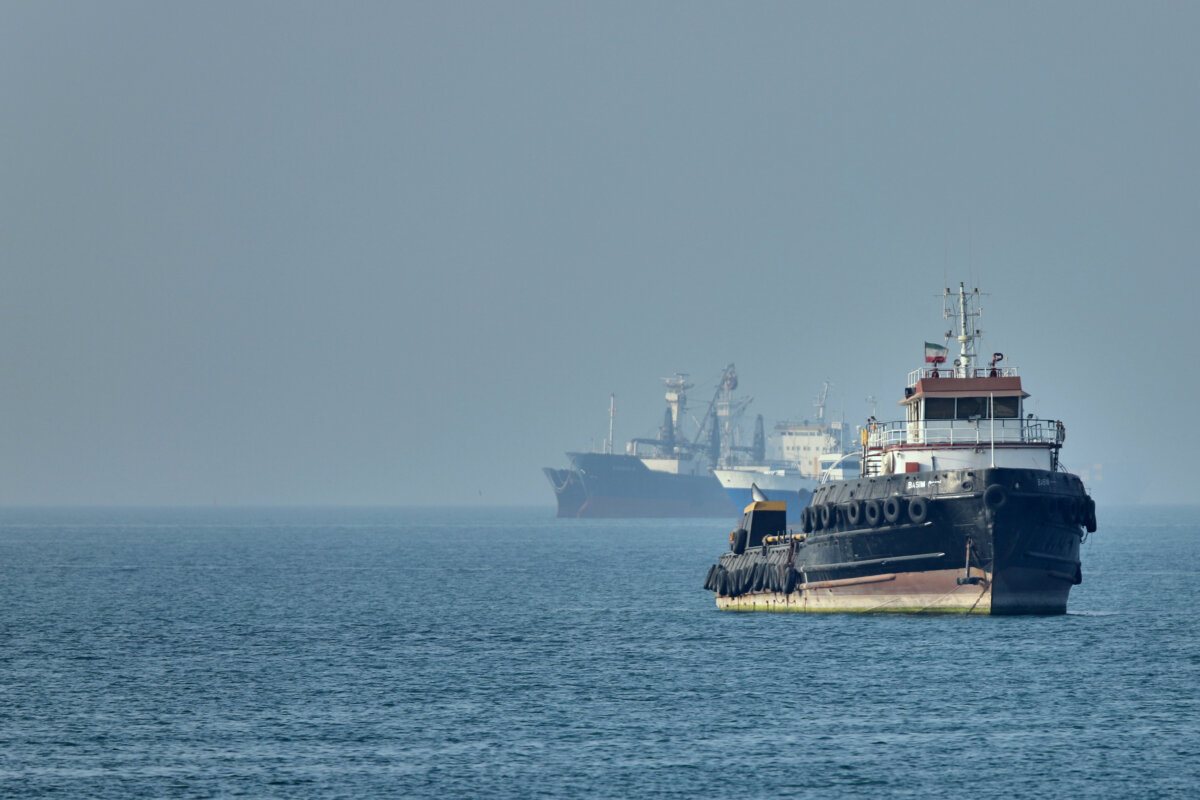

Tehran has expanded the definition of the Strait of Hormuz into a “vast operational area” far larger than before the Iran war, the Islamic Revolutionary Guard Corps (IRGC) has said.
Political deputy of the IRGC Navy Mohammad Akbarzadeh said that a newly implemented military plan had expanded the effective operational zone of the strait from roughly 20 to 30 miles to more than 200 to 300 miles, according to a May 12 report by the state-affiliated Fars News Agency.
Akbarzadeh said the expanded zone now forms “a complete crescent.”
The Strait of Hormuz remains one of the world’s most important shipping chokepoints, with roughly one-fifth of global oil supplies normally passing through the narrow corridor.
Akbarzadeh’s remarks come as the ceasefire between the United States and Iran appears increasingly unstable.
President Donald Trump said on May 11 that the truce was on “life support” after Tehran submitted what he described as an unacceptable proposal to end the conflict.
Akbarzadeh said Iran closely monitors regional activity and “will not allow any violation of its waters and interests.”
He said the “guardians of the Strait of Hormuz” had demonstrated that the waterway remained under Iran’s “authoritative control.”
According to Akbarzadeh, Iran’s approach to Hormuz is not “a limited geographical perspective, but a strategic and distinctive one.”
“In the fields of energy, commodity trade, and transit, the Islamic Republic of Iran has not only created no obstacles in the Strait of Hormuz but has also provided extensive services to the world,” he said.
The IRGC navy published a map on May 4 showing a newly defined zone of control stretching across significant sections of the Gulf of Oman and near parts of the United Arab Emirates coastline.
The zone extended from Iran’s Mount Mobarak and the UAE emirate of Fujairah in the east to Iran’s Qeshm Island and the UAE emirate of Umm al Quwain in the west.
May 12 statements appeared to further broaden the claimed operational area.
The developments come as shipping traffic through the region remains severely disrupted.
At least three crude oil tankers exited the Strait of Hormuz with tracking systems switched off to reduce the risk of Iranian attacks.
Shipping data from Kpler and LSEG showed that two very large crude carriers, the Agios Fanourios I and the Kiara M, each transporting approximately 2 million barrels of Iraqi crude oil, passed through the strait on Sunday while operating without active trackers.
Iran Warns Western Navies
Iranian officials have also warned the United Kingdom and France against increasing naval deployments near the strait.
Iran’s deputy foreign minister for legal and international affairs, Kazem Gharibabadi, said in a May 10 post on X that any deployment of destroyers near Hormuz “will be met with a decisive and immediate response” from Tehran’s armed forces.
This came two days before the multinational defense ministers meeting focused on the Strait of Hormuz mission, hosted by France and the UK.
A Royal Navy destroyer, HMS Dragon, would deploy to the region as part of efforts to support maritime security, a statement by UK officials said on May 11.
The continuing closure of the strait had disrupted global shipping and contributed to rising energy prices and supply chain instability worldwide, the statement added.
The Strait of Hormuz remains effectively closed to normal commercial traffic, contributing to higher global oil prices and growing concerns over regional stability and international energy supplies.
U.S. Central Command (CENTCOM) said on May 12 that the USS Abraham Lincoln continued operations in the Arabian Sea as part of enforcement efforts connected to the U.S. blockade on Iran.
CENTCOM said U.S. forces had redirected 65 commercial vessels and disabled four others.
Reuters contributed to this report.
 Friends Read Free
Copy
Facebook
Tweet
Friends Read Free
Copy
Facebook
Tweet