

An Italian court has granted a child three legally recognized parents—two fathers and a mother—in a landmark ruling at odds with the country’s socially conservative government and Catholic culture.
The decision sparked anger when it was reported on Tuesday by several Italian media outlets and confirmed by the lawyer of the legally recognized fathers.
The 4-year-old child was born in Germany and lives there with two married gay men, one of whom is the biological father. The mother is described as a woman who is a friend of the couple.
The Italian German non-biological father adopted the child under German law, before applying for the adoption to be recognized in Italy.
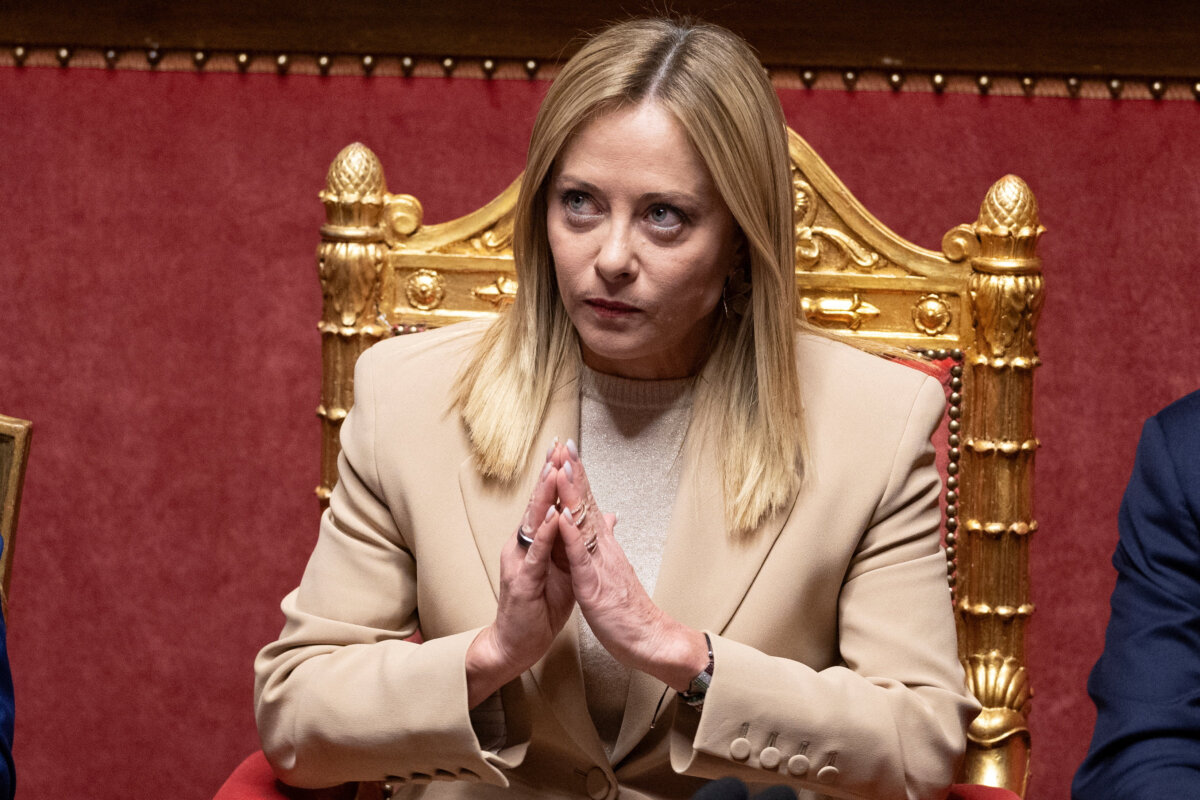
A local authority rejected the request, suspecting that the child was born from surrogacy “tourism” carried out abroad—a practice that Italy’s government has criminalized under Prime Minister Giorgia Meloni.
‘No Secret Surrogacy Deal’
A court of appeal in the southern Italian city of Bari then overturned the decision of the local authority, finding that no surrogacy arrangement had taken place.
The ruling means that Italian law now allows a child to have two legally recognized fathers and one mother. Germany already has such legal recognition in place.
“There was no secret surrogacy deal here. This is a case of three people who all want to be the parents of this child, and the court recognized this,” Pasqua Manfredi, the lawyer of one of the two men, told reporters.
The ruling was made in January but came to light as Italy marked 10 years since its parliament voted to legalize same-sex partnerships.
Pro Vita & Famiglia, a Catholic group that campaigns for traditional family values, criticized the ruling and said the legal recognition of same-sex unions had upended family law and left children at the whim of social experimentation.

Children ‘Not Stuffed Animals’
“Children are not stuffed animals to fill the shortcomings of adults,” The group said in a May 12 X post. “Justifying these legal and anthropological aberrations with the ‘best interest of the minor’ is unacceptable. Here is the result of the [law change] that equated same-sex unions with the natural family.”
Italy extended its long-standing ban on surrogacy beyond its borders in October 2024 to include its citizens traveling to countries where surrogacy is legal, such as the United States and Canada.
In Italy, surrogacy—defined as when a woman carries a pregnancy and gives birth to a baby for someone else, whether or not money changes hands—has been punishable under law since 2004.
The law change was put forward by Meloni’s Brothers of Italy party.
Those who seek surrogacy abroad now face jail terms of up to two years and fines of up to 1 million euros (about $1.08 million).
Surrogacy ‘Tourism’ Made Illegal
Brothers of Italy Sen. Lavinia Mennuni said during the parliamentary debate that the aim was “to uproot the phenomenon of surrogacy tourism.”
While Italy is a secular state, it is predominantly Catholic, with the Vatican often influencing policy on social and moral issues. Same-sex marriage remains illegal in the country.
Meloni came to power in 2022 promising to curtail the influence of the LGBT lobby. Under her premiership, local authorities in 2023 passed legislation so that only the biological parent in same-sex couples can have parenting rights.
Meloni has branded surrogacy an “inhuman” practice that treats children as supermarket products.
Speaking in April 2024 ahead of the law being expanded to surrogacy abroad, she said, “No one can convince me that it is an act of freedom to rent one’s womb; no one can convince me that it is an act of love to consider children as an over-the-counter product in a supermarket.”
“I still consider the practice of uterus renting to be inhuman; I support the proposed law making it a universal crime.”
Meloni’s views echo that of the Vatican, with Pope Leo speaking out against the practice in January, describing it as a threat to life and dignity.
“By transforming gestation into a negotiable service, this violates the dignity both of the child, who is reduced to a product, and of the mother, exploiting her body and the generative process, and distorting the original relational calling of the family,” he said.
Reuters and Owen Evans contributed to this report.
 Friends Read Free
Copy
Facebook
Tweet
Friends Read Free
Copy
Facebook
Tweet