
Italy and Spain on Tuesday extended their reciprocal border controls for another 15 days as the fallout from the Ceuta immigrant crisis continues.
Rome told the European Commission that the controls will run from Sept. 16 to Oct. 1, citing “high risks to internal security” and a possible terrorist-infiltration threat. Madrid said the original grounds still stand and that it will keep checking passengers from Italy until Oct. 8.
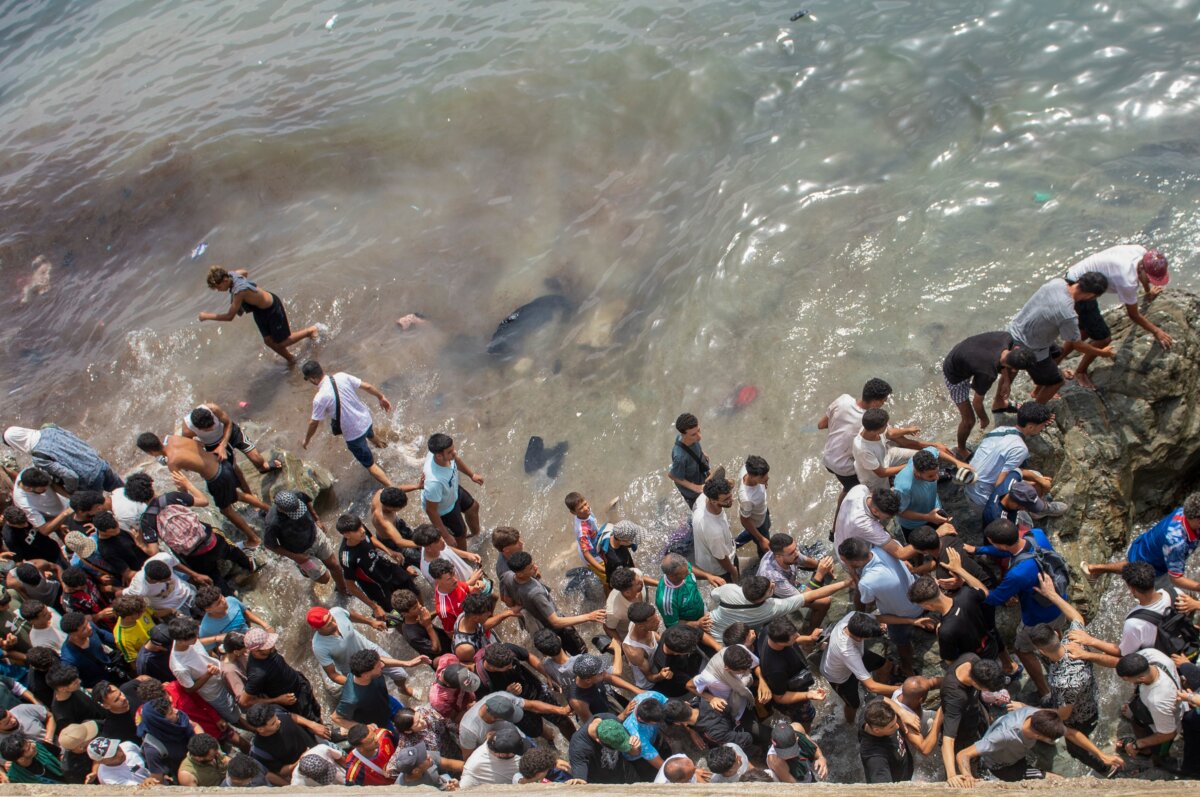
Tens of thousands of young men from Morocco entered the tiny Spanish exclave of Ceuta in North Africa between July 30 and July 31 in an unprecedented surge at one of the European Union’s only two land borders with Africa.
Rome’s government initially announced restrictions on Aug. 1, saying it wanted to make sure no illegal immigrants in Ceuta could travel on to Italy.
The checks apply between two countries that normally allow free movement as EU member states in the Schengen passport-free travel area.
The travel curbs were due to expire on Aug. 31. Italy then said that day that it would suspend its open-border arrangements with Spain for another 15 days. In response, Spain said it would also keep checking passengers arriving from Italy by air and sea for 15 more days.
Italy notified the European Commission on Sept. 16 that it is keeping temporary checks at all air and sea borders with Spain from Sept. 16 to Oct. 1.
Italy’s main national news agency, ANSA, reported on Sept. 16 that Interior Minister Matteo Piantedosi’s department said that “there remain high risks to internal security, in addition to a potential threat from terrorist infiltration.”
Spain’s Interior Ministry said in a statement on Sept. 15 that the circumstances justifying the measure remained in place.
Spain also notified the EU that it was matching controls at all air and sea borders with Italy from Sept. 8 to 22, pointing to a “continued threat to public policy, internal security, and the management of migration flows due to recent developments, resulting from large-scale movements of third-country nationals within the Schengen area.”
On July 30, Spain deployed military units to Ceuta to reinforce security after thousands of illegal immigrants breached its border with Morocco.
Ceuta is a Spanish autonomous city in North Africa, like Melilla, which together represent the European Union’s only land borders with Africa and often face surges of illegal immigrants seeking to reach Europe.
The Spanish government’s current official estimate is that about 72,000 people crossed into Ceuta from Morocco between July 30 and July 31.
Ceuta’s president, Juan Vivas, on Sept. 11 said that his administration estimated that about 13,000 illegal immigrants currently remained in the enclave, a figure that represents about 15 percent of the population of the city.
Vivas warned that the city is “in a pressure cooker” due to the influx.
Tens of thousands of people took to the streets across Spain earlier this month to protest the country’s government and Socialist Prime Minister Pedro Sánchez’s handling of the Ceuta immigration crisis.
The protests were called on Sept. 2 by the FEMP federation of municipalities, which is dominated by the main opposition conservative People’s Party.
Tens of thousands came out across different regions, waving Spanish flags, with some protesters calling for Sánchez to go to jail.
Authorities said about 20,000 people protested on Sept. 2 in Ceuta, which has only 84,000 legal residents.
However, Ceuta protest organizers told Spanish newspaper El Debate that they believed that the real number was higher.
Sánchez also this year approved a mass amnesty to legalize at least 500,000 illegal immigrants. In an April 14 X post, he said the move was an act of “normalization” and “justice.”
With Spanish residency permits, regularized immigrants would be entitled to travel within the Schengen area of the European Union for up to 90 days in any 180-day period.
Reuters contributed to this report.
 Friends Read Free
Copy
Facebook
Tweet
Friends Read Free
Copy
Facebook
Tweet