
Japan and the Philippines said Thursday that they would begin negotiations on a military information-sharing agreement, deepening security ties as both countries face growing tensions with China in nearby waters.
The announcement came after talks in Tokyo between Japanese Prime Minister Sanae Takaichi and Philippine President Ferdinand Marcos Jr., according to statements released by Japan’s foreign ministry and the Philippine Presidential Communications Office.
Takaichi said she hoped to “further strengthen cooperation with the Philippines, one of the closest like-minded countries for Japan,” according to Japan’s Ministry of Foreign Affairs.
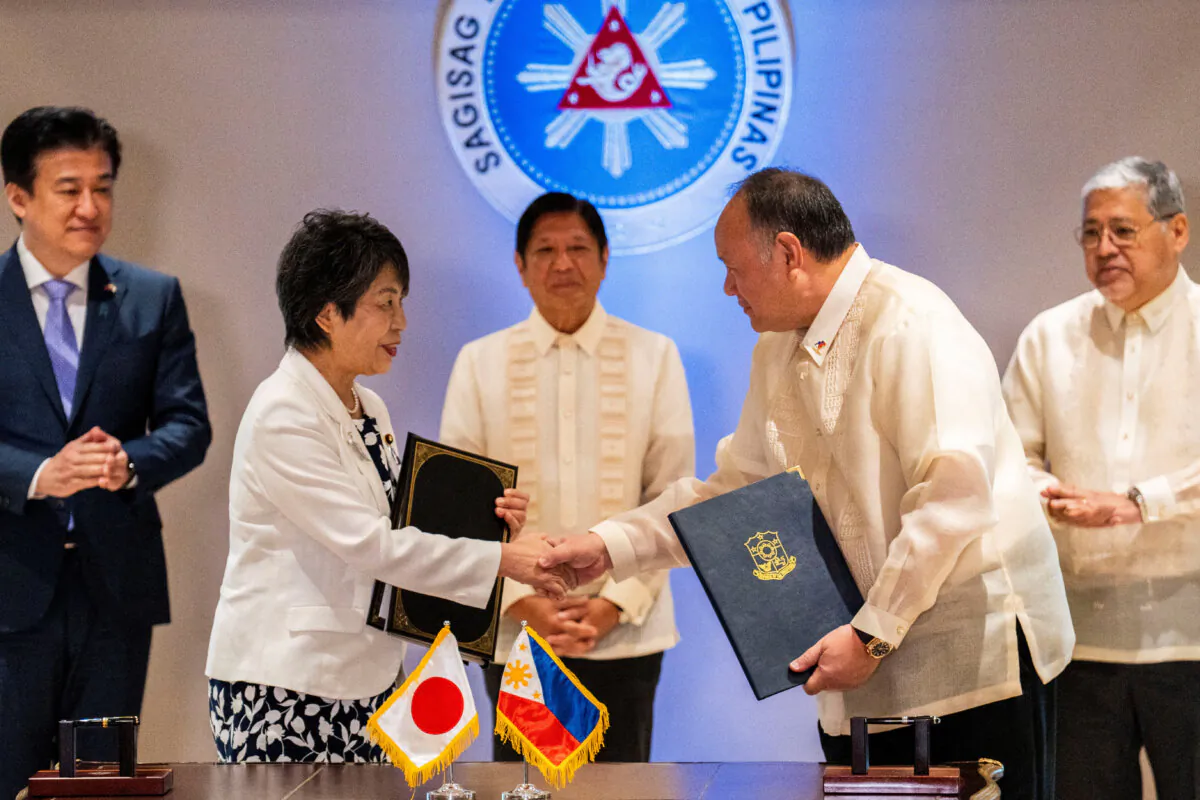
Marcos said the two governments had agreed to start negotiations on a General Security of Military Information Agreement, which would allow the sharing of classified defense information between Tokyo and Manila.
The two sides also agreed to elevate ties to a Comprehensive Strategic Partnership, expanding cooperation on defense, maritime security, infrastructure, and economic resilience, Japan’s foreign ministry said.
Neither government gave a timeline for the talks or released details of the proposed agreement.
Japan’s Ministry of Defense said this month that Defense Minister Gen Nakatani and Philippines Defense Secretary Gilbert Teodoro had agreed to strengthen operational and equipment cooperation between the two countries.
Thursday’s summit built on steadily expanding ties since Marcos took office in 2022.
Japan and the Philippines signed a Reciprocal Access Agreement in 2024, allowing troops from both countries to enter each other’s territory for joint exercises and disaster response operations.
The agreement made the Philippines Japan’s first Southeast Asian partner to conclude such an arrangement.
The move follows several years of steadily closer military cooperation between Japan and the Philippines, driven largely by security concerns in the South China Sea and around Taiwan.
The Philippines has repeatedly accused Chinese coast guard vessels of blocking and colliding with Philippine ships near disputed reefs and shoals, including at Second Thomas Shoal, where Manila maintains a small military outpost.
China claims most of the South China Sea under its “nine-dash line,” despite a 2016 Hague tribunal ruling that found the claim had no basis under international law—a decision Beijing rejects. The nine-dash line is a U-shaped boundary containing contested areas of the South China Sea.
Japan is not a claimant in the South China Sea disputes, but Tokyo has expanded bilateral defense ties with regional partners as China increases military activity around Taiwan and in the East China Sea.
Japanese officials increasingly describe stability in the Taiwan Strait as important to Japan’s own security, particularly because nearby sea lanes carry much of the country’s imported energy and trade.
Tokyo has also eased decades-old restrictions on defense exports in recent years, opening the way for broader transfers of military equipment and technology to partners including the Philippines.
The ministry on Thursday did not publicly confirm reports that Japan is considering transferring naval destroyers or patrol aircraft to the Philippines.
Manila has also expanded defense cooperation with the United States and Australia under Marcos, while Japan has increased coast guard support, surveillance assistance, and security aid across Southeast Asia.
Alongside defense issues, the Japanese and Philippine governments said Thursday’s talks also covered energy security and economic cooperation.
Japan’s foreign ministry said the two leaders agreed to cooperate on efforts to strengthen regional energy resilience amid instability in global energy markets.
Neither side announced specific funding commitments or new defense transfers following the meeting.
The summit ended with both governments reaffirming support for what Japan’s foreign ministry described as a “free and open Indo-Pacific” based on the rule of law.
Reuters contributed to this report.
 Friends Read Free
Copy
Facebook
Tweet
Friends Read Free
Copy
Facebook
Tweet