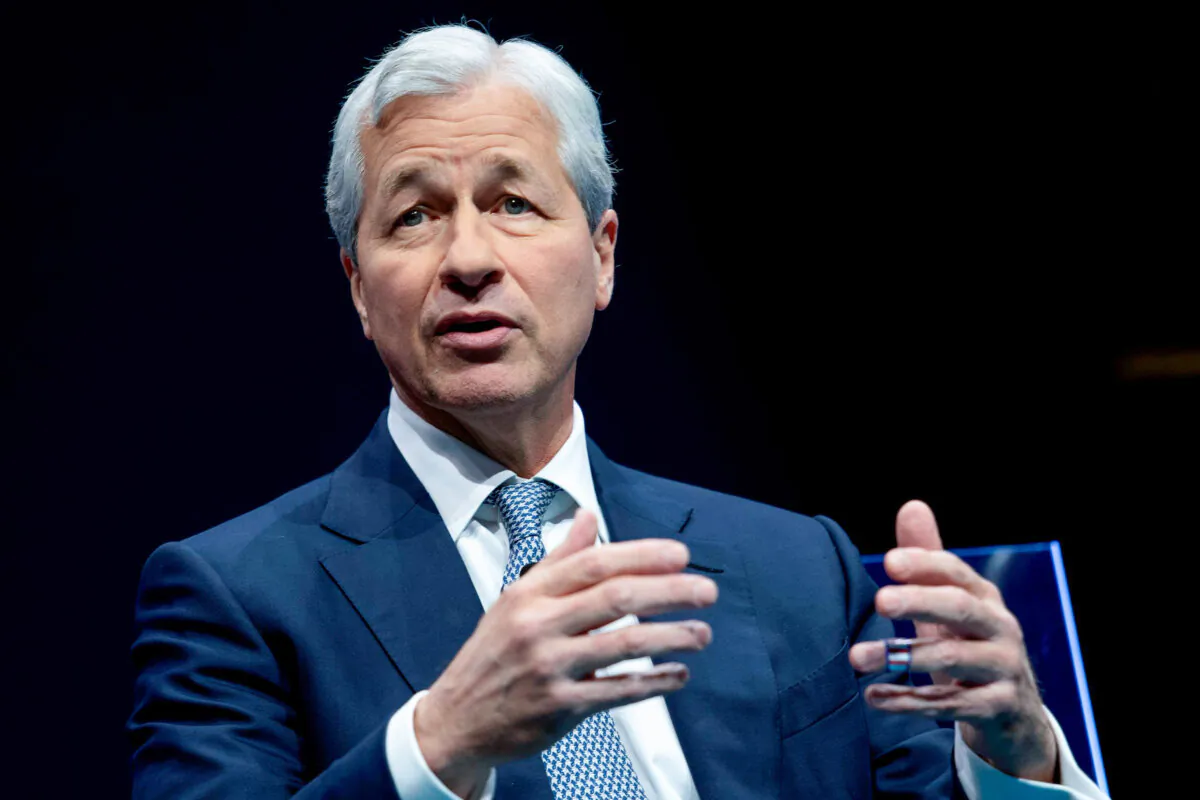

JPMorgan Chase CEO Jamie Dimon said on April 28 that although he is not currently concerned about inflation, he still sees stagflation as a possible worst-case economic scenario.
Speaking at Norges Bank Investment Management’s Investment Conference in Oslo, Norway, Dimon said that inflation risks may be higher than markets assume.
“There are a lot of inflationary things out there,” he said, pointing to the Iran war, global deficits, and military spending.
He also said that it is possible that inflation “ticks up and that will catch a lot of people off guard.”
“The worst case is stagflation,” Dimon said, using the term during an exchange about economic stress scenarios. “And I just wouldn’t take it off the list.”
Stagflation refers to a combination of rising inflation, weak economic growth, and elevated unemployment.
It is a condition that policymakers find difficult to address because measures used to curb inflation can further weaken growth, according to UK investment platform AJ Bell.
Dimon made the comments days before the European Central Bank and the Bank of England are due to announce policy decisions.
Both central banks kept rates unchanged at their March 19 meetings. The European Central Bank said it left its three key interest rates unchanged, while the Bank of England voted to maintain its Bank Rate at 3.75 percent.
Inflation has remained above both institutions’ 2 percent targets. Eurostat’s March 31 flash estimate put euro-area inflation at 2.5 percent, while the UK’s annual inflation rate reached 3.3 percent in March.
Dimon also warned that sharply higher interest rates could expose vulnerabilities in heavily indebted sectors. He questioned assumptions that debt rollover costs would rise modestly, asking, “Why not 500 basis points more?”
Such a scenario could place stress on borrowers and financial markets, even if major banks could withstand it, he said.
Earlier this month, Dimon raised similar concerns in his annual shareholder letter, warning that conflict involving Iran could trigger oil and commodity shocks that keep inflation elevated and push rates higher.
Geopolitics, Cybersecurity
Although much of the discussion focused on inflation, Dimon said political disputes pose a greater long-term threat than the business cycle.
“I don’t worry about the U.S. economy,” he said. “The most significant thing for the future of the free world … is the geopolitics.”
He pointed to the wars involving Ukraine and Iran, NATO cohesion, and risks of Western fragmentation. Dimon said economic alliances should be strengthened rather than weakened by trade or regulatory disputes.
He also warned that growing sovereign debt burdens could eventually produce trouble in the bond market, although he said governments would likely manage through such an event.
“There will be some kind of bond crisis, and then we’ll have to deal with it,” Dimon said.
Dimon also told the conference that cybersecurity threats remain a concern, particularly as artificial intelligence advances may expose new vulnerabilities.
Referring to Anthropic’s Claude Mythos Preview model, he said that “the bad guys can use cyber and they’re going to get stronger and more powerful in terms of finding vulnerabilities.”
His warning echoed concerns raised earlier this month at the International Monetary Fund and World Bank Spring Meetings, where senior financial officials discussed whether increasingly powerful AI models could expose weaknesses in global banking defenses.
In an April 7 statement, Anthropic said its Claude Mythos Preview identified “thousands of zero-day vulnerabilities,” including critical flaws across major systems, underscoring what the company called the dual-use risks of advanced AI.
Bank of England Governor Andrew Bailey also referenced the issue on April 14, saying that the emergence of such capabilities could reshape cyber-risk for financial institutions.
 Friends Read Free
Copy
Facebook
Tweet
Friends Read Free
Copy
Facebook
Tweet