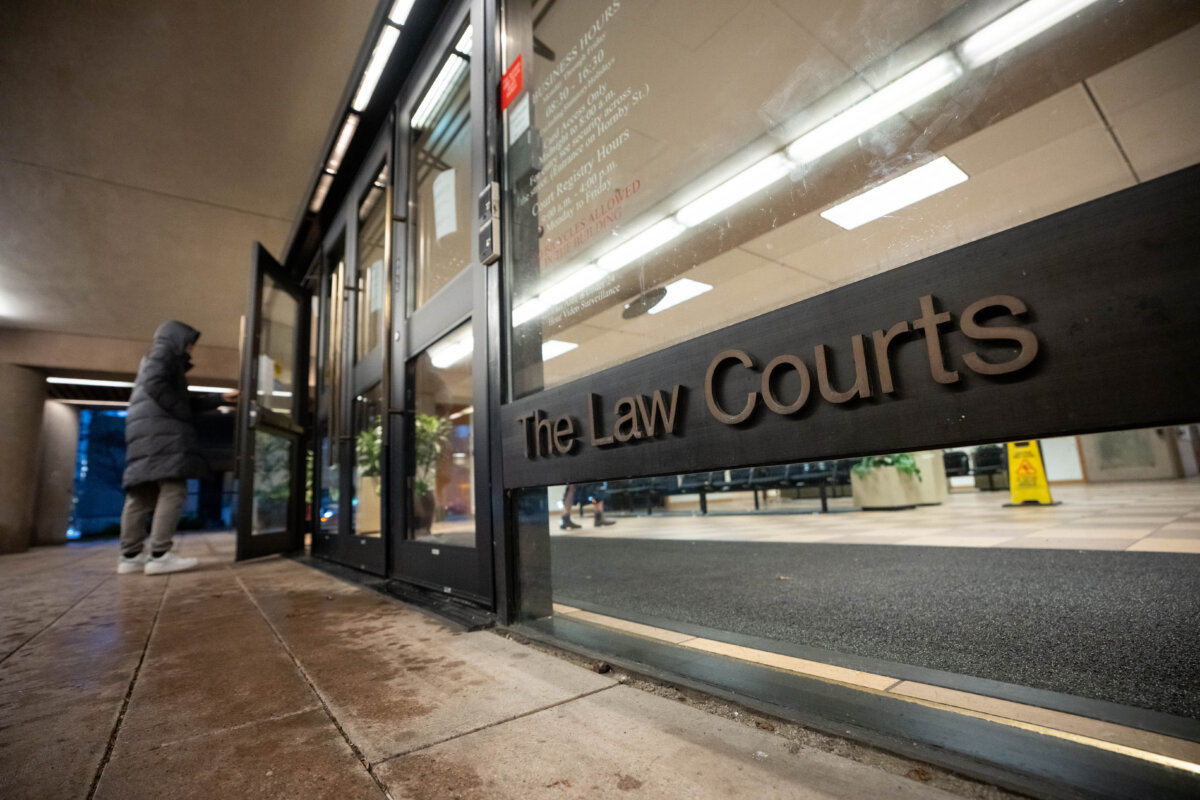

A man found guilty of stabbing his girlfriend to death in a British Columbia parking garage will be eligible for parole after 12 years because the judge considered his race a mitigating factor, court documents indicate.
Everton Javaun Downey, 35, was convicted of second-degree murder last August for stabbing 25-year-old Melissa Blimkie 15 times in a stairwell at the Metrotown Shopping Centre in Burnaby, B.C., on Dec. 19, 2021.
Downey, a black man, was sentenced to life in prison last month by B.C. Supreme Court Associate Chief Justice Heather Holmes. A recently posted decision by Holmes says she rejected the Crown’s suggestion of no possibility of parole for a minimum of 15 years, opting instead for 12 years after considering Downey’s Impact of Race and Culture Assessment (IRCA).
IRCAs are pre-sentencing reports received by judges when the offender is black or “racialized,” according to Canada’s department of justice.
The reports are similar to Gladue reports, which take into account the background and circumstances of an indigenous accused. IRCAs inform sentencing judges of the “disadvantages and systemic racism” faced by black offenders and may recommend alternatives to incarceration or accountability measures within a sentence of incarceration.
“Downey’s background, as described in the IRCA, included early exposure to violence, chronic instability, poverty, systemic anti-Black racism, and untreated mental health symptoms, such as hypervigilance, that may be trauma related,” Holmes wrote in her ruling, which noted that Downey has a “substantial” criminal record related to violence and firearms.
“I recognize, however, that the aggravating effect of his criminal record is offset in part by the mitigating circumstances of his background, as detailed in the IRCA,” the judge added.
The IRCA in Downey’s case described him as a “Black man of African Nova Scotian, African American and Jamaican ancestry” who grew up in Toronto in predominantly black and “racially diverse” neighbourhoods. It also says he did not experience “overt racism” during his time there.
The IRCA said that feeling of belonging changed in 2016 when Downey moved to British Columbia. A much smaller black population and a different culture contributed to feelings of “disconnection and isolation,” the document said.
Holmes referenced Downey’s “lasting sense of danger and mistrust,” persistent mental health effects due to incarcerations, and the stress of leaving Toronto as mitigating factors listed in the IRCA.
Other mitigating factors were Downey’s confession to killing Blimkie, his apology to her family, and his expression of remorse in a personal statement to the court, the judge said.
2021 Murder
Downey and Blimkie lived together at Blimkie’s apartment in North Vancouver before her death.
The couple drove to the Metrotown Shopping Centre in Burnaby on Dec. 19, 2021, and, after parking the car, walked to a stairwell near the entrance to the shopping centre, court documents show. It was there that Downey stabbed her 15 times with a folding knife before leaving Blimkie to bleed out in the stairwell.
“People responding to Ms. Blimkie’s cries from the stairwell found her clutching her bleeding abdomen and expecting to die,” the ruling said. “She quickly lost consciousness, and, despite prompt medical intervention, did not survive.”
Downey fled the scene and tried to hide the murder weapon and conceal other evidence before eventually turning himself in, the court documents said.
Downey admitted during the trial to killing the victim but said he should be found guilty of manslaughter, not murder, because he lacked the specific intent to kill Blimkie.
He testified that in the days or weeks leading up to the incident he had “disturbing and frightening perceptions,” according to the ruling. He said Blimkie hurled a white powder at him as they approached the shopping centre, which resulted in his intoxication and a loss of control over his actions.
“This was evidence that I found to be unreliable and untruthful. I concluded that it did not reflect Mr. Downey’s actual mental state at the time of the offence,” Holmes wrote. “Ultimately, I concluded that neither intoxication nor mental disturbance displaced the common sense inference that Mr. Downey intended to kill Ms. Blimkie when he stabbed her 15 times.”
Holmes said he had the required intent to kill Blimkie and found him guilty of second-degree murder rather than the lesser charge of manslaughter.
Murder convictions in Canada come with an automatic life sentence. The only aspect Holmes needed to decide when sentencing Downey was the timing of his eligibility for parole.
“Mr. Downey’s attack on Ms. Blimkie, while savage, was not lengthy or prolonged or committed in the presence of a child,” Holmes said in her decision. “However, as I have noted, after the attack Mr. Downey showed callous disregard for Ms. Blimkie in leaving her severely injured and alone in the stairwell, while he spent the next 40 minutes trying to avoid responsibility by discarding and concealing evidence and evading the police.”
She said the mitigating factors in the case and Downey’s remorse justified her ruling of parole ineligibility for 12 years.
The judge also imposed a lifetime firearms prohibition and ordered him to provide a DNA sample suitable for justice databases.
 Friends Read Free
Copy
Facebook
Tweet
Friends Read Free
Copy
Facebook
Tweet