
News Analysis
It was an eventful week for Canada on the defence front as Prime Minister Mark Carney visited Europe to sign a security deal and agree to a sizable increase in the NATO spending guideline.
Canada has been struggling with a number of issues on the defence file, including a personnel crisis, aging equipment, and a glacially slow procurement process.
With a new prime minister elected on a promise to bring transformation, and as the world deals with multiple flashpoints, there is momentum as well as a stated intention to bring Canada up to speed militarily.
There’s also a new president in the White House who has expressed in no uncertain terms his desire to see allies carry their weight, whether it comes to defending the Arctic or Europe.
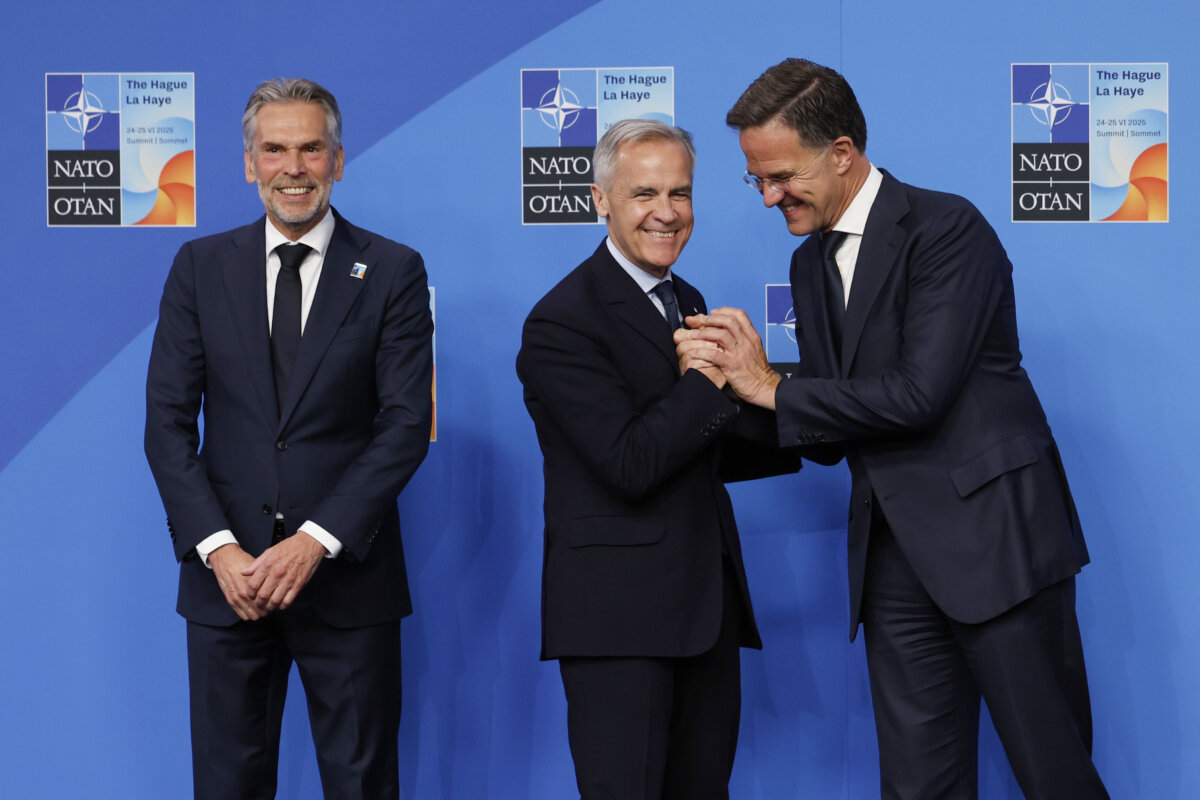
It’s within this context that Carney participated in the EU-Canada summit in Brussels on June 23 and the NATO summit in The Hague on June 24 and 25.
From 2 Percent to 5 Percent
The big news from the NATO meeting was members countries agreeing to significantly increase the alliance’s defence spending guideline from 2 percent of GDP to 5 percent.
A renewed commitment to meet the 2 percent target had been agreed upon in 2014 following Russia’s capture of Ukraine’s Crimea region. At the time, only four countries of the 28-member military alliance were spending up to that level on defence: the United States, the United Kingdom, Estonia, and Greece.
In the decade following, Canada never got close to meeting the objective. The latest NATO estimates for 2024 show that Canada was among nine countries of the now 32-member alliance not having met 2 percent of GDP spending on defence.
In 2014, Canada allocated 1.01 percent of its GDP to defence spending. The percentage has since fluctuated, with peaks at 1.44 percent and dips to 1.2 percent and as low as 1.16 percent, before reaching the current estimate of 1.45 percent.
Before the recent G7 summit in Alberta and the NATO summit, however, Carney said Canada would reach the 2 percent target with an additional $9 billion in defence spending this year. This represented quite the shortcut after former Prime Minister Justin Trudeau pledged at the NATO summit last year to reach the benchmark by 2032.
This followed a general trend in the alliance, with other defence spending laggards like Belgium and Portugal also announcing they would hit 2 percent this year.
NATO has now set the requirement to reach the new 5 percent target by 2035, with 3.5 percent to be dedicated to core defence spending and 1.5 percent for related spending in defence-enabling items such as critical infrastructure.
Allies said in a joint declaration that increased spending is necessary to face “profound security threats and challenges,” such as Russia’s stance in Europe as well as the “persistent threat of terrorism.”
Carney said the summit took place at a “transformational moment” for Canada, NATO allies, and the international rules-based system, which is under “unprecedented pressure.”
“The threats that are facing individual member states are evolving. They differ both in their form and severity,” he said. “At the same time, Canada’s own relationship with NATO is appropriately evolving.”
Rutte Credits Trump
Carney called U.S. President Donald Trump a “transformational” leader when the two met in Washington in early May, and NATO Secretary General Mark Rutte sang a similar tune in The Hague this week. Rutte said that without Trump, the alliance would not have embarked on a massive re-armament project.
“I want to state here, without President Trump, this would not have happened,” he said on June 25, speaking alongside Trump during a media availability at the summit.
Trump has long criticized NATO allies for not spending enough on defence. In widely reported comments last year, he suggested he would not protect a country that doesn’t pay its fair share. This is in the context that NATO has a provision for mutual defence that can be invoked by a member if it comes under attack.
Rutte said NATO’s re-armament trajectory has occurred in three stages, all related to Trump and starting with his first term in 2017. “You forced Europeans and Canadians to pay more at this moment. Result of that phase is $1 trillion extra aggregate defence spending [by Canada and Europe],” he said.
Phase two was Trump’s return to the White House, Rutte said, after which NATO allies failing to meet the spending guideline and having pledged to do so by 2030 began announcing they would reach it in 2025. The “big splash” came on June 25 with allies agreeing on the 5 percent target, he said.
The secretary general said this will allow Canada and European countries as a whole to equalize what the United States spends on defence on its own.
Trump reacted by calling it a “great victory” for everybody. “We will be equalized very shortly, and that’s the way it has to be.”
NATO estimates put the U.S. defence budget at US$935 billion in 2024, compared to a combined US$521 billion for European members and Canada.
How to Get There
If history teaches anything, the new 5 percent benchmark could prove difficult to reach without external pressure tied to trade and economics, coupled by the impetus to bolster defence in the face of constant and growing threats and crises.
The new spending guideline is not being welcomed by all members of the alliance, with Spain being put on notice by Trump. Spanish Prime Minister Pedro Sanchez said after the summit that the 2 percent target is “sufficient, realistic, and compatible with the welfare state.”
Trump reacted by saying his administration could use trade to pressure Spain. “They want a little bit of a free ride, but they will have to pay it back to us on trade because I am not going to let that happen. It’s unfair,” he said in his post-summit press conference.
Canada has been playing ball, and Carney and Trump are currently negotiating what the prime minister calls a “new economic and security relationship” with the United States.
The task of meeting NATO’s new spending guideline could prove daunting for Canada nonetheless, after never meeting even 2 percent.
The Department of National Defence (DND) is underspending its budget, facing lengthy procurement processes for new equipment that have been plagued by controversies. Even with new equipment, there are critical shortages of soldiers to operate it.
With Ottawa running multi-billion deficits for an extended period, and keeping or expanding its social safety net, it remains to be seen how Carney will manage the various fiscal pressures.
The prime minister said on June 25 he would make the case to Canadians that increased defence spending is necessary to protect against an array of new and developing threats, including those from missiles and artificial intelligence.
“I wish we didn’t have to, but we do have to, and it is our core responsibility as government,” he said in his post-summit press conference.
Carney also said that Canada is well-placed to meet the 1.5 percent NATO target of spending on items like critical infrastructure and civil preparedness. The development of critical minerals in the country will also help, he said.
As for the issue of procurement, the prime minister said his new defence procurement agency overseen by a junior minister will lead the way to reform the procurement process, working alongside DND and Public Services and Procurement Canada.
A major procurement project having faced previous controversies returned to the news cycle in the spring amid tensions with the United States, with Carney ordering a review of the purchase of F-35 fighter jets. Canada has a contract for 88 jets and has purchased 16 so far.
The review is ongoing. Meanwhile, Carney said that during his visit he had talks with specific European partners about fighter jets and submarines that Canada is looking to procure.
Canada’s Chief of the Defence Staff Gen. Jennie Carignan said this week she favours purchasing more F-35s, noting that acquiring a different aircraft would come at significant additional costs and require retraining pilots.
European Pact
Carney’s talks regarding European fighter jets is in line with his larger strategy of strengthening relations with the Old Continent.
Amid uncertainty with Canada’s closest ally the United States, Carney travelled to the United Kingdom and France immediately after being sworn in as prime minister in March.
He has continued to work on those relationships, and some of these efforts culminated this week at the Canada-EU Summit in Brussels.
The security deal between Canada and the EU, first announced at the G7 summit, was signed on June 23. Carney had sought to gain access to Europe’s re-armament plan, and the signing of the security and defence partnership will allow negotiations to begin.
European Commission President Ursula von der Leyen said talks will now “swiftly” begin for Canada to join the EU’s $240 billion Security Action for Europe program.
Carney says joining the program will allow Canada to meet its defence requirements faster and more effectively. He also said diversifying providers would avoid creating some “choke points” by spending money in just one area, which can lead to increased prices.
“That’s part of the reason why we’re cooperating more closely with the Europeans, part of the reason why we continue cooperation with the U.S. in the right areas, but also part of the reason why this increase [in defence spending] will happen at a measured pace,” Carney said on June 25.
NATO allies have agreed to review the new spending guideline in 2029. By that time Trump will have left office. Carney was asked by reporters whether the date was chosen for that reason.
“I didn’t realize that,” he replied. “Look, it’s a natural time to review. We’ll have enough information at that point.”
Reuters contributed to this report.
 Friends Read Free
Copy
Facebook
Tweet
Friends Read Free
Copy
Facebook
Tweet