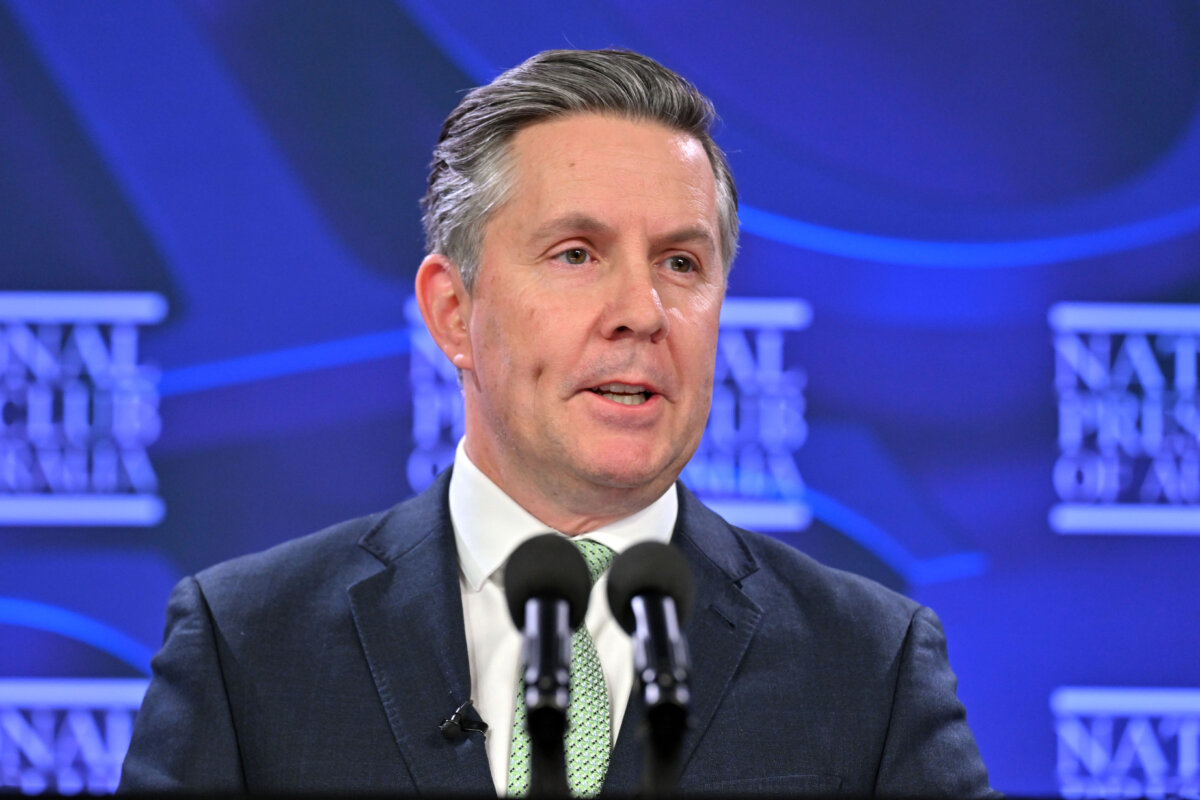

Labor’s Health Minister Mark Butler has taken to task his party’s handling of the multi-billion-dollar National Disability Insurance Scheme (NDIS) ahead of the next federal budget.
“For the sake of the people the NDIS was created for, we have to make sure it’s sustainable now and for future generations,” Butler told the National Press Club in Canberra, Australia on April 22.
The federal health minister revealed a swathe of policies aimed at getting the near-$50 billion a year program under control amid budgetary pressures, as well as a surging One Nation, which has been a vocal critic of the taxpayer-funded program.
Butler has pledged to reassess the needs of every single one of the NDIS’s 760,000 participants with another goal to cut about 160,000 people off the program.
The NDIS was established under the Gillard Labor government and came into operation in 2013. While initial estimates was for the program to stop at 411,000 people and cost about $13.6 billion, it has now ballooned to AU$49.8 billion (US$33.4 billion) covering about 761,000 people.
NDIS has been used to fund an array of services and products—with autism the fastest growing area—including carers who assist with day to day needs, health professional visits, remodifying homes for accessibility, and even mundane tasks like mowing the lawn or taking a person to the movies.
Butler also said there would be a shift away from relying on diagnosis to determine funding, to scrutinising a person’s functional capacity and its impact on living.
The minister expects these drastic changes to keep growth to around 2 percent per year, before it increases to 5 percent. The NDIS currently expands at a rate of over 10 percent per year.
Butler says that after these changes, the cost to taxpayers should drop from $70 billion by 2030, to around $55 billion a year.
As for individual funding packages, Labor says it will aim to cut the average spend from $31,000 per person to about $26,000—the standard in 2023.
Further, NDIS providers will now need to be registered and prove their ability. Currently just 10 percent of providers are registered.
NDIS Distorting Other Parts of Care Economy: Minister
Butler admitted the scheme was growing too fast.
“The fraud fusion taskforce that we established shortly after coming to government has identified eight recurring design failures in long-standing government programs that make them susceptible to fraud. The NDIS has all eight,” he said.
“It also identified seven fundamental building blocks for high-integrity programs. The NDIS has none of them. These structural flaws mean that measures that we have introduced to control spending are simply not working as we intended.”
Butler said seven out of 10 Australians agreed the NDIS had become too large, while more than six out of 10 believed it was “broken.”
“The scale and chaotic nature of the NDIS market is distorting other parts of the care economy, and too often not providing high quality care to participants themselves,” he said.
Research from last year found the NDIS was one of the biggest job providers in the Australian economy, growing about 35 percent in 12 years.
The minister also pointed to a submission from the Australian Criminal Intelligence Commission to a government inquiry into the NDIS which found criminals were “paying cash kickbacks to participants and their families, and sometimes resorting to intimidation and threats of violence towards vulnerable people.”
“The ACIC said large cash withdrawals, asset purchases and fraudulent financial transactions are common, including efforts to obscure the origin of NDIS funds.”
The government says 90 percent of claims by plan managers are not backed by visible evidence—around 600,000 claims a day.
A new digital payment system will aim to regulate providers more carefully.
A $200 million “Inclusive Communities Fund” will be set up to try divert interest away from NDIS. Further details will be “settled in consultation with the disability community,” Butler said.
NDIS ‘Unsustainable’: Albanese
Prime Minister Anthony Albanese said Labor had made progress in cutting back the scheme.
“The important thing is that it deliver what it was intended to do—looking after people, Australians with disabilities, making sure they can fully participate in society,” Albanese told reporters on April 22.
“Now, the growth rate when we were elected to office was 22 percent. That quite clearly … is unsustainable for any program, and what’s important is that it be made sustainable because it’s too important to be undermined in terms of confidence in the scheme.”
Coalition to Back Reforms
Deputy Opposition Leader Jane Hume says the Coalition will back Labor’s NDIS reforms.
“I am very concerned about the level of growth in the NDIS,” she told media.
“Now, it was growing at around 18 percent when [the Liberals were] in government, we desperately tried to rein it in, to bring it back under control, and the Labor opposition then blocked us every step of the way.
“Now that it’s their problem, we’ve said that we will help them.”
One Nation Repeats Call for ‘Means Testing’
One Nation Senator Pauline Hanson repeated her call for “means testing.”
“People whose disability care is covered by insurance due to an accident should not be able to double-dip with the NDIS,” she wrote on X.
The senator was also critical of trivial expenditures under the scheme like holidays, sex workers, and recreation.
Greens Criticise Plan
Greens Senator Larissa Waters said Labor was taking from the NDIS and funnelling the funding into aged care reform.
“Pitting people who genuinely need care against each other while leaving $17 billion in the pockets of gas corporations they’re too cowardly to tax is shameful,” she said on X.
 Friends Read Free
Copy
Facebook
Tweet
Friends Read Free
Copy
Facebook
Tweet