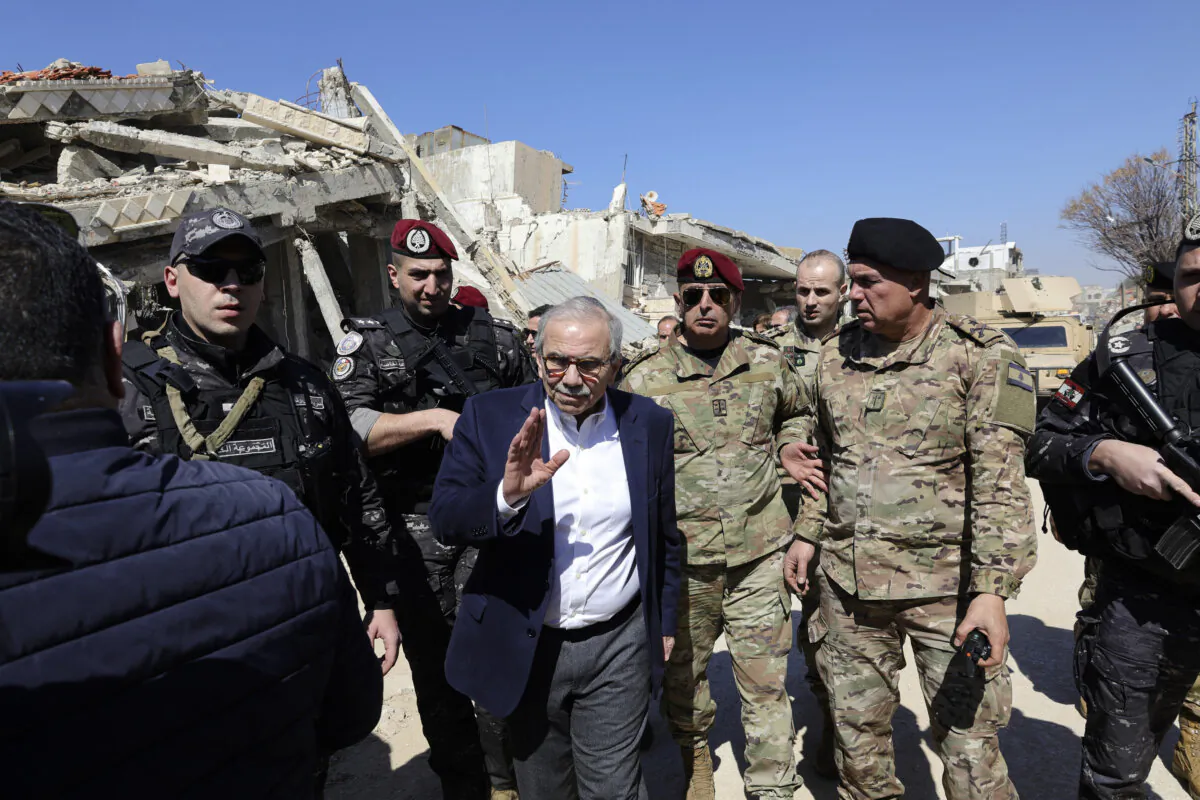

Lebanese Prime Minister Nawaf Salam has said the normalization of diplomatic or economic relations with Israel remains distant, even as officials from the two countries met under a U.S.-backed mechanism designed to support the 2024 cease-fire agreement.
Speaking to reporters at his office on Dec. 3, Salam said he continues to adhere to the 2002 Arab peace plan, which links normalization with Israel to the creation of a Palestinian state, a condition firmly rejected by Israeli Prime Minister Benjamin Netanyahu’s government.
“Economic [talks] will be a part of normalization. Normalization will follow peace. It cannot precede peace,” Salam said when asked about Israel’s statements that it was hoping to build ties and economic cooperation with Lebanon.
“We are far from being there.”
Military activity and tensions between Israel and Lebanon have persisted despite a 2024 cease-fire agreement mediated by the United States and France.
Israel still holds positions in southern Lebanon and is carrying out airstrikes against what it says are Hezbollah’s efforts to re-arm and plan new operations against Israel.
Naquora Meeting
Salam’s comments came as Lebanese, Israeli, and U.S. representatives met on Dec. 3 in the Lebanese southern coastal town of Naqoura.
The meeting is part of the monitoring mechanism established under the 2024 cease-fire accord, which requires Israel to withdraw from Lebanese territory and obliges Lebanon’s army to dismantle Hezbollah fortifications along the border.
Israel was represented by the deputy head of the Foreign Policy Division at Israel’s National Security Council Uri Resnick. Netanyahu cast the move as a first step toward laying the groundwork for relations and economic cooperation with Lebanon. Resnick participated alongside Morgan Ortagus, who is U.S. President Donald Trump’s adviser on Lebanon, and Simon Karam, a former Lebanese ambassador to Washington.
Their participation, the U.S. Embassy in Beirut said in a statement on Dec. 3, reflected the mechanism’s commitment to “facilitating political and military discussions with the aim of achieving security, stability, and a durable peace for all communities affected by the conflict.”
Under the 2024 agreement, Lebanon was tasked with expanding its army’s control over the south and restricting Hezbollah’s operations near the border. Washington designated Hezbollah a terrorist organization in 2014.
In August, the Lebanese government authorized the army to prepare a plan to limit all weapons in the country to six recognized security agencies by the end of the year.
The decision followed a visit by U.S. envoy Tom Barrack, who pressed Beirut to consolidate authority over all armed entities.
Following the Naqoura talks, U.S. Ambassador Michel Issa praised the parties for opening “a channel of dialogue.” In a statement on Dec. 3, he said the meeting showed “a sincere willingness to pursue peaceful, responsible solutions grounded in good faith.”
Issa reaffirmed that the United States “stood ready to engage” in further efforts to ease the burdens faced by affected populations.
Netanyahu’s office said afterward that the session took place in “a good atmosphere.” In its Dec. 3 statement, Israel said it had clarified during the meeting that “the disarmament of Hezbollah is obligatory, regardless of the advancement of economic cooperation.”
The participants agreed to hold a follow-up discussion.
Cease-Fire Strains Persist
Despite the truce, Israeli airstrikes have continued.
On Nov. 6, the Israeli military said it targeted Hezbollah positions in southern Lebanon, striking what it called terrorist infrastructure and weapons storage sites tied to the group’s Radwan Force.
The Israel Defense Forces said Radwan units “continue to reestablish terrorist infrastructure in southern Lebanon with the intention of harming Israel,” vowing to “continue to remove any threat posed to the State of Israel.”
Lebanese President Joseph Aoun condemned the Nov. 6 strikes as a “fully-fledged crime” and accused Israel of violating international humanitarian law and U.N. Security Council Resolution 1701, which ended the 2006 Lebanon War between Israel and Hezbollah.
 Friends Read Free
Copy
Facebook
Tweet
Friends Read Free
Copy
Facebook
Tweet