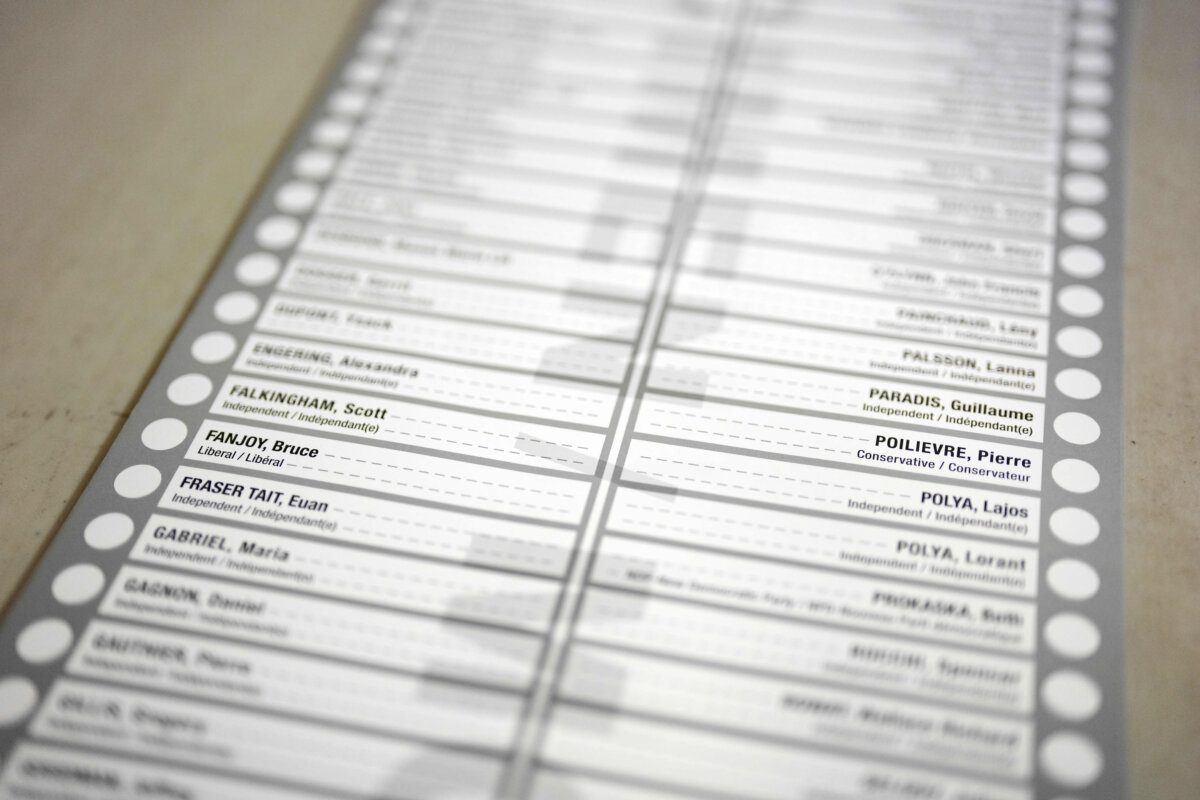

The group that has flooded federal election ballots with candidates to run as a protest is now targeting the byelection in the Terrebonne riding in Quebec next month.
The Longest Ballot Committee, an activist group seeking electoral reform, said it is currently collecting signatures for candidates to run in the upcoming Terrebonne byelection. Prospective candidates have until March 23 to submit their paperwork.
Tomas Szuchewycz, an organizer with the group, has said that MPs should not be able to write election rules, calling it a conflict of interest, and that an independent, non-partisan body should oversee election law instead.
The Terrebonne riding byelection is one of three byelections Prime Minister Mark Carney has called to be held on April 13. If the Liberals win seats in all three ridings, it would bring the party’s seat count in the House of Commons to 173, which is one seat more than the minimum to form a majority government.
The other two ridings, University-Rosedale and Scarborough Southwest, are considered “safe” Liberal seats, while the Terrebonne riding is considered a “toss-up” between the Bloc Québécois and the Liberals.
The Montreal-area riding of Terrebonne became vacant after the Supreme Court of Canada on Feb. 13 overturned the riding’s April 28, 2025, federal election outcome.
Liberal candidate Tatiana Auguste was declared the winner in the riding by a single vote last spring over Bloc MP Nathalie Sinclair-Desgagné.
Following its election loss, the Bloc filed a legal challenge and asked the court to invalidate the result, after a Terrebonne voter told several media outlets that she had mailed in her vote supporting Sinclair-Desgagné weeks before the April 2025 election but had her marked ballot returned to her on May 2, 2025. Elections Canada investigated and subsequently explained that the problem was due to an error in the return address placed on the envelope used to return the ballot to the local Elections Canada office.
The Longest Ballot Committee targeted the federal election last year, signing up more than 80 candidates to run against Conservative Leader Pierre Poilievre in his Ottawa-area Carleton riding. Poilievre had represented the Carleton riding since 2004 but lost his seat to Liberal candidate Bruce Fanjoy, who garnered 50.6 percent of the vote compared to the Tory leader’s 46.1 percent.
The Longest Ballot Committee also targeted the Battle River-Crowfoot riding in Alberta last summer, which Poilievre ran in to regain a seat in the House of Commons after his Carleton loss. Although the group signed up hundreds of candidates to run against Poilievre, he won the byelection with more than 80 percent of the vote.
The group was first created to protest against Canada’s first-past-the-post system, in which the party winning a riding takes all, with the voice of voters choosing other parties not being represented.
Szuchewycz testified before the House of Commons Standing Committee on Procedure and House Affairs last October and admitted to collecting signatures from electors without specifying which candidate the signatures were for. He said he had collected signatures to nominate “any and all candidates.”
Proposed Changes
Poilievre asked the federal government in a letter last July to introduce changes to Canada’s election rules to make it harder for protest groups to stack ridings with inauthentic candidates.
He said the Longest Ballot Committee protest movement makes the voting process confusing for voters and undermines democracy. He suggested the federal government require candidates to obtain signatures from at least 0.5 percent of a riding’s residents, instead of the current requirement of only 100 individual signatures.
He also recommended that nomination supporters only be allowed to endorse one candidate and that candidates’ official agents be restricted to representing only a single candidate at a time.
Carney’s government responded to Poilievre’s letter, with Government House Leader Steven MacKinnon saying he shares some of the Conservatives’ concerns and was studying the matter.
The Alberta government has also sought to prevent long ballot protests in Alberta elections by introducing amendments to legislation last December to increase the number of signatures needed to become a candidate in a provincial election.
The province also proposed to expand the restrictions for political party names so that a political party cannot be registered if it uses a word or phrase associated with another party.
Matthew Horwood and The Canadian Press contributed to this report.
 Friends Read Free
Copy
Facebook
Tweet
Friends Read Free
Copy
Facebook
Tweet