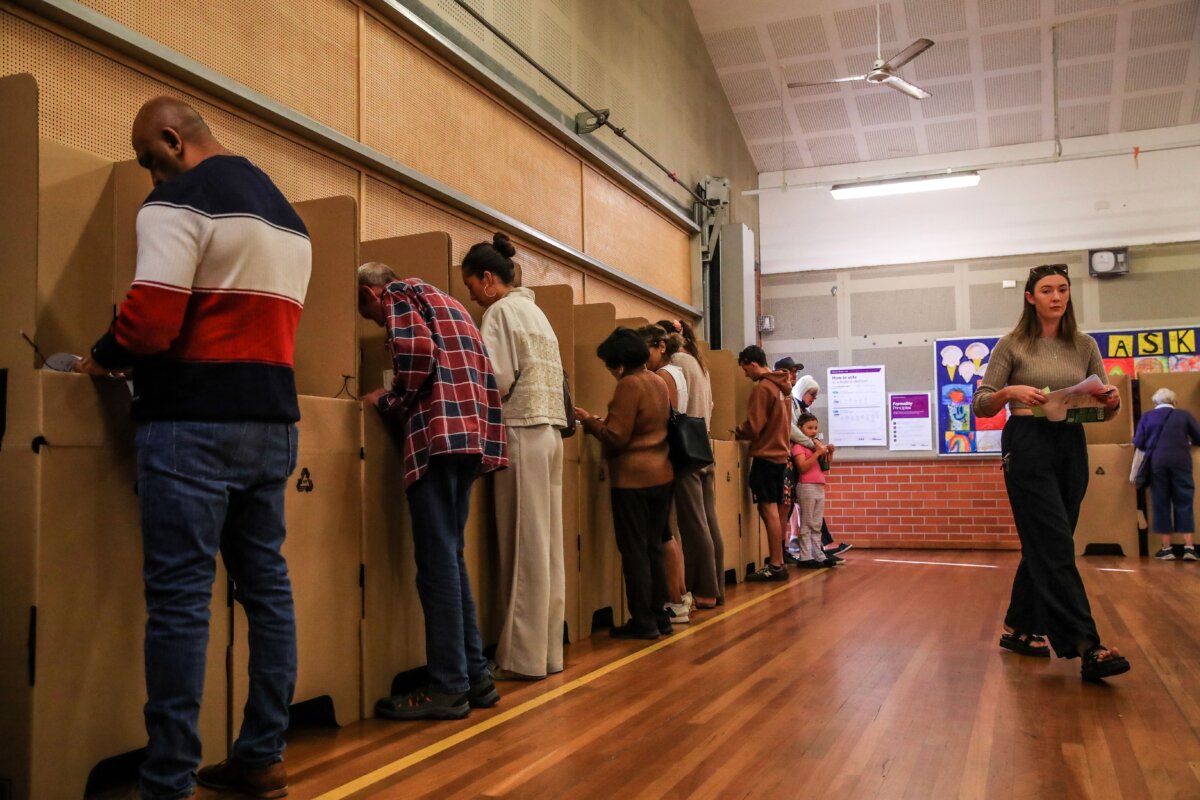

The founder of a major political funding body has urged the government to delay implementing what he described as the “unfair parts” of new electoral laws, warning they could undermine the integrity of Australia’s democratic system.
During a recent parliamentary hearing on the 2025 federal election, Climate 200 convenor Simon Holmes à Court called on lawmakers to reconsider elements of the reforms.
“Make no mistake, these new laws will limit voter choice,” he told the Joint Standing Committee on Electoral Matters.
Holmes à Court argued the legislation would strengthen the dominance of the major parties even as voters increasingly turn away from them.
“You don’t have to be too cynical to argue that the duopoly, Labour and the coalition, the Coles and Woollies of Australian politics, designed the new laws to entrench incumbency.”
The Electoral Legislation Amendment (Electoral Reform) Act 2025, which received Royal Assent on Feb. 20, 2025, introduces major changes to Australia’s political funding rules.
Key reforms—including lowering the donation disclosure threshold to $5,000 (US$3,500), requiring faster reporting of donations, and introducing caps on political donations and campaign spending for political parties and independent candidates—will take effect from July 1, 2026.
When introducing the bill Labor Minister Don Farrell had argued that the reforms would “tackle big money in our electoral system and protect our democracy.”
He said inquiries and evidence from multiple elections showed that the biggest weakness in Australia’s electoral system was the influence of large political donations and funding.
The law changes came at a time when independents had established a significant presence in the last two elections, creating the largest crossbench in Australian history.
In the 2022 federal election, many independent candidates captured previously safe Liberal seats, and the trend continued in 2025, with most “teal” independents retaining their seats.
Funding Gap Criticised
Holmes à Court told the committee the reforms would increase taxpayer funding for major parties while restricting fundraising options for independents, creating a significant funding gap between them.
He alleged that if the laws had applied during the previous electoral cycle, Labor and the Coalition would have enjoyed a 9.5 percent increase in income, including $47.5 million in additional taxpayer funding through loopholes.
The political activist further claimed that $126 million in taxpayer funding would flow to the major parties over the current electoral cycle, up from $57 million in 2022.
In contrast, Holmes à Court said independent challengers would face tighter donation limits, adding that the caps would have reduced income for independent campaigns by 44 percent, particularly affecting crowdfunding models used by community-backed candidates.
“If these laws had applied over the 2025 election period, public funding would have covered 61 percent of Labor’s $90 million spending cap, 46 percent of the Liberals, but independents, by contrast, would have received an average of just 14 percent of their far smaller cap,” he said.
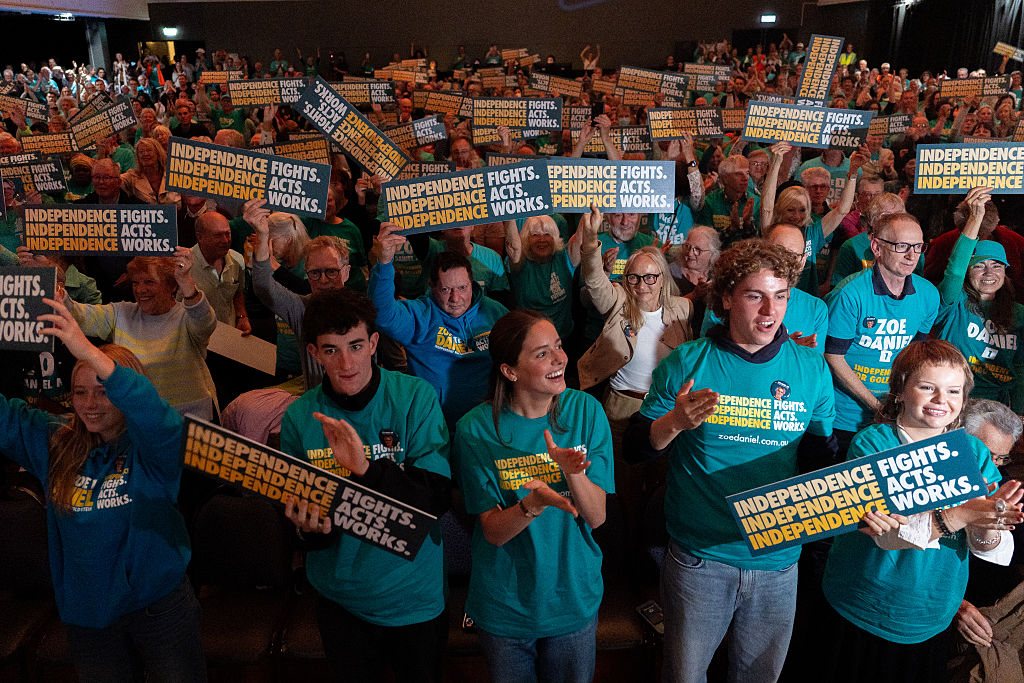
According to electoral funding disclosures, Climate 200 was the largest single donor in a federal election campaign, almost doubling its 2022 contribution to Teal candidates by providing $10,857,934 during the 2025 election.
Climate 200 describes itself as a community-funded initiative backing candidates aligned with three principles: climate action based on science, stronger political integrity and anti-corruption measures, and greater equality and respect for women.
While the group donated to 34 different candidates, its largest contributions went to Teal independents. Overall, the organisation received $9.45 million in reportable donations during the 2025 election.
Labor’s Polling Booth Concerns
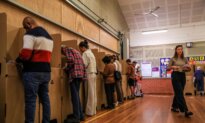
Meanwhile, Paul Erickson, national secretary of the Australian Labor Party, gave evidence supporting possible reforms to campaign conduct at polling stations.
He said the party would welcome a recommendation from the Australian Electoral Commission (AEC) to limit campaign signage at polling booths to improve accessibility and reduce obstruction.
Erickson also highlighted the need for some reforms to improve the safety and security arrangements of polling booths, citing the experiences of volunteers and candidates who were harassed or intimidated.
“We heard from many of our own volunteers and campaign staff who recounted feeling unsafe and intimidated and a number of volunteers indicated that these experiences left them uncertain about whether they would be comfortable volunteering at polling booths at future elections. A number of our candidates also reported being harassed,” he said.
In the previous hearing in October 2025, AEC Commissioner Jeff Pope stated that there was a surge in hostility and harassment at polling places in the most recent federal election..
Pope said the AEC received 2,200 complaints, including 550 relating specifically to intimidation or abuse, most originating from pre-poll centres in Sydney and Melbourne.
“I’ve never seen more corflutes out the front of some pre-poll voting centres,” he told the committee. “Some people found that very intimidating and difficult to navigate.”
Noting the AEC’s powers are largely limited to enforcing rules within a six-metre boundary around polling stations, Erickson suggested creating a designated campaigning zone beyond the six-metre limit where only authorised volunteers could engage voters and distribute campaign materials.
He said such a framework could allow stronger oversight, including the creation of a formal register of polling booth incidents and complaints.
 Friends Read Free
Copy
Facebook
Tweet
Friends Read Free
Copy
Facebook
Tweet