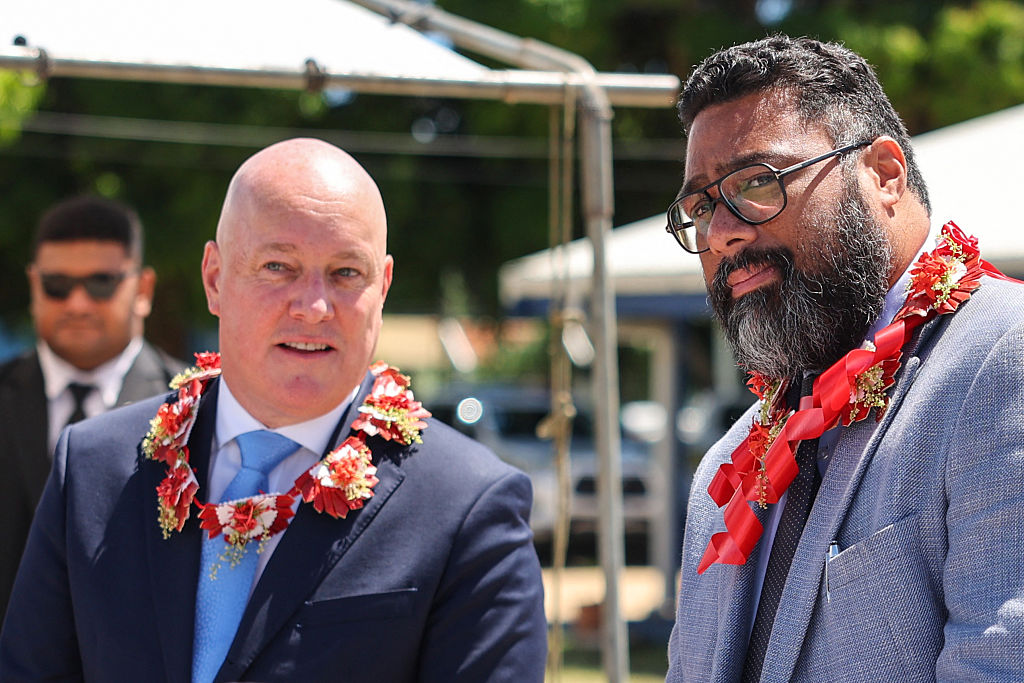

New Zealand’s Prime Minister, Christopher Luxon, has signalled stronger cooperation with Pacific nations to stem the flow of drugs in the region as he visits Samoa and Tonga.
The South Pacific is the principal transit route for trafficking drugs and chemical precursors from Asia and South America to Australia and New Zealand, where consumers pay some of the highest street prices in the world.
When FBI Director Kash Patel opened a new outpost in Wellington in July last year, he made it clear transnational organised crime was an area of focus.
Before leaving New Zealand, Luxon told reporters that smugglers had even resorted to using submarines to bring illicit drugs into the region.
“Those criminal gangs will not give up,” he said. “They are very innovative, and they keep pushing their product on our people, and we don’t like it.”
New Zealand Customs CEO Christine Stevenson told the Wellington Post newspaper that drug trafficking in the Pacific had worsened in recent months, with around 14 tonnes of cocaine intercepted this year alone.
“There’s no sign of the drugs stopping,” she said. “We’ve seen more ventures on the water, maritime ventures coming down from South America, in the first eight weeks of this year than we saw in the whole of the two previous years.”
Drug-Related Arrests Balloon by Nearly 800 Percent
A 2022 study by the Lowy Institute found that the problem was rapidly accelerating.
In 2009, Fiji had only 148 drug-related policing cases (including arrests for cocaine and heroin). But by 2018, this had risen to almost 1,400 arrests, while methamphetamine cases rose from two in 2009 to 113 in 2019.
Cocaine accounted for the largest volume of illicit drugs seized by the region’s law enforcement agencies, with a record eight tonnes confiscated between mid-2016 and 2018.
More recently, authorities in French Polynesia made a record 524 kg cocaine bust in late 2024; Fiji saw the seizure of nearly five tonnes of methamphetamine in January of that year; and Samoan authorities intercepted 10 kg of meth in January 2025.
The Lowy report noted that “the cultural, social, and hierarchical web of Pacific Islands families and societies serves as a further barrier, the framework creating both a frontline against illicit activities but at times also providing a shield for actors reliant on impenetrable networks.”
Just a month ago, the U.S. Coastguard seized more than US$133.5 million worth of cocaine in the Eastern Pacific. America announced an initiative to assist Pacific nations in combating trafficking originating in China when it opened its embassy in Port Vila, Vanuatu, in 2024.
Kurt Campbell, deputy secretary of state in the Biden administration, said at the time that the United States was “concerned some of the networks that have grown in China and Southeast Asia are beginning to use the Pacific for transshipment both to Latin America and the United States.”
In an attempt to help reverse the trend, Luxon and Samoan Prime Minister La’aulialemalietoa Polataivao Leuatea Fosi Schmidt have signed memorandums of understanding which will see police and customs in both countries working together and sharing more information.
It will also embed dedicated New Zealand Police officers in Samoa.
New Zealand Police Commissioner Richard Chambers has made working with police chiefs across the Pacific on drug trafficking a priority since his appointment in November 2024.
Island nations, including Samoa, needed support for investigations and dog detector programmes, and New Zealand was happy to provide these, he said.
“There’s no point [in] us trying to tackle the extent of this problem on our own, and neither should Samoa be doing that.”
 Friends Read Free
Copy
Facebook
Tweet
Friends Read Free
Copy
Facebook
Tweet