
In a stance that differs from that of many of its closest allies, New Zealand has announced that it will not recognise Palestinian statehood.
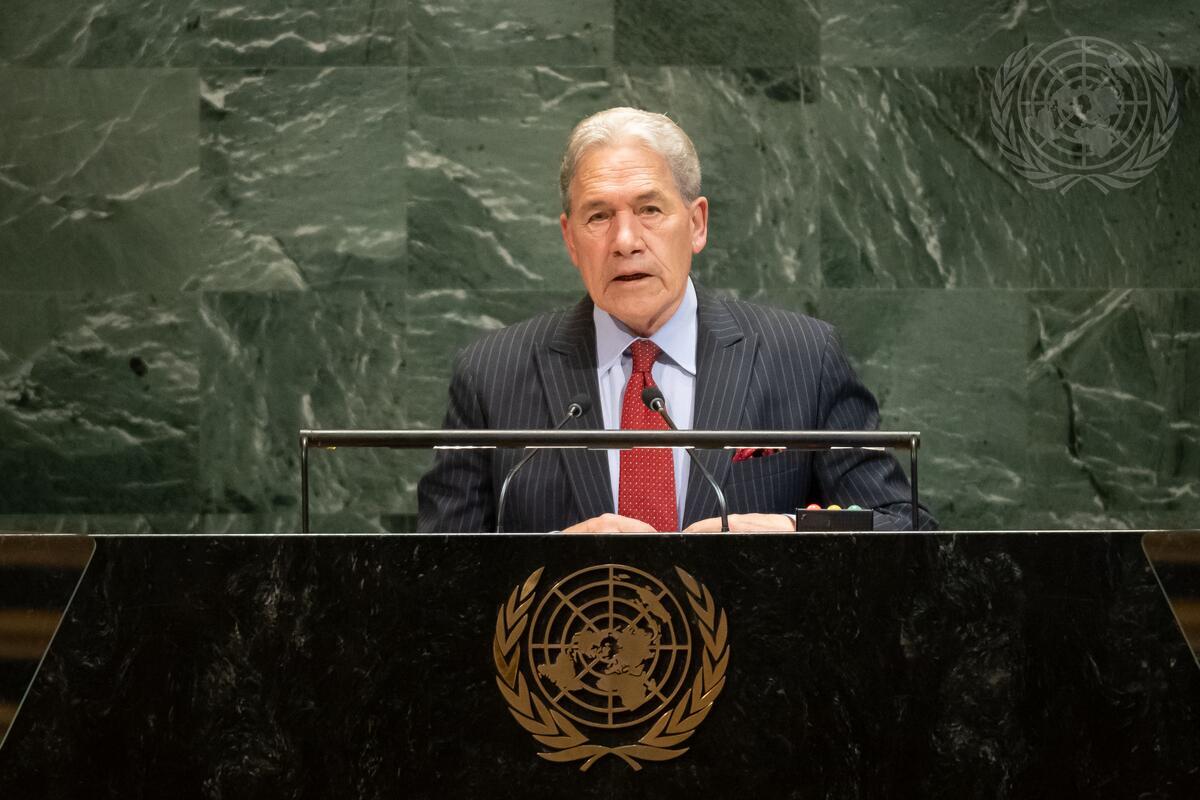
Foreign Minister Winston Peters made the announcement in a much-heralded address to the U.N. General Assembly, taking most observers by surprise.
Peters appeared to obliquely criticise other countries, including Australia, the UK, and France, which had recently announced they recognised Palestinian statehood.
New Zealanders, he said, had been “appalled by the barbarity of Hamas’s attack on Israeli citizens on Oct. 7, 2023,” leading them to conclude: “Hamas have no place in any future Palestinian state. They know only hate.”
But, he said, at the same time, “We are also revolted by what can only be described as a grossly disproportionate response from the Israeli government.”
“However, there is an old saying about a musical instrument that sums up well the vexed question of Palestinian statehood recognition: ‘If the string is too tight it will snap, but if it is too loose, the instrument will not play,'” he said.
“Those countries who hoped their earlier signalling of Palestinian statehood recognition would protect and promote the two-state solution have instead seen the Israeli government snap and continue its widely condemned military actions in Gaza while continuing to develop illegal settlements on the West Bank, in defiance of international law.”
Recognition Will Be Counterproductive: Peters
New Zealand acknowledged the good intentions of countries that had recognised Palestine, but reaching a similar decision would “serve as little more than an existential act of defiance against an unalterable state of affairs,” Peters said.
“Statehood recognition, as an instrument for peace … does not play because there is no fully legitimate and viable State of Palestine to recognise,” he said.
“Indeed, what we have observed since partners’ pre-announcements reveals that recognising Palestine now will likely prove counterproductive. That is, Hamas [is] resisting negotiation in the belief it is winning the global propaganda war, while pushing Israel towards even more intransigent military positions.”
Peters told delegates that recognition now would be used as political leverage by both Hamas and Israel.
“Hamas will seek to portray our recognition of Palestine as a victory, as they have already done in response to partner announcements. Israel will claim that recognition rewards Hamas and that it removes pressure on them to release hostages and agree to a cease-fire,” Peters said.
Still, New Zealand has not completely ruled out the possibility of recognition in the future, “when Israeli and Palestinian political leadership is an asset, not a liability,” and the situation shifts from conflict to peace, he said.
David Seymour, deputy prime minister and leader of the ACT Party, reacted to the announcement with a post on X, in which he said: “I’m proud that our government has shown independence in foreign policy. Without political hype, we have worked through the issues as a coalition and come to the right position on a terrible situation where there are no easy options.”
‘Wrong Side of History’: Labour
Peeni Henare, Labour’s foreign affairs spokesperson, called the decision “an embarrassment” which puts the country “on the wrong side of history.”
“[Prime Minister Christopher] Luxon had a chance to stand up for what is right, but he failed. There is no two-state solution or enduring peace in the Middle East without recognition of Palestine as a state,” he said.
“We also need meaningful sanctions on Israel, cutting trade and economic ties, freezing assets, and implementing travel bans on named individuals, as we have with Russia.”
The decision puts New Zealand at odds with many of its global defence and trading partners, though not the United States. Both countries are members of the Five Eyes alliance, which also includes Australia, Canada, and the UK.
Similarly, all but two members of the Association of South East Asian Nations, with which New Zealand has dialogue partner status, have opted for recognition.
It does, however, keep it aligned with the stance of its Pacific partners—of the 18-nation Pacific Islands Forum, of which New Zealand is a full member, only Vanuatu and Papua New Guinea have announced that they recognise Palestinian statehood.
The government has released all the Cabinet papers it relied upon in reaching the decision.
 Friends Read Free
Copy
Facebook
Tweet
Friends Read Free
Copy
Facebook
Tweet