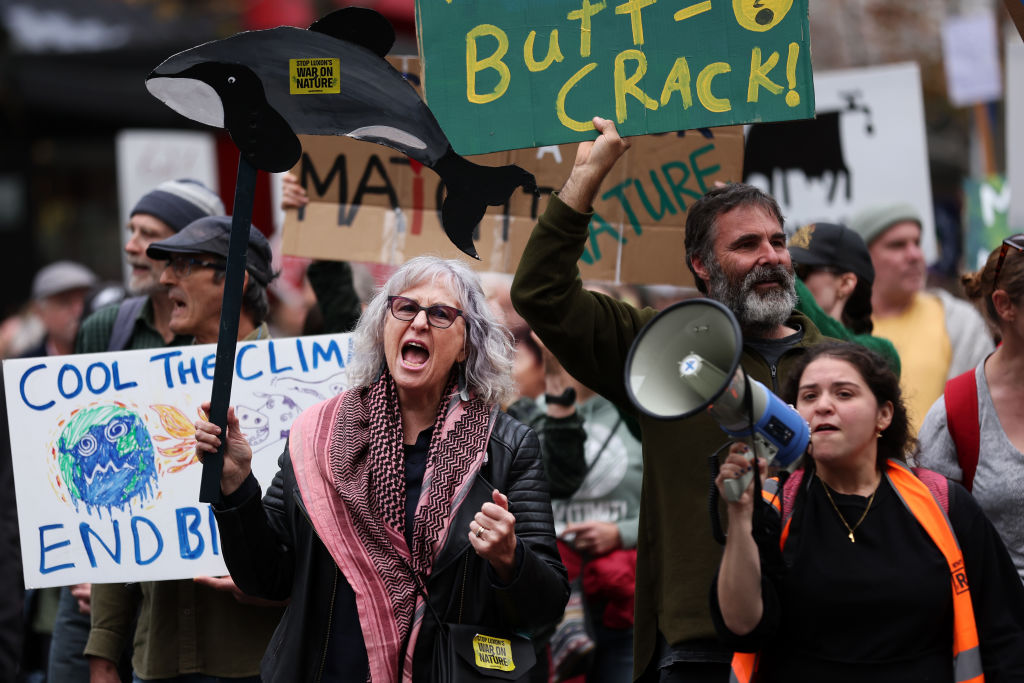

New Zealand’s Parliament is considering a bill that would outlaw people who hold targeted and disruptive demonstrations near residential homes.
However, critics say that, in failing to define details such as how close to a home a protest would need to be to trigger the offence, it risks abridging free speech and could be used to shut down protests outside places like embassies.
Introducing the bill on behalf of the minister for justice, junior National Party Minister James Meagher said he was “sure this bill will be a welcome relief to many MPs, officials, and individuals who have had themselves targeted.”
“Just as we value the right to protest, privacy is also a key value of our society. It reflects our respect of freedom and individuality,” he told Parliament in August.
“Unreasonable, disruptive intrusions into peoples’ private spaces are simply unacceptable. In particular, the home is the place where anyone should be able to retreat to, irrespective of who they are or what they do for a job.”
He pointed out that the bill includes a list of “considerations to assist police and the courts, as well as demonstrators themselves, in assessing what is unreasonable.”
This could include factors such as the time of day, duration, the actions of the demonstrators, the level of noise, and the distance to the premises.
“The law will only apply to demonstrations that are directed at a person and which occur near a person’s private residence. This includes any place where that person regularly resides, even if it is not their main residence,” Meagher said.
“Demonstrations that affect the enjoyment of or access to a property but are not directed at the person living there are not covered.”
But as there are no set limits, critics and opposition parties fear the potential for misuse, and cite the prospect of protesters needing lawyers to argue complex cases and shield them from the penalties, which range up to three months in jail or a fine of $2,000.
Labour’s Duncan Webb warned that if Parliament passed the law, New Zealand “will stand apart as being one of the very few countries that claim to be a liberal democracy which is actually prohibiting a demonstration.”
“This is targeted to suppress political action … the point of political action is to disrupt. It is not to be nice. It’s not to be convenient. Protest is disruptive; that’s what a protest is,” he said.
Existing Laws Can Address Disruptive Protests: Professor
Kris Gledhill, professor of law at the Auckland University of Technology, is raising concerns the law could infringe on people’s right to protest.
“The boundaries of peaceful protest are regulated by long-established summary offences, including disorderly behaviour or assembly, or using offensive, threatening or insulting language. So what will a new law really achieve?” he asks.
“The courts have decided those offences apply only to conduct that goes beyond what we should be expected to tolerate in a democracy.”
He cites a 2005 case (pdf) in which the Supreme Court found in favour of someone who protested outside the home of a police officer whom the protester believed had misused a search warrant.
The protest was during the daytime and for a limited time, but the officer had been on night duty and was trying to sleep. The court found that this had not overstepped the boundary and become disorderly.
“Importantly, this means that if conduct does overstep that mark—goes on longer, involves more people or more noise—it could be disorderly and therefore criminal (under existing law),” Gledhill points out.
Wide definitions of terms like “residential premises” mean the proposed law could cause confusion for police and protesters alike, he says.
“Protest is a significant part of our democratic tradition,” Gledhill says. “Any proposal to restrict it must be scrutinised closely for whether it is genuinely needed, and for potential pitfalls. [This bill] can be found wanting on both counts.”
Public submissions on the bill are currently open.
 Friends Read Free
Copy
Facebook
Tweet
Friends Read Free
Copy
Facebook
Tweet