
Growing concern over people stripping beaches of sea life has motivated New Zealand’s government to look at ways of preventing the practice, but since the problem is mostly with migrants, this has led to accusations of racism.
While the practice has long been of concern to many across the entire country, the matter came to a head on Jan. 17 when more than 100 residents of the small Northland town of Whangaparāoa, about 45 kilometres north of Auckland, protested at one badly affected bay.
They say busloads of people regularly arrive and comb the beaches taking everything from crabs to sea cucumbers.
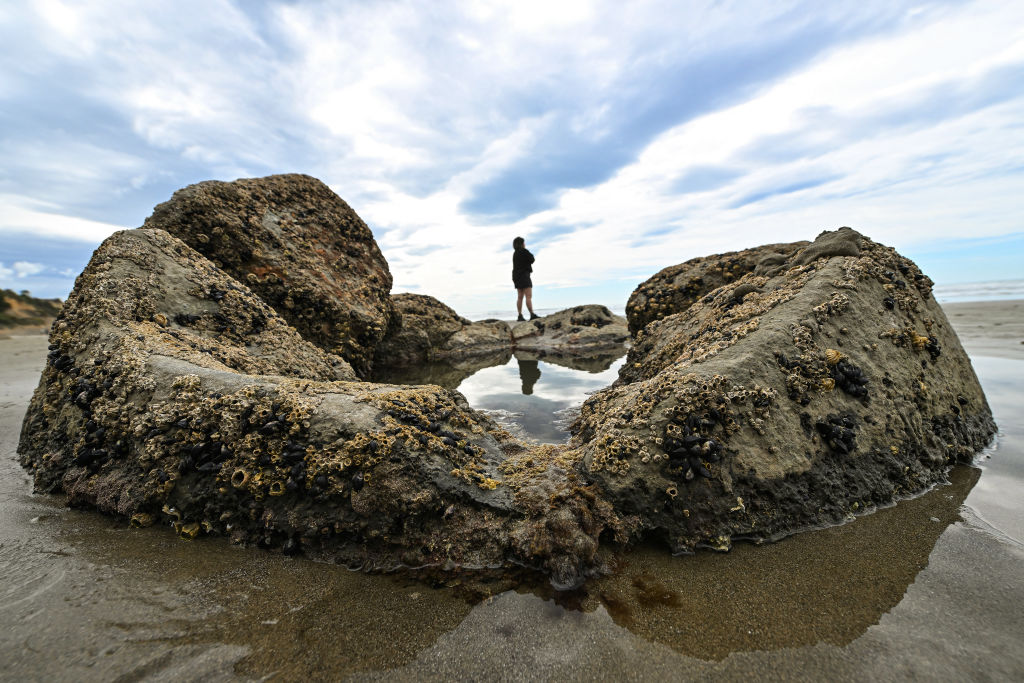
Mark Lenton from the Protect Whangaparāoa Rockpools group (PWR) told One News that “2 to 300 people a day, with chisels and hammers and piano wire, removing all plant and animal life from the rock pools.
“What was once a thriving ecosystem only two years ago, are now empty rock pools. The only thing there now is seawater.”
That prompted a quick response from Fisheries Minister Shane Jones, who asked for urgent advice from Fisheries New Zealand on how to deal with the issue.
“I acknowledge people are concerned at what they say is the indiscriminate collection of marine life at intertidal rockpools,” he said in a statement. “These shellfish and other marine creatures [which are] reportedly being collected in large numbers by often big groups of people are crucial for the health of these ecosystems.”

He was looking at potential fishery closures and prohibiting the collection of certain species not usually taken for food.
On top of this he is considering social media campaigns aimed at “educating collectors from all cultures about the risks of taking large amounts of sea creatures from tiny ecosystems.”
But it was what he said later, during an interview on RNZ, which caused the subsequent uproar.
Speaking to the Morning Report programme, Jones bluntly stated: “Kiwis, we’re fairly laidback, and we make an assumption that, when immigrants come to New Zealand, they won’t crap on the beach, they won’t slaughter all the periwinkles. Well, this is evidence that, as our democracy changes, we’re going to have to be more vigilant.
“The New Zealand public has got to wake up to the fact that unfettered immigration is going to import these problems, because a lot of the migrant communities have a different cultural mindset and, until they abide by the Kiwi ways, we are going to have to both educate and regulate,” he said.
Government MPs Scramble, Say Migration Not the Issue
That caused Asian MPs from across several parties, including his own coalition, along with Minister for Ethnic Communities Mark Mitchell, to hit back.
“It’s not related to ethnic behaviour or ethnic culture, activity or tradition,” National list MP Nancy Lu said. “It’s more around the individuals who have taken actions and are now getting some feedback from other people who are locals.”
Mitchell, who is also the National Party’s MP for Whangaparāoa, agreed the debate should not focus on ethnicity but on protecting the marine environment.
“It’s incumbent on all Kiwis to be good custodians and do that,” he said. “Some people are choosing not to do that.”
Another National MP, Carlos Cheung, said the problem was “more a fisheries issue, not a migrant or immigration issue. I think everyone, no matter what [ethnicity] or … what community you belong to, we all should work together to make sure New Zealand sea life is sustainable.”
Without naming Jones, he warned that it was “easy for individuals to try to blame someone or highlight a certain group, but … that can be individual behaviour that doesn’t represent a whole community.”
Jones’ party, New Zealand First is a right-leaning, nationalist party that governs in coalition with the libertarian ACT Party, and traditional centre-right National Party.
Greens Says Focus Should be on Environmentalism
But the strongest criticism came from China-born Green MP Lawrence Xu-Nan, who pointed out that Jones’ New Zealand First Party had always campaigned on an anti-immigration platform, and accused Jones of blaming migrants ahead of this year’s election, the date of which will be announced by Prime Minister Christopher Luxon on Jan. 21.
“I think this is simply a distraction because when we’re looking at the most harm to our … marine environment, it’s industrial fishing, bottom trawling and seabed mining,” Xu-Nan said.
“These are the things that a minister of fisheries, Shane Jones, should be focusing on and banning. But, instead … he’s using racist rhetoric as a distraction to address the much bigger issue to our marine ecosystem.”
Jones Calls on Migrants to Embrace Local Culture
All Jones’ critics said the answer to the problem lay in education. In Australia, many beaches have signs in Chinese warning against overfishing or taking too much shellfish.
But Jones was undeterred, telling RNZ that the “majority of the people scouring the rock pools are from the migrant community. They are Asian. We need to educate and we need to cause people to understand they must embrace the culture of the host society.
“New Zealand First has always had a ‘Doubting Thomas’ attitude to unfettered immigration. The more our demography changes, the more it’s important that politicians … remind all people seeking a new home in New Zealand that when in Rome, you do as the Romans do.”
Local Māori tribe, the Ngāti Manuhiri Settlement Trust, has applied for a two-year legal ban on taking shellfish from Whangaparāoa down to the east coast of Auckland, including the Hauraki Gulf islands.
Jones said a decision on the Trust’s request would be made next month.
“Sadly, an ethnic vacuum cleaner has been at work,” he said.
 Friends Read Free
Copy
Facebook
Tweet
Friends Read Free
Copy
Facebook
Tweet