
New Zealand should follow the example of Australia, where reforms in 1987 reduced 28 portfolios to 16 and created durable “consolidated ministries,” a think tank says.
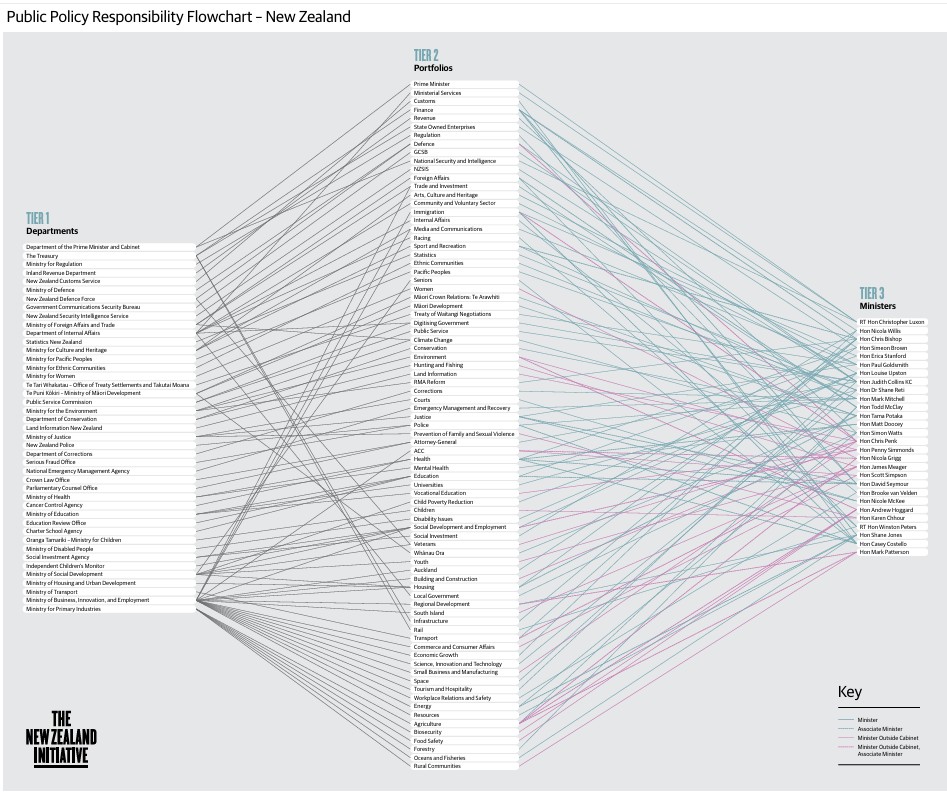
With a population of 5.4 million, New Zealand has 81 ministerial portfolios, 28 ministers and 43 government departments—about three times as many portfolios and nearly twice as many departments as comparable countries.
The New Zealand Initiative on Sept. 2 launched its Unscrambling Government report.
It points to the Ministry of Business, Innovation and Employment (MBIE), which reports to 20 different ministers, as an example of the complex and inefficient structure that makes accountability unclear, drives up costs, and slows down, or stops, the implementation of effective solutions.
It recommends consolidating portfolios into 15 to 20 “natural policy domains” and cutting departments from 43 to around 20.
“The goal is coherence, not centralisation for its own sake,” the report’s author, Roger Partridge, told a webinar.
“Critics of what we’ve proposed will be tempted to dive into the detail, and there will doubtless be objections to whether this particular role best sits with that particular function. But the short point is that New Zealand’s executive is too big, too fragmented, and too costly.
“Reform can sharpen accountability, improve coherence, and still meet political realities. Other countries have done it. The question is whether we will have the will to follow their lead.”
Too Complex, Inefficient
He admitted that the realities of an MMP system, where smaller parties want roles for their MPs as a condition for joining a coalition, meant that it would be unlikely that the number of ministers could be substantially reduced.
“We’ve currently got 28, we’ve said either 15 plus 10 junior ministers, or 20 plus 5 junior ministers … so there’ll be just as many ministerial roles available,” he said, though the number of portfolios would be consolidated.
“And the good thing is you’re not creating junior ministers for that purpose. You’re creating junior ministers because it will help the system run smoothly and ease the burden of the senior, budget-holding, cabinet ministers. So I don’t think MMP is an obstacle at all,” Patridge said.
“I don’t think we’ve got too many ministers [but] there are too many MPs. It’s just that we’ve sliced up all the portfolios so that you get ministers that are expected to be jacks of all trades, and they risk becoming masters of none.”
He used the example of Judith Collins, former leader of the National Party, who is currently serving in seven portfolios.
“She’s expected to be in charge of defence, space, the public service, the Attorney-General, [and] digitising government. So we’ve got these fruit salad portfolio allocations. What we should do is collect like with like and have a minister that develops deep expertise in that area,” Patridge said.
Former Treasury Secretary Murray Horn, who wrote the foreword to the report, agreed that the current structure, illustrated in the diagram below, was both overly complex and inefficient.
“You can’t generate coherence from below unless you’ve got coherent set of ministers,” he said.
“The departmental reorganisation is always a hassle. You’ve got people worried about where they’re going to sit … So you don’t want them to take their eye off the ball for very long. So my view is, you want to get a pretty clear [idea] where you’re going, and you want to be pretty quick about it.
“It comes down to the government’s ability to generate an environment which is reasonably predictable, where unnecessary regulation is just stripped out of the system, and the government focuses on doing its job well,” Horn said.
Since government is now a considerable part of the economy, Horn said productivity in public services is important.
“If you don’t have coherence at the top, you’re not going to get productivity. You’re going to get what we’ve got, which is a lot of extra spending and very little traction on the results.”
 Friends Read Free
Copy
Facebook
Tweet
Friends Read Free
Copy
Facebook
Tweet