
Ottawa is allocating more than $900 million to the National Research Council (NRC) to fund drone technology and other domestic defence initiatives, including the acquisition of a Bombardier jet for research.
The funding announced March 9 by Industry Minister Mélanie Joly is part of the Defence Industrial Strategy unveiled by Prime Minister Mark Carney last month. The strategy aims to allocate $6.6 billion over the next five years to development of the domestic defence sector.
“Canada’s security depends on our ability to innovate at home,” Joly said at the announcement in Ottawa. “We are strengthening our sovereign capabilities and supporting Canadian companies in the development of next-generation aerospace, drone, quantum and biomedical technologies.”
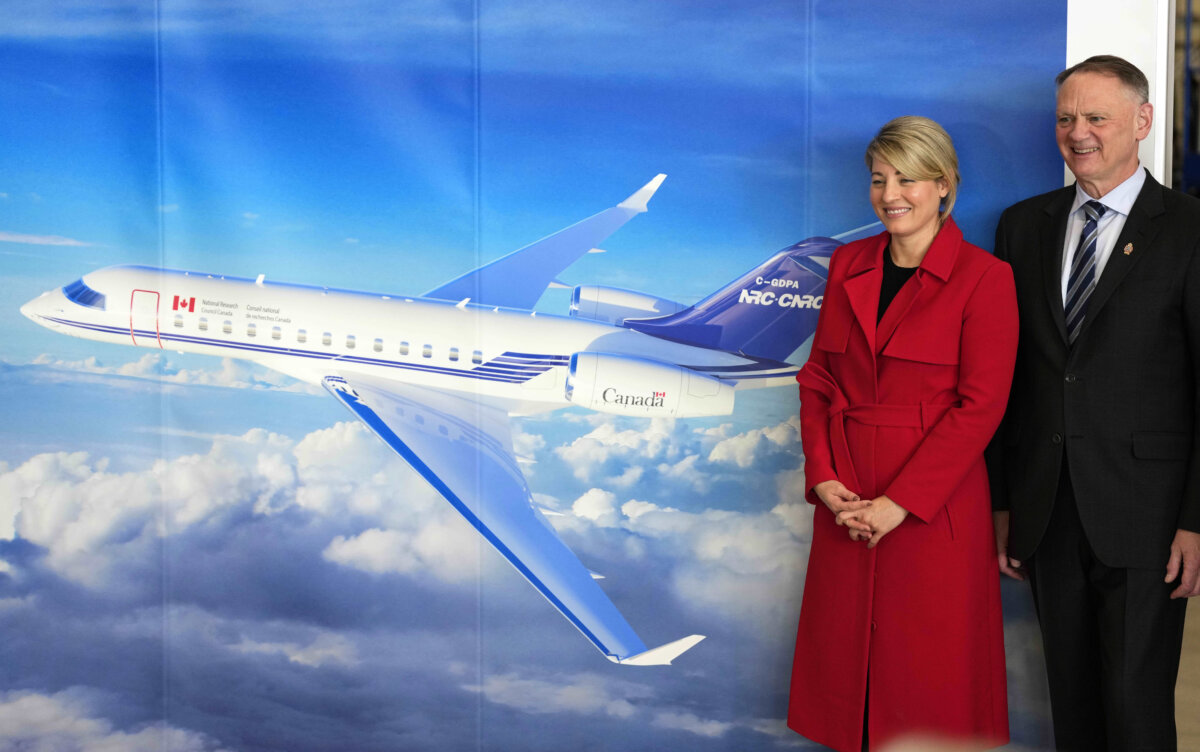
The funding package announced by Joly, which includes $500 million in support for drone and aerospace technology, will establish a new “drone innovation hub” to operate in the Ottawa and Montreal areas.
The NRC will also acquire a Bombardier Global 6500 jet for use in researching and developing defence-related technology, Joly said.
The government didn’t state the cost of buying and overhauling the Bombardier jet. Joly said the purchase is separate from the $753 million, six-jet deal announced by Ottawa last year with Bombardier to replace aging air force Challengers.
Ottawa will also allocate $161 million over five years for development of quantum technology, the government said.
Defence Minister David McGuinty, also on hand for the announcement, said the funding aims to strengthen Canada’s industrial foundations. Both the new jet and the drone testing facility will benefit the military, he said.
“This is about testing intelligence, surveillance and reconnaissance technologies in real world conditions, helping our forces make faster and more informed decisions during their operations,” McGuinty said, adding the drone innovation hub will have similar benefits with its focus on counter-drone systems and autonomous flight technologies.
A government press release said the funding will help to create “high-quality” job opportunities for Canadians. Joly was asked by reporters how many jobs would be linked to the more than $900 million investment, but did not provide a figure.
“In the $900 million, there is definitely the Bombardier aircraft, which will create jobs itself in Ontario, in Quebec, but also at Cascade in B.C.,” Joly said, referring to the jet being built in Canada.
Ottawa said the aircraft will undergo major research technology modifications in Abbotsford, B.C., by Cascade Aerospace and Bombardier. The changes are expected to be complete by 2028.
Defence Push for NATO
The Carney government’s defence spending strategy is also meant to meet Canada’s aggressive NATO alliance commitments.
Canada has vowed to invest the equivalent of 2 percent of its GDP in defence, aiming to elevate this to 5 percent by 2035—a level of defence spending not seen in this country since the Cold War.
Canada has said it is dedicated to achieving the 5 percent NATO target, which includes a specific goal of 3.5 percent for essential military expenditures and 1.5 percent for defence-associated spending. This includes investments in security-related infrastructure, telecommunications, dual-use military-civilian initiatives, and the procurement of critical minerals needed for defence and advanced technology supply chains.
The Carney government’s first budget, released last November, promised to “put Canada on the pathway” to meeting the 5 percent target.
Parliamentary Budget Officer (PBO) Jason Jacques indicated in his Feb. 5 report that the government has not disclosed any projections on how it intends to fulfill the 5 percent target. Despite that, Jacques estimated that the expenses will total about $33.5 billion each year for the next 10 years.
The analysis estimates the federal deficit could be approximately $63 billion higher by 2035 if spending increases gradually to meet the 5 percent NATO target.
The Canadian Press contributed to this report.
 Friends Read Free
Copy
Facebook
Tweet
Friends Read Free
Copy
Facebook
Tweet