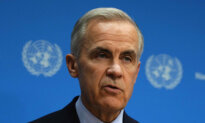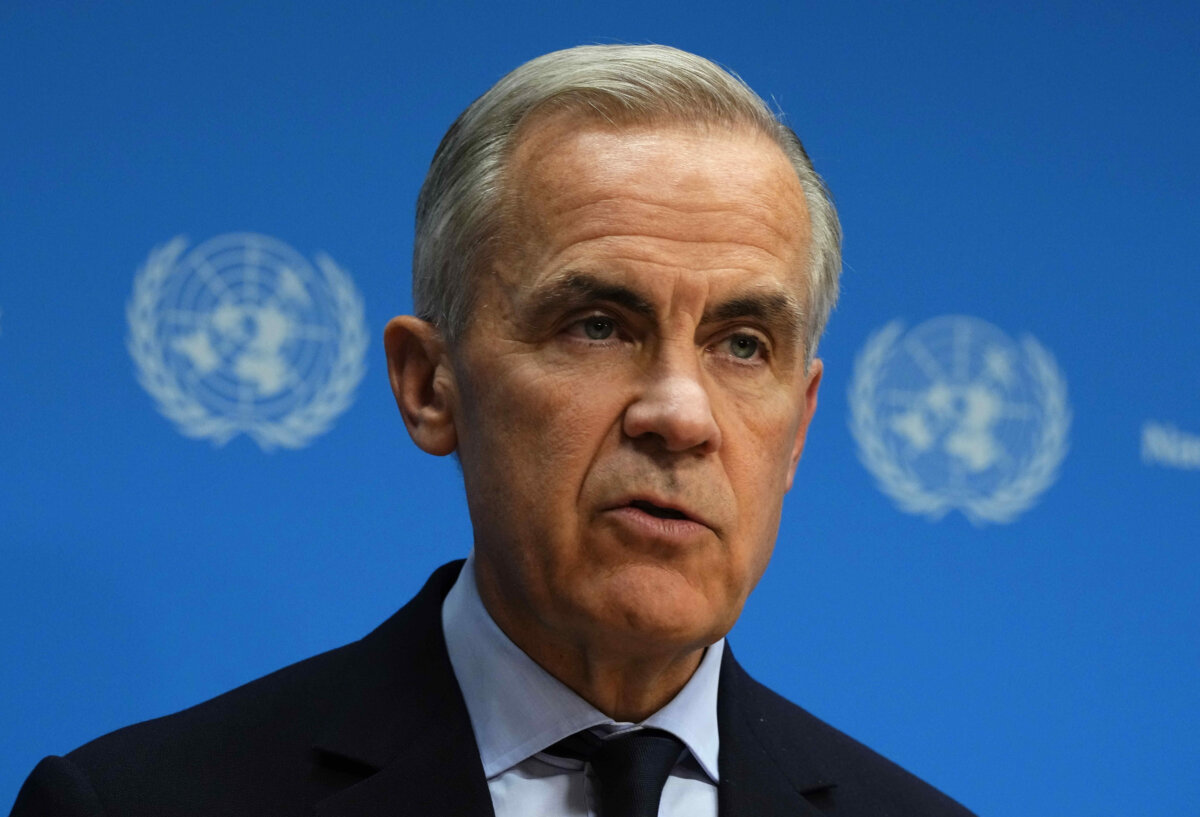

Prime Minister Mark Carney has announced a $100 million aid package for Palestine aiming to help preserve the “possibility of a two-state solution” and to provide humanitarian aid for Gaza and the West Bank.
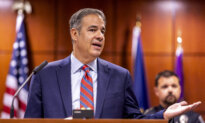
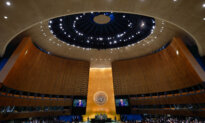
The bulk of the financial package—$80 million—will be earmarked for humanitarian assistance, Carney told reporters on the sidelines of the United Nations General Assembly in New York.
The remainder will be allocated toward development funding for security programs, including supplementary funds for a multi-year initiative to train police in the West Bank, he said during the Sept. 22 press conference.
“In Gaza, immense human suffering continues,” Carney said. “Next door, Israelis continue to live with existential threats from Hamas and from Iran and its proxies.”
He added that international support for a two-state solution “will mean nothing if these conditions continue.”
Carney announced the funding ahead of a meeting with British Prime Minister Andy Burnham, French President Emmanuel Macron, and Saudi Foreign Minister Prince Faisal bin Farhan to discuss the two-state framework and implementation of U.N. Security Council Resolution 2803, adopted in November 2025 to endorse a U.S.-backed plan to end the Gaza conflict.
Carney’s aid announcement comes two weeks after Canada, France, and Britain joined with other nations in committing to restrict the commercial exchange of items manufactured in Israeli settlements located throughout the West Bank.
Carney also voiced opposition to Israel’s proposed E1 settlement during the Sept. 22 press conference, calling it a “direct threat to peace” and a barrier to a viable two-state solution.
E1 (East 1) is an approximately 12-square-kilometre area between East Jerusalem and the Israeli settlement of Ma’ale Adumim where Israel has proposed settlement construction.
Carney characterized the settlements as “illegal” and said Canada would “bring forward trade restrictions targeting goods produced” there alongside an international coalition of 12 countries.
The coalition released a statement earlier this month to announce the trade ban. It also criticized the Israeli government for what it characterized as a “rapidly deteriorating” situation for Palestinians.
Deputy Conservative Leader Melissa Lantsman criticized Ottawa’s stance on the issue, saying that it was choosing to “double down on a double standard” at a time when anti-Semitic violence is on the rise in Canada.
“Nowhere in these one-sided declarations is there any demand that the Palestinian Authority deliver on what it promised Prime Minister Carney,” Lantsman said in a Sept. 8 social media post. “The pressure simply evaporates, and it’s the Palestinian people, their economy, and Canadian workers who will pay the price.”
Canada officially recognized Palestinian statehood last year. The move was a departure from its earlier stance that recognition should be contingent on a negotiated resolution between Israel and Palestinian representatives.
Carney said at the time that the expansion of settlements combined with the ongoing Gaza war had substantially weakened the viability of reaching such a settlement.
Canada has committed more than $600 million in aid to support Palestinian civilians following the outbreak of the Israel-Hamas conflict in October 2023.
The Canadian Press contributed to this report.
 Friends Read Free
Copy
Facebook
Tweet
Friends Read Free
Copy
Facebook
Tweet