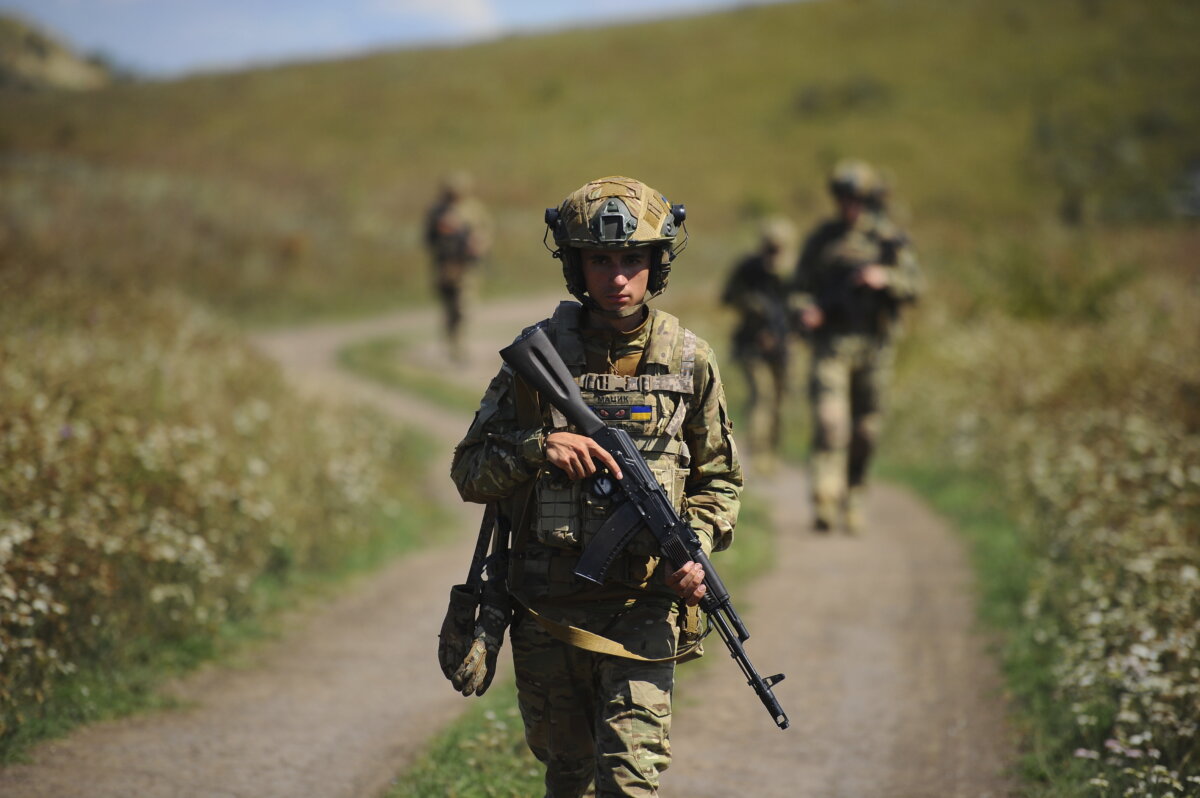

Ottawa is no longer planning on sending guns collected through the federal buyback program to Ukraine after the country expressed “extremely limited” interest in the firearms.
Former Prime Minister Justin Trudeau’s government had committed to working with the Ukrainian government to send prohibited guns from Canadian firearms businesses obtained through the buyback program to Ukraine to support its defence against Russia.
However, Prime Minister Mark Carney has now cancelled the plan after Ukraine has shown interest in an “extremely limited” number of firearms collected through the program, Public Safety Minister Gary Anandasangaree’s office told the Toronto Star on Sept. 25.
A “vast majority” of the collected firearms do not meet NATO compliance standards, the minister’s office said, adding that this wasn’t a “practical or effective way to support Ukraine’s defence.”
The Trudeau government announced its intention to send firearms to Ukraine last December in tandem with outlawing another 324 firearm makes and models, which the government said belong on the battlefield, not in the hands of hunters or sport shooters.
Ottawa first banned approximately 1,500 makes and models of so-called “assault-style” firearms after a mass shooting in Nova Scotia in 2020, which involved stolen and smuggled weapons. By March of this year, the prohibited firearms list was expanded to more than 2,000.
Former Defence Minister Bill Blair said offering assistance to Ukraine was a “worthwhile investment of [Canada’s] collective time and efforts.” Ukraine had identified 23 types of firearms that could be useful to its military in its war against Russia, a government official said last December.
The Department of National Defence said only new firearms would be sent to Ukraine so the department wouldn’t have to inspect them for safety or maintenance first.
Ottawa has provided approximately $22 billion in financial support to Ukraine since its war with Russia began in 2022, largely in the form of loans.
‘Weapons of War’
The Liberal government has described the recently prohibited semi-automatic rifles as “weapons of war” that are “designed to kill as many people as possible in the least amount of time possible.”
Meanwhile, Tracey Wilson from the Canadian Coalition of Firearm Rights says the government’s decision to not send banned guns to Ukraine “proves our point that these aren’t ‘weapons of war.’”
“No military in the world would send their troops into combat with a bunch of semi automatic, 5 round max hunting and sporting plinkers,” Wilson told The Epoch Times in a Sept. 26 email.
Wilson said she’s hopeful the Liberal government will scrap the buyback program entirely and “focus on criminals, violence and gun smuggling instead of Canada’s most vetted citizens.”
Ottawa launched the buyback program this week for individual firearm owners, starting with a six-week pilot in Cape Breton, Nova Scotia, where the local police service has agreed to participate in the program.
The program will be launched nationwide later this fall and will be open to all eligible firearm owners, Anandasangaree announced this week. He said there are approximately 180,000 registered firearms in Canada that are subject to the prohibition.
Carney has said the program aims to take “guns off the street in a voluntary fashion,” and has noted his government is moving forward with the program to fulfill its promises made in the election campaign earlier this year.
The Alberta government won’t be participating in the program, Premier Danielle Smith said in a Sept. 23 X post. She called the program a “gun grab against law abiding firearms owners” and said her province’s municipal police forces will focus on “real” policing priorities instead.
Some police associations have also criticized the buyback program, saying it won’t address illegal gun crime and is a misuse of police resources.
Toronto Police Association President Clayton Campbell told MPs at a Sept. 25 parliamentary committee meeting that the program won’t bring down crime in Toronto since the majority of firearm offences involve illegal firearms, not licensed guns.
Canadian Police Association President Tom Stamatakis has said police forces in Canada don’t have the resources to manage the program, while National Police Federation President Brian Sauvé said the government should focus on illegal firearms coming from the United States.
The Canadian Press contributed to this report.
 Friends Read Free
Copy
Facebook
Tweet
Friends Read Free
Copy
Facebook
Tweet