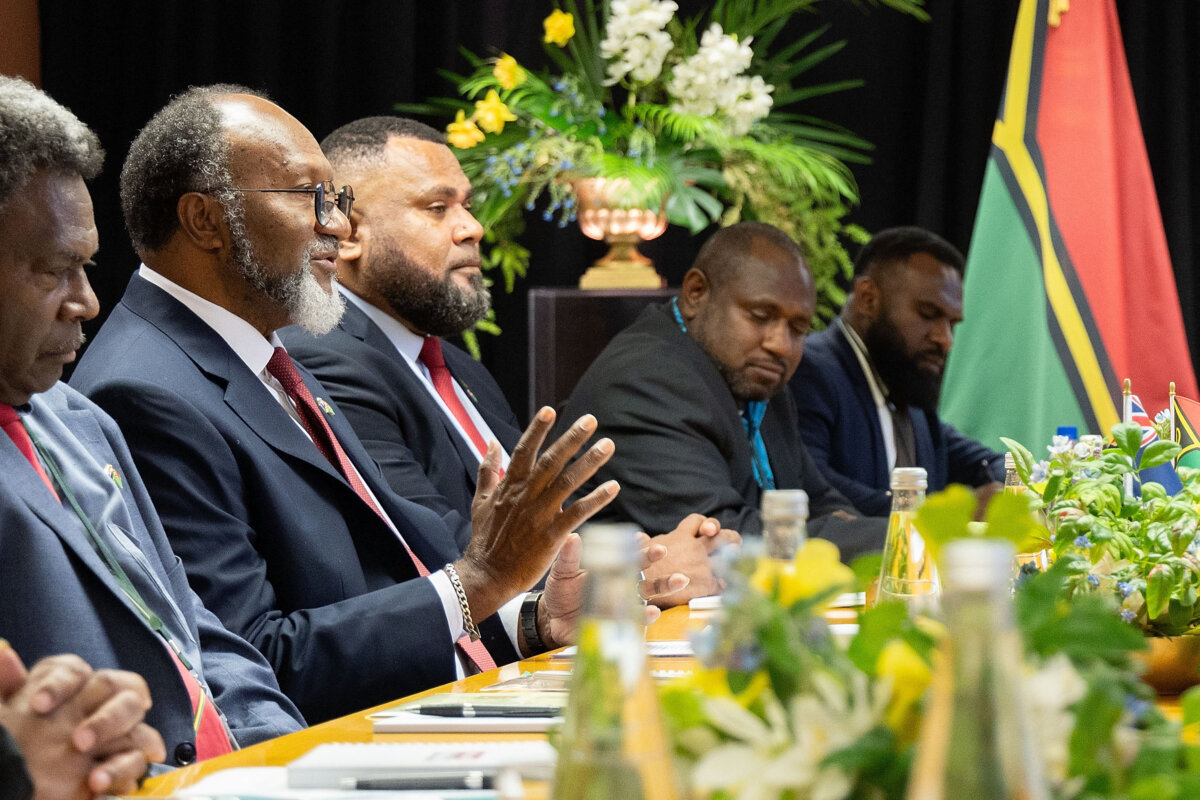

Cross-border efforts to stem the inflow of drugs and tackle other organised crime activity in the Pacific may be just one casualty of a surprise decision by the Vanuatu government to expel all foreign advisers and police officers from government buildings, citing the need to protect its own sovereignty.
There is also uncertainty about what effect this will have on the as-yet-unsigned Nakamal Agreement, which Australia is pursuing partly to have a bulwark against Beijing’s increasing influence in the region.
Since 2022, when it signed a security pact with the Solomon Islands, Beijing has steadily been establishing a foothold across the Pacific, dispatching police advisers to the Solomons, Fiji, Kiribati, Vanuatu, and beyond, and gaining agreement from the Cook Islands earlier this year to enter a comprehensive strategic partnership.
So concerned was Wellington by that last move, made without consultation despite the Cooks’ status as part of the Realm of New Zealand, that it froze foreign aid in protest, although so far that has done little to deter Avarua.
Meanwhile, Vanuatu’s minister of internal affairs, Andrew Napuat, visited Beijing in September, announcing his country was “willing to deepen practical cooperation with China in the field of police and law enforcement.”
Only weeks earlier, it had refused to sign the $500 million Nakamal Agreement, saying it would block other countries providing infrastructure funding, and Napuat told reporters that Vanuatu would not give in to “bullying” from larger countries.
He went on to rebuke Canberra, saying it must respect Vanuatu’s policing agreement with China, as he accepted policing equipment from Beijing worth $635,000 (about US$416,000).
Government to Change Security Laws
The latest attempt to distance the country from its traditional allies in the Pacific came after Vanuatu’s Parliament last week introduced several significant changes to its national security laws.
One clause says any foreign adviser working on national security “must be stationed at neutral venues or at his or her respective embassy,” barring such advisers from accessing government premises without authorisation by the minister.
Although the new rules apply to any foreign power, they will disproportionately affect Australia and New Zealand, both of which have numerous police and defence personnel working in Vanuatu, some currently working directly out of that country’s police headquarters and other government institutions.
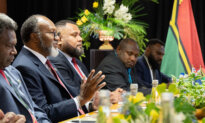
Vanuatu’s prime minister, Jotham Napat, assured MPs that Chinese police officers providing training programmes in Vanuatu and working in government buildings would have to follow the same rules.
He said that Vanuatu was “seeing outside influence coming in” and that the government had “issued an advisory to remove police officers from the main police headquarters, [both] Chinese police officers and Australian [officers],” to prevent that influence.
“We have to make it neutral as much as possible,” he said.
However, the decision has stoked concerns that it will damage efforts to combat transnational crime in the region.
Earlier this year, the U.S. State Department put Vanuatu—along with Fiji and the Solomon Islands—on the Tier 2 watchlist in its Trafficking in Persons Report, alongside countries that include Algeria, Barbados, Kyrgyzstan, Nepal, Rwanda, South Africa, Turkmenistan, and Zimbabwe.
This generally means that the estimated number of victims in those countries is either very significant or is markedly increasing and that the governments are not taking proportional, concrete actions.
New Zealand and Australia Say They Will Negotiate
A spokesperson for New Zealand’s Ministry of Foreign Affairs and Trade told The Epoch Times that it has “a number of police and Defence Force staff working in close collaboration with Vanuatu agencies, at the request of the Government of Vanuatu.”
“We will work to understand the impacts of the new bill, which are not yet known,” the spokesperson said.
“Should we need to raise concerns, we will do so privately in respect of our longstanding and deep partnership.”
New Zealand Foreign Affairs Minister Winston Peters said he had nothing to add to that statement, but his Australian counterpart, Penny Wong, told ABC’s “Insiders” that Australia would “work through this with Vanuatu.”
“Obviously, they will continue to seek a partnership and us working with them, we’ll do that in a way that works for them,” she said.
She refused to write off the Nakamal agreement, saying Nakamal was a place “where leaders come together to talk, to resolve issues, to work out the way forward.”
“We will work through that with Vanuatu because we want to make sure that whatever agreement is finalised and we enter into, that has the support of both countries’ leaders [and] the parliaments of both countries.”
 Friends Read Free
Copy
Facebook
Tweet
Friends Read Free
Copy
Facebook
Tweet