
A euthanasia prevention group is asking the federal government to endorse a private member’s bill that stops next year’s expansion of medically assisted death to those whose sole condition is a mental health problem.
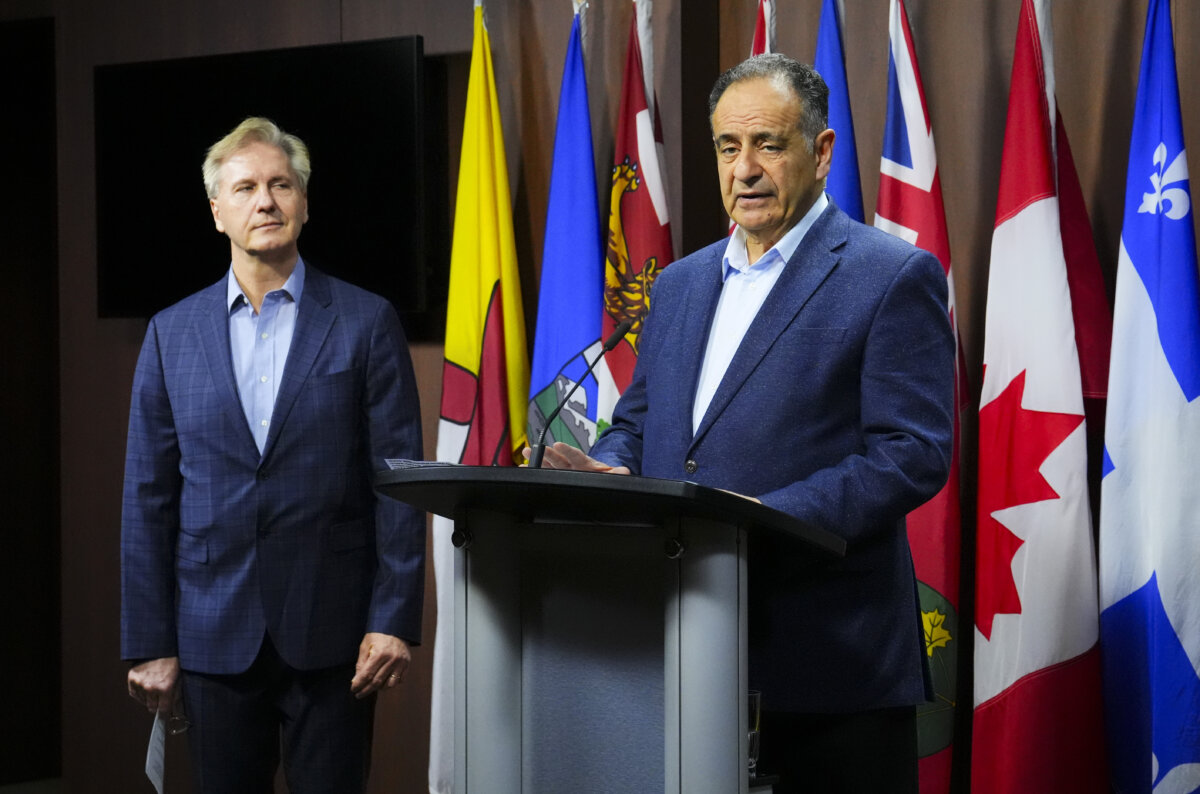
Members of the Euthanasia Prevention Coalition reiterated their support for Bill C-218 during an April 13 press conference on Parliament Hill.
Bill C-218, tabled last June by Conservative MP Tamara Jansen, is a private member’s bill that would amend the Criminal Code to prevent medical assistance in dying (MAID) from being expanded to include those diagnosed solely with mental illness.
Dr. Peter Blusanovics, a family physician based in Montreal who spoke at the press conference, said he has treated many patients with mental illnesses and wants to “provide a voice for our most vulnerable—those who have and are suffering from mental illness.”
“Bill C-218 needs to pass to put a stop to euthanasia for people with mental illness,” he said. “Basic needs are currently not being met in our health care system.”
“Without this bill, we are condoning a bypass towards suicide and blatantly admitting defeat. Mental illness needs to be properly identified and treated.”
Blusanovics said people will mental illness do not want to die—they want their suffering to be relieved. He noted that there is currently a lack of medical support, such as physicians, psychologists, social workers, as well as a lack of psychiatric support.
The lack of “proper care” in Canada’s health care system “is not a good enough excuse” to offer MAID as a solution to mental health issues, he added.
“I know that offering medical aid in dying provides no solution. Everyone deserves the right to be treated with dignity and humanity,” he said.
MAID became legal in Canada in 2016 for adults suffering from grievous and irremediable medical conditions. In 2021, Parliament passed Bill C-7 to expand MAID to include those diagnosed solely with mental illness. The provision was set to take effect in 2023, but has been delayed twice for further review by physicians and lawmakers until March 2027.
‘Informed Consent’
Dr. Paul Saba, another family physician based in Montreal, also spoke at the press conference and said Bill C-218, which is currently undergoing second reading in the House of Commons, “must be supported by our members of Parliament who care about their citizens and who value life.”
He noted there is “overwhelming evidence” that people with mental disorders can be treated, and that most psychiatrists cannot determine whether a patient has an irreversible condition.
“From a legal standpoint, those with mental disorders requesting euthanasia … do not meet the condition of free and informed consent because the desire to die in most cases is a symptom of a mental illness,” he said.
Saba noted that according to a Harvard public health study, nine out of 10 people who unsuccessfully attempted suicide did not make another attempt following treatment. He said one of his patients had attempted suicide in her 20s while she was in an abusive relationship, but her neighbour found her and saved her life.
“If she had been euthanized, she wouldn’t have survived, because euthanasia with a legal injection is a guaranteed death. There’s no survivors after euthanasia or medical aid in dying,” he said, adding that the patient is now in her 50s and is happy to be alive.
The average wait time to see a psychiatrist is five months in Quebec, while the average waiting period before receiving MAID is three months, he said.
Saba also noted there are hundreds of different medications and treatments available for mental illness, including art, music, dance, pet, and recreation therapy, among other types.
Euthanasia Prevention Coalition executive director Alex Schadenberg, also speaking at the press conference, said there have been more than 100,000 euthanasia deaths in Canada since MAID was legalized a decade ago.
“We challenge the federal government not to expand Canada’s euthanasia law, but to launch a study by neutral researchers … on the effect of Canada’s out-of-control euthanasia regime,” adding that he believes MAID for mental illness alone is “absolutely the wrong way to go.”
Alberta Legislation
The Alberta government tabled a bill last month that would ensure MAID is not used in the province “when other care and treatment options are available,” such as in cases where mental illness is the sole underlying condition.
The bill would limit MAID eligibility to those whose natural death is “reasonably foreseeable” and prohibit MAID where a natural death is “not reasonably foreseeable,” which is known as Track 2 MAID.
It would also prohibit physicians from making referrals for individuals to receive MAID outside of Alberta, allow physicians and health care facilities to refuse to assess or provide MAID, and restrict health care professionals from initiating conversations about MAID with a patient.
Alberta Premier Danielle Smith said the bill “restores clear limits on eligibility to protect vulnerable Albertans facing mental illness or living with disabilities.”
“Those struggling with severe mental health challenges need treatment, compassion and support, not a path to end their life at what may be their lowest moment,” Smith said in a March 18 statement.
Paul Rowan Brian contributed to this report.
 Friends Read Free
Copy
Facebook
Tweet
Friends Read Free
Copy
Facebook
Tweet