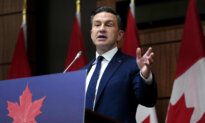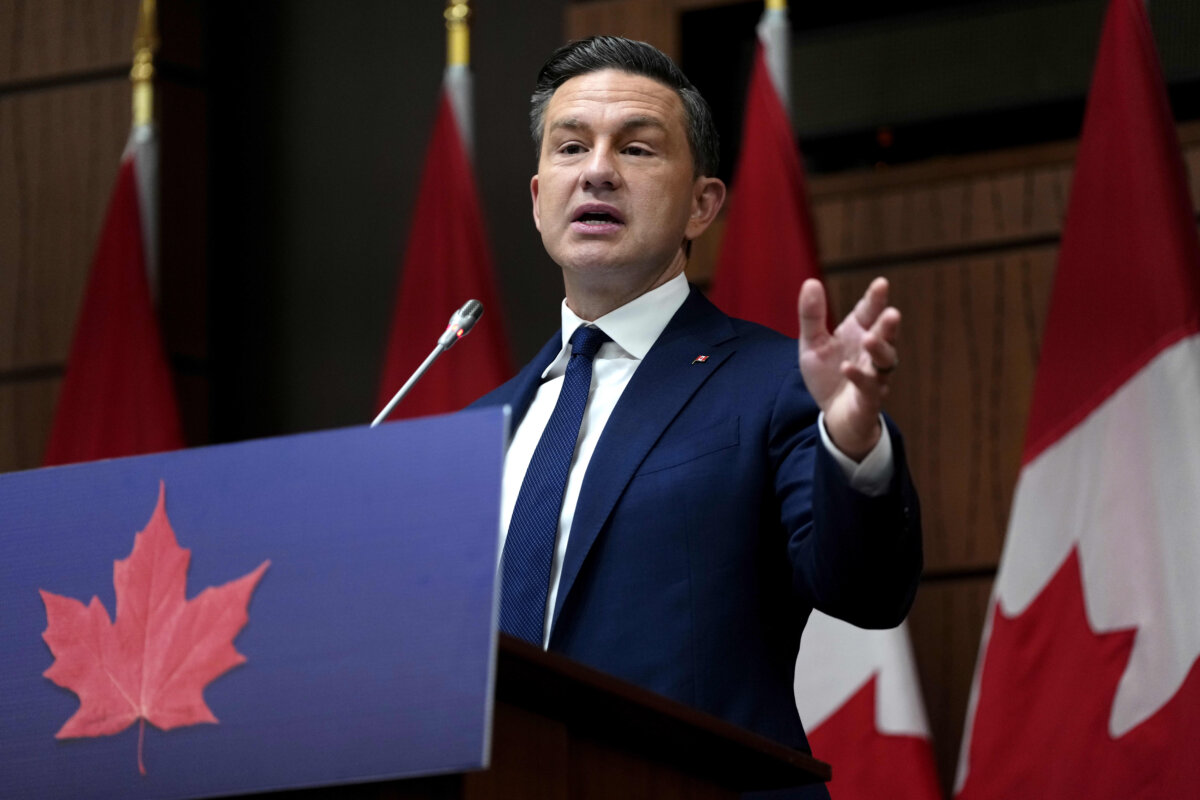

Conservative Leader Pierre Poilievre says his party will focus on tackling the country’s rising cost of living, crime rates, immigration policy, and unemployment when Parliament returns on Monday, Sept. 15.
Poilievre addressed his caucus on Parliament Hill in Ottawa on Sept. 14, where he said the Tories will propose “real solutions” as he outlined his party’s priorities for the upcoming fall session.
“We’re going to work to turn things around. We’ll work with anybody from any party in order to make this session a success for the Canadian people,” he said, as he prepared his caucus to face the minority Liberal government under Prime Minister Mark Carney the following day.
On housing affordability, Poilievre reiterated his promises from the federal election campaign, saying the Conservatives will pursue measures such as removing the GST on all homes priced up to $1.3 million and scrapping the capital gains tax when the proceeds from the sale of assets are reinvested domestically “to build, invent, create, and hire here in Canada.”
“Let’s incentivize the municipalities to speed up permits, free up land, and cut development charges, and let’s cap immigration so that we can add homes faster than people and put roofs over the heads of Canadians,” he added.
‘Brakes on Immigration’
The Conservatives have focused particularly on the issue of immigration numbers and the policies rolled out by the federal government on that issue in recent years. According to Statistics Canada, the country’s population increased from 38 million in July 2020 to over 41.7 million in mid-September this year.
The Liberal government under former Prime Minister Justin Trudeau reversed some of its immigration policies beginning in 2024, saying it would reduce the number of permanent residents admitted into the country over the next three years and announcing a cap on the number of international students allowed in Canada.
During his caucus address on Sept. 14, Poilierve said Canada needs to “pump the brakes on immigration”—a position similar to one he expressed in July when he said the country needs “more people leaving than coming for the next couple of years” in order to relieve the strain on Canada’s employment numbers, housing, and health care.
The Tory leader has also called on Ottawa in early September to permanently end the temporary foreign worker (TFW) program, arguing that it has shut young Canadians out of employment and allowed some businesses to take advantage of newcomers.
Prime Minister Carney told reporters on Sept. 3 that the TFWs account for a small portion of immigration and that his government has implemented policies to ensure the overall level of immigration declines in the country. He added that businesses had also feedback to him of their challenges in acquiring TFWs to fill the labour gap. “So we can’t just erase this program, but we can definitely improve it as a whole,” Carney said.
Bail Reform
In his speech on Sept. 14, Poilievre also honed in on the increasing crime rates seen in Canada of late, saying his party will address this issue when Parliament reconvenes. During a press conference on Sept. 3, he pledged to introduce the “Jail Not Bail Act” in the fall session to increase public safety, by making it tougher for those accused of serious crimes to be granted bail.
The Conservative leader has likewise on many occasions criticized the Liberals’ Bill C-75, which directed judges to mainly focus on releasing the accused as quickly as possible when adjudicating bail, and Bill C-5, for getting rid of mandatory minimum sentences for serious crimes, instead allowing for parole or house arrest.
Meanwhile, Justice Minister Sean Fraser on Sept. 12 announced that the federal government will introduce legislation this fall to reform Canada’s criminal justice system. The measures, he said, will include stricter bail conditions, strengthened sentencing for violent repeat offenders for serious crimes, and creation of a reverse onus for serious and violent crimes such as auto theft, home invasion, human trafficking, assault, and sexual assault.
‘Money-Making Projects’
Speaking about the first five major projects recently announced by the Liberal government, Poilievre told his caucus that those projects “had already been approved, some of them were already under construction,” as he questioned Carney’s ability to deliver major initiatives of national interest.
Poilievre said the Conservatives will table the Canadian Sovereignty Act in the new session of Parliament, which will “open our country up for business, remove the bureaucracy, and build pipelines, ports, power lines, mines, LNG [liquified natural gas], plants and more.”
“We need to get building to put our country first with money-making projects, not money-losing projects,” he added.
The first tranche of projects Carney announced on Sept. 11 include the second phase of LNG Canada in Kitimat, B.C.; the Darlington New Nuclear Project in Clarington, Ont.; and the Contrecœur Terminal Container Project to expand the Port of Montreal. Besides those, the McIlvenna Bay Foran Copper Mine Project in Saskatchewan and the expansion of the Red Chris Mine in northwestern B.C are included on Carney’s list.
Carney said during the announcement that the LNG project will “directly help transform our country into an energy superpower.” On the Darlington nuclear project, the prime minister said it will make Canada the first G7 country to have an operational small modular nuclear reactor, while expanding the Port of Montreal in Contrecœur will allow Canada to explore new markets. In addition, the two mining projects will “strengthen Canada’s position as a global supplier of critical minerals for clean energy, advanced manufacturing, and modern infrastructure.”
While addressing the Liberal caucus on Sept. 10, Carney noted the issue of immigration weighing on the country and reiterated his previous promise to keep TFWs and international students below 5 percent of the population by 2027 and make immigration more sustainable.
In terms of defence, the Liberal leader repeated his pledge to boost defence spending to 5 percent of GDP in the next decade, and beef up border security by hiring 1,000 new border agents and 1,000 new RCMP officers.
Matthew Horwood, Olivia Gomm, and Paul Rowan Brian contributed to this report.
 Friends Read Free
Copy
Facebook
Tweet
Friends Read Free
Copy
Facebook
Tweet