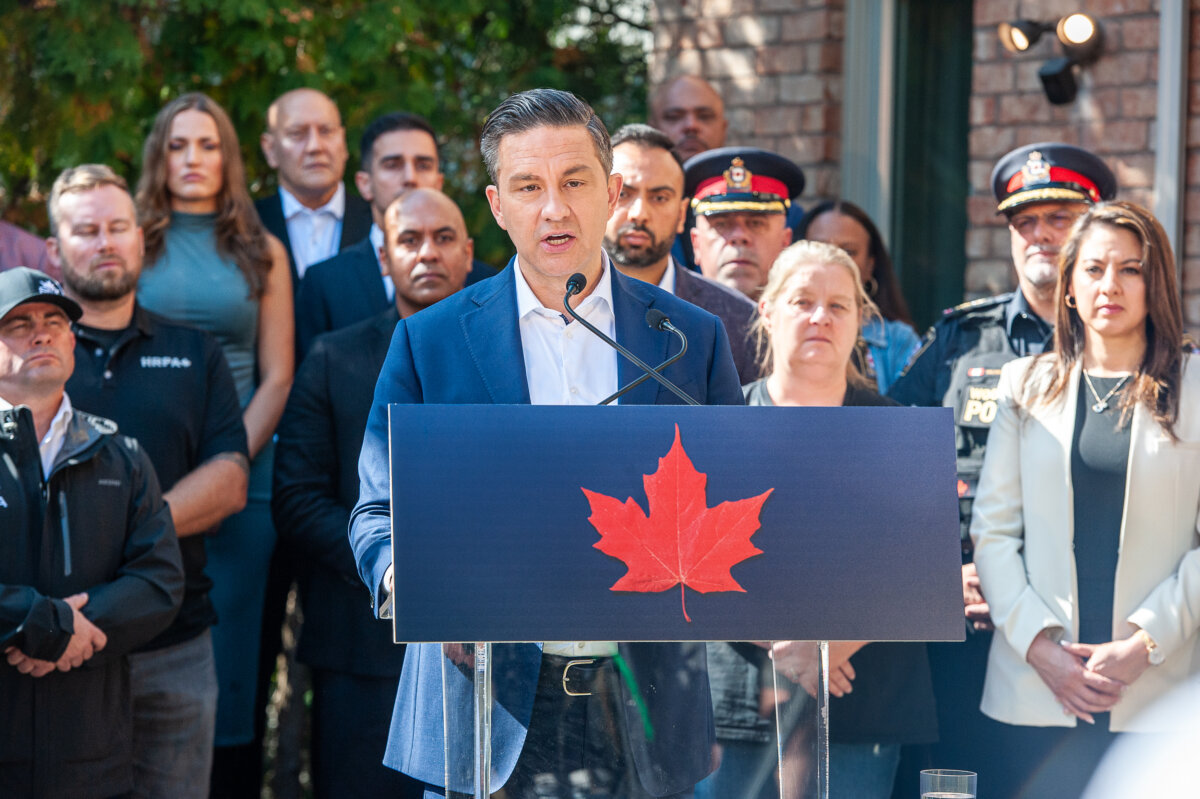

Conservative Leader Pierre Poilievre says his party will introduce the “Jail Not Bail Act” to make it more difficult for those accused of serious crimes to receive bail.
The legislation would modify Canada’s justice system by eliminating the requirement for judges to release individuals accused of crimes at the “earliest reasonable opportunity and on the least onerous conditions possible,” a stipulation that was established under Liberal Bill C-75, Poilievre said during a Sept. 11 press conference in Woodbridge, Ont.
The Tory leader said the bill would also introduce a new major offences category that requires those accused of charges like sexual assault, kidnapping, human trafficking, home invasion, robbery, arson, and firearms crimes to “prove that it is safe to release them on bail.”
Poilievre said judges will be required to consider the full criminal history of the accused before granting them bail, including by examining whether an offender is likely to re-offend after being released. Those who have been convicted of a major offence in the last 10 years would not be eligible for bail.
Additionally, those with an indictable offence will be unable to act as a guarantor for another accused person.
Poilievre referenced data from Statistics Canada indicating that firearms-related violent crime has increased by 55 percent, sexual assaults have risen by 76 percent, and extortion cases have surged 330 percent across the country. He attributed the rise in crime to the Liberal government’s “catch and release system.”
Conservatives have criticized Bill C-75, which directed judges in adjudicating bail to primarily focus on releasing the accused as quickly as possible. Bill C-5 has also been criticized by the Tories for getting rid of mandatory minimum sentences for serious crimes, instead allowing for parole or house arrest.
Canada’s bail laws have attracted national attention in recent months, following incidents where individuals on bail for prior offences were accused of committing new crimes. These included a man accused of stabbing several people on a Manitoba First Nation after being out on bail for assault with a weapon and mischief, and a man who was charged in connection with the sexual assault of a three-year old child in Ontario after being let out on bail for a previous sexual assault conviction.
“This is sick. As a father, I am sickened by these stories and the unnecessary nature of them,” Poilievre said. “All of these crimes were avoidable if the criminals had been kept where they belong—in jail—and not released.”
The killing of Ontario Provincial Police (OPP) Const. Grzegorz Pierzchala by a suspect out on bail prompted provincial and territorial premiers to send a letter in January 2023 to then-Prime Minister Justin Trudeau requesting bail reform. The Ontario Association of Chiefs of Police had also called for new reverse onus provisions in the Criminal Code for some offences, meaning it would become the accused’s responsibility to demonstrate why they should not be detained.
Bill C-48 was enacted into law in December 2023. It created a reverse onus provision for individuals charged with a serious violent offence involving a weapon, provided they have been convicted of a similar offence within the past five years.
Justice Minister Sean Fraser recently said the Liberal government intends to introduce legislation this fall to reform Canada’s criminal justice system. He said there will be amendments to the Criminal Code imposing stricter bail conditions and sentencing, particularly for offences related to organized crime, car theft, home invasion, and human trafficking.
“We will be strengthening the system and cracking down on violent crime with new legislation this Fall,” Fraser said in a social media post on Sept. 5.
In June, Liberal MP and Fraser’s parliamentary secretary Patricia Lattanzio said in the House of Commons that Canadians “deserve to feel safe in their own communities,” and that Ottawa would “move aggressively to protect victims.”
 Friends Read Free
Copy
Facebook
Tweet
Friends Read Free
Copy
Facebook
Tweet