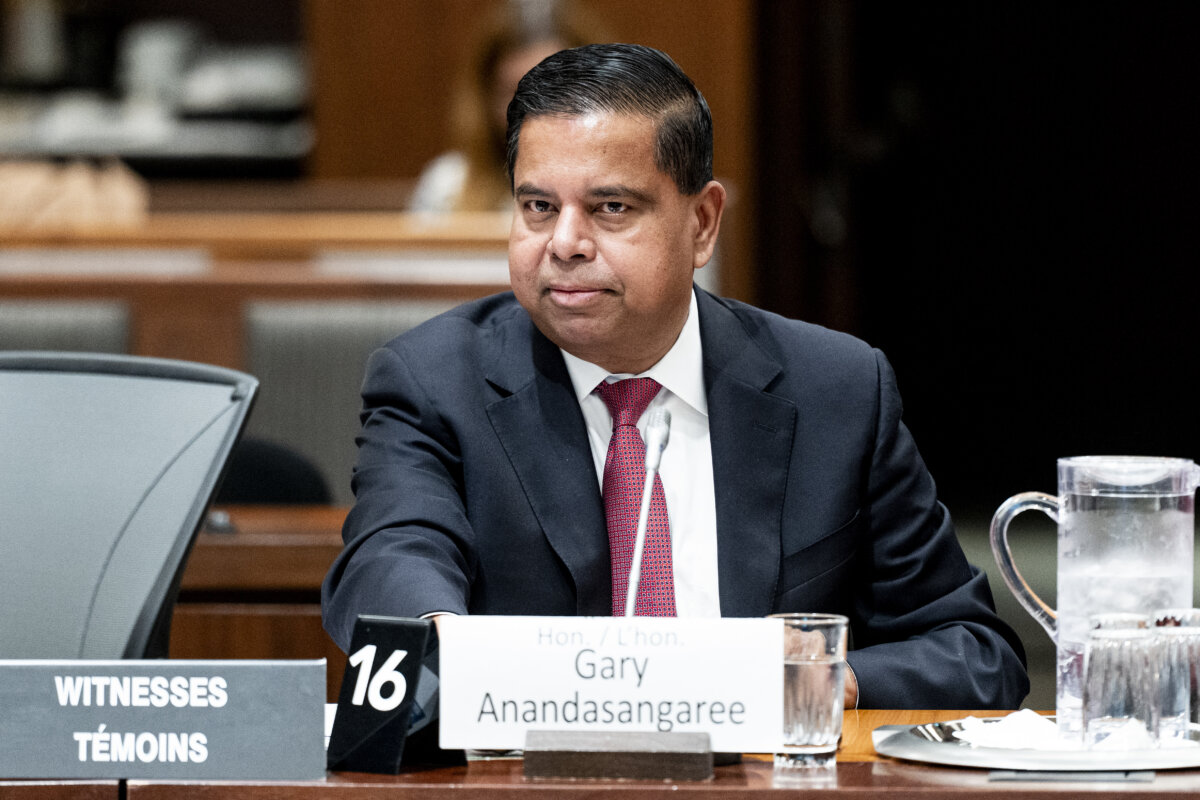

Public Safety Minister Gary Anandasangaree says no federal security review was done on last year’s BC Ferries procurement deal in which a Chinese shipyard was chosen for a contract to build four new vessels for its aging fleet.
Anandasangaree made the comments Feb. 25 in testimony before the House transport committee, saying the purchase was a provincial decision and the provision of $1 billion from the Canadian Infrastructure Bank (CIB) also fell outside Public Safety’s review authority.
“[Public Safety] does not review procurement decisions at the provincial level such as this one. Therefore, we would not have had the authority to conduct a national security review,” Anandasangaree told MPs.
Anandasangaree made the comments in response to questions from Conservative MP Dan Albas, who cited past Transport Canada warnings about the potential risk of surveillance technology being embedded into foreign-built vessels.
Anandasangaree said federal security officials only began engaging BC Ferries after Transport Canada raised the issue of potential national security sensitivities in late April or early May 2025. However, Anandasangaree said by that time “BC Ferries had already made their procurement decision.”
Albas expressed concern that no security review was done before the procurement decision was made.
“The fact that no security review has been done is unfathomable to me,” Albas said. “Transport Canada states plainly that Canada does not have comprehensive legislation to manage the risks identified on this file.”
Anandasangaree repeatedly said in the hearing that Ottawa lacked authority to review or control the deal, which was up to the province.
“So, the B.C. government has the right to put our national security and the Canadians’ own national security at risk,” Albas said. “Is that what you’re saying?”
Contract
BC Ferries decided last spring to order four new major vessels to modernize its aging fleet and, in March 2025, was approved for a $1 billion loan by the CIB, a federal Crown corporation, to support their construction.
In August, CIB CEO Ehren Cory told MPs that when the CIB approved the loan, BC Ferries had not yet made its decision on who it would contract for the construction of the new vessels.
By mid-April 2025, BC Ferries CEO said procurement was “coming to a close.” The procurement decision to contract a Chinese state-owned shipyard for the construction of the new vessels became public on June 10, 2025.
During the Feb. 25 hearing, Liberal MP Will Greaves emphasized the urgent need for the fleet for the transport needs of B.C.’s coastal communities. He said the aging vessels are “creating real challenges and also is a drag on our economic productivity,” and said the new ships “can’t come quickly enough.”
In the Feb. 25 hearing, MPs asked Anandasangaree as well as Public Safety’s senior assistant deputy minister Richard Bilodeau and Canadian Security and Intelligence Service (CSIS) deputy director Vanessa Lloyd about the national security risks of having the new vessels built in China, and asked for clarity on whether current federal safeguards are sufficient.
In framing concerns over surveillance or spy technology or capabilities in the vessels being constructed for BC Ferries, Albas asked if China is a strategic ally or “the most sophisticated and active state cyber security threat to Canada today,” saying “it cannot be both.”
Anandasangaree said that Canada is working to “expand trade relations, including with China” and said Ottawa is able to boost economic ties while also being vigilant on security.
Anandasangaree declined to answer when Conservative MP Aaron Gunn asked if he believes Chinese leader Xi Jinping is a “dictator,” saying he’s not there to “put tags” on world leaders.
While Anandasangaree acknowledged “documented evidence” of Chinese cyberattacks and meddling in Canadian affairs and said he would “absolutely” prefer that the vessels have been built in Canada, he repeatedly emphasized that Ottawa doesn’t have a role in telling provinces where to award contracts.
National Security
Lloyd said that based on her current understanding, the vessels do not raise specific national security concerns.
“These ferries are not connected vehicles. So some of the concerns the committee might have with respect to data sovereignty or other concerns around EVs, to my current understanding, don’t apply in this case,” Lloyd said, though she added she had not “reviewed the procurement” and was not “in a position to understand the technologies that will be on the actual vessels.”
She said CSIS continues to monitor security threats and is available for assistance to B.C. if concerns come up regarding the vessels.
Bilodeau said legislation has been tabled in Parliament to enhance protections on critical infrastructure that could ensure safety of the vessels as well, an apparent reference to Bill C-8, also known as the Cyber Security Act. The bill aims to protect Canada’s critical infrastructure in finance, telecommunications, energy, and transportation by strengthening cybersecurity requirements.
“There is legislation before Parliament on protecting critical infrastructure in federally regulated infrastructure, for example, in transport, that would require those operators to have certain protections in place,” he said. “That’s a piece of legislation that would help in supporting the protection from a cyber perspective.”
 Friends Read Free
Copy
Facebook
Tweet
Friends Read Free
Copy
Facebook
Tweet