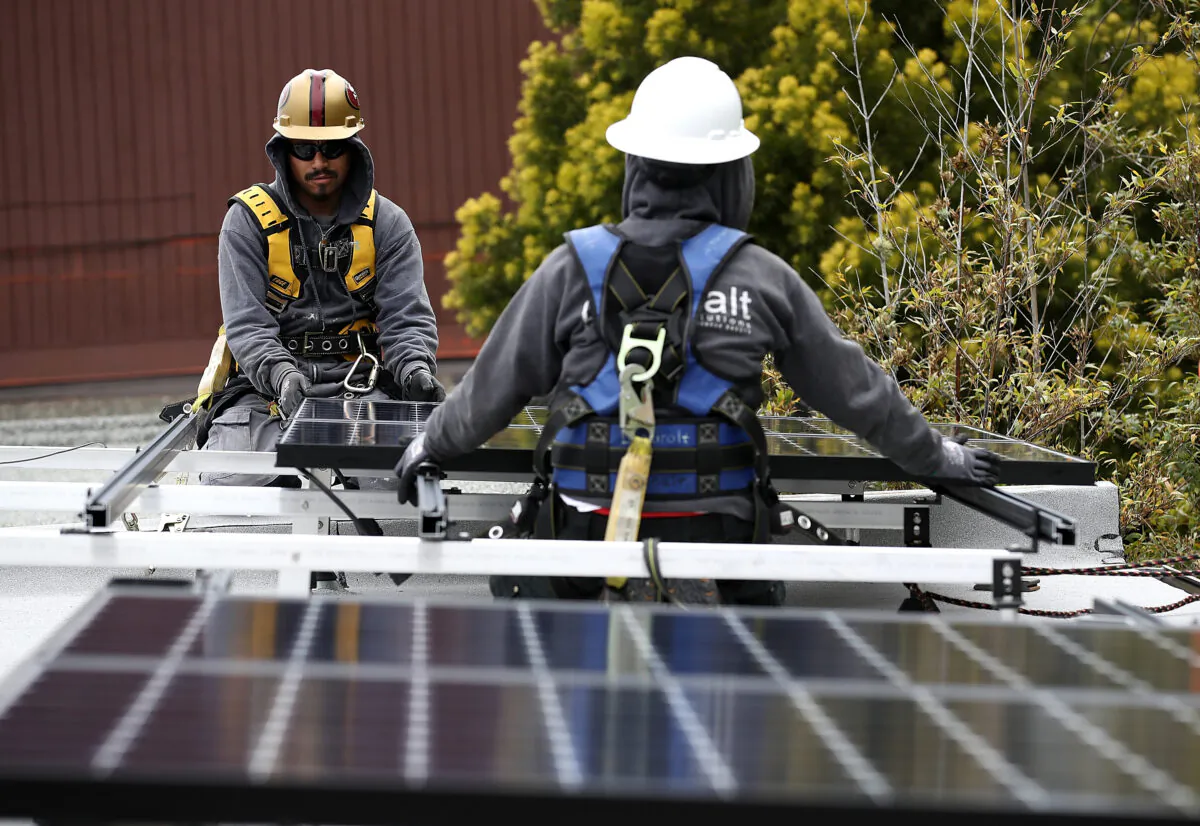
Installing rooftop solar panels has a “limited” economic case in most of Canada because it can take decades for homeowners to recoup their upfront costs, according to an internal government memo.
“At present, the economic case for widespread residential rooftop solar PV [photovoltaic] installations in most jurisdictions across Canada is limited compared to other international jurisdictions,” says the May 20 internal report from the Department of Natural Resources prepared for Minister Tim Hodgson.
The memorandum, which was first obtained by Blacklock’s Reporter, provided analysis and background on residential solar panel installations connected to the continental grid and their economic viability in Canada. The federal government released the document through an access to information request.
Natural Resources Canada’s analysis found that the “modeled payback period” for rooftop solar systems is between 10 and 30 years, depending on the jurisdiction and additional financial supports.
“The business case for rooftop solar in Canada is less competitive compared to leading jurisdictions such as Australia, primarily due to Canada’s relatively low electricity rates and comparatively high labour costs for installation,” the document says.
“Other factors, such as interest rates for financing system installations, also contribute.”
Installing the systems includes a “significant upfront cost” that homeowners slowly recoup through reduced electricity bills and/or financial compensation from utilities, the report noted.
That means the number of Canadians who can pursue the projects is limited to those with enough financial security to absorb upfront costs—usually in the thousands of dollars—and “manage associated debt servicing costs, which can range from $10,000 to $45,000,” the report said.
“This was partly why solar PV eligibility under the Greener Homes Program saw strong uptake,” the memo noted.
The Greener Homes Program supported the installation of 38,500 residential solar PV systems, with Alberta accounting for 46 percent, followed by British Columbia at 17 percent, and Nova Scotia and Ontario at 11 percent each.
“Most homeowners who installed PV systems received the maximum $5,000 grant available under the program and often spent between five and ten times that amount on the overall system,” the memo says.
Some provinces and municipalities offer other financial support mechanisms, including grants and interest-free loans for residential, business, and industrial solar installations. The rebates typically range from $1,000 per installed kilowatt to $10,000 for combined solar and battery-storage systems, or $5,000 for solar-only systems.
“Payback period analysis for homeowners is only one factor to consider when determining overall benefits,” the memo added.
Governments and utilities that encourage residential solar installations can also consider benefits to the electricity grid, including “avoided costs associated with reducing the need for large-scale electricity infrastructure, as well as broader electricity system benefits.”
“However, this valuation is highly context-specific and difficult to extrapolate,” the document says.
Natural Resources Canada said unlocking these benefits for households and the electricity grid would require provinces to continue pursuing “regulatory innovation” to properly value system benefits and improve the economics of residential solar and storage projects.
The economic case for residential solar could also improve when systems are paired with batteries, allowing households to store electricity, use it during peak pricing periods, or sell it back to the grid.
“This can further reduce electricity bills by lowering reliance on grid electricity during peak pricing periods or by enabling power to be sold back to the grid when it is most profitable,” the memo says.
The department also noted that some homeowners and renters internationally are installing “balcony” solar systems that can be placed outdoors and plugged into wall sockets.
“Initial analysis suggests these systems may have shorter payback periods because they eliminate high installation costs,” the document says.
However, the report noted such systems would require Canada to establish appropriate product standards, certifications, fire safety regulations, and “utility interconnection standards” to address safety risks, two-way power flow, and grid stability.
 Friends Read Free
Copy
Facebook
Tweet
Friends Read Free
Copy
Facebook
Tweet