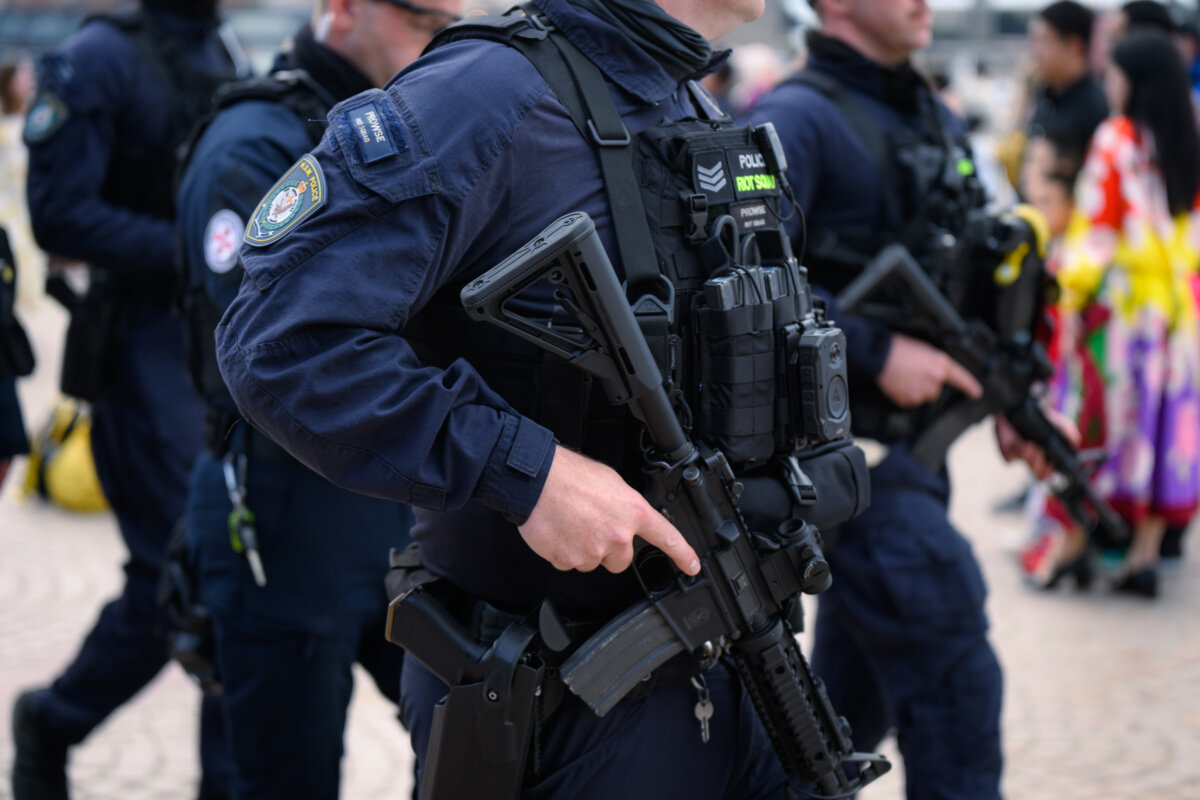

Routine arming of police officers in Australia has not led to a spike in officer-involved shootings, according to a new Monash University study that challenges a long-standing assumption about firearms and police violence.
The study, which examined 50 years of data and 581 shooting incidents, found that the introduction of routine firearm carriage in New South Wales in 1991 and Victoria in 1993 was not followed by a spike in shootings. In fact, shooting rates declined over time, although researchers caution the policy was not the cause of that trend.
Researchers say the findings suggest that training, operational practice, and police culture are more important than firearm availability alone in shaping outcomes.
The research challenges the commonly held view that increasing the number of firearms carried by police inevitably leads to more fatal force.
Because there is no official national database for non-fatal shootings, researchers tracked incidents by cross-checking decades of news archives with official coronial and police reports.
The study covers officer-involved shooting (OIS) incidents between 1970 and 2020, spanning both fatal and non-fatal cases.
While most countries regularly arm their police, others, including England, New Zealand, Norway, and Scotland, continue to debate the issue. The researchers said this is because of concerns that giving weapons to police could harm their rapport with the public or result in a more authoritarian approach to law enforcement.
Lead researcher Ross Hendy, from Monash University’s School of Social Sciences, said the data showed no increase in shootings following the shift to routine arming.
“The data shows that the transition to routine arming, moving from a system where officers chose when to carry a gun to a requirement that they wear one at all times on duty, was not followed by an increase in shootings,” he said.
“In fact, after these policy changes in the early 1990s, we actually saw a downward trend in shooting rates.”
The paper concludes that organisational, tactical, and cultural factors, rather than firearm availability alone, shape officer-involved shooting outcomes.
“Our research suggests that arming police can be done safely if the right conditions are in place,” said co-author Zarina Vakhitova, a senior lecturer in criminology at Monash University.
“When you combine arming with better tactical training and de-escalation protocols, it acts as a critical safeguard.”
The researchers say routine arming should be viewed not simply as an equipment change, but as a broader policy shift involving training, culture, and accountability.
Hendy pointed out that international jurisdictions considering routine arming could learn from Australia’s experience.
“This isn’t about whether a police officer carries a gun; it’s about the training, culture and accountability structures that surround that officer,” Hendy said.
“When you invest in de-escalation and professional standards, the availability of a firearm does not automatically lead to its use. It is a structural and cultural issue as much as it is a policy one.”
The Monash study also draws on international comparisons and related research, including analysis of data from 2015 to 2022.
That research revealed three factors associated with fatal outcomes in police shootings: the number of officers involved in the event (the more officers present, the greater the likelihood of a fatal outcome), the length of service of the officers (the more experienced the officer, the greater the probability of a fatal outcome), and the age of the person shot.
 Friends Read Free
Copy
Facebook
Tweet
Friends Read Free
Copy
Facebook
Tweet