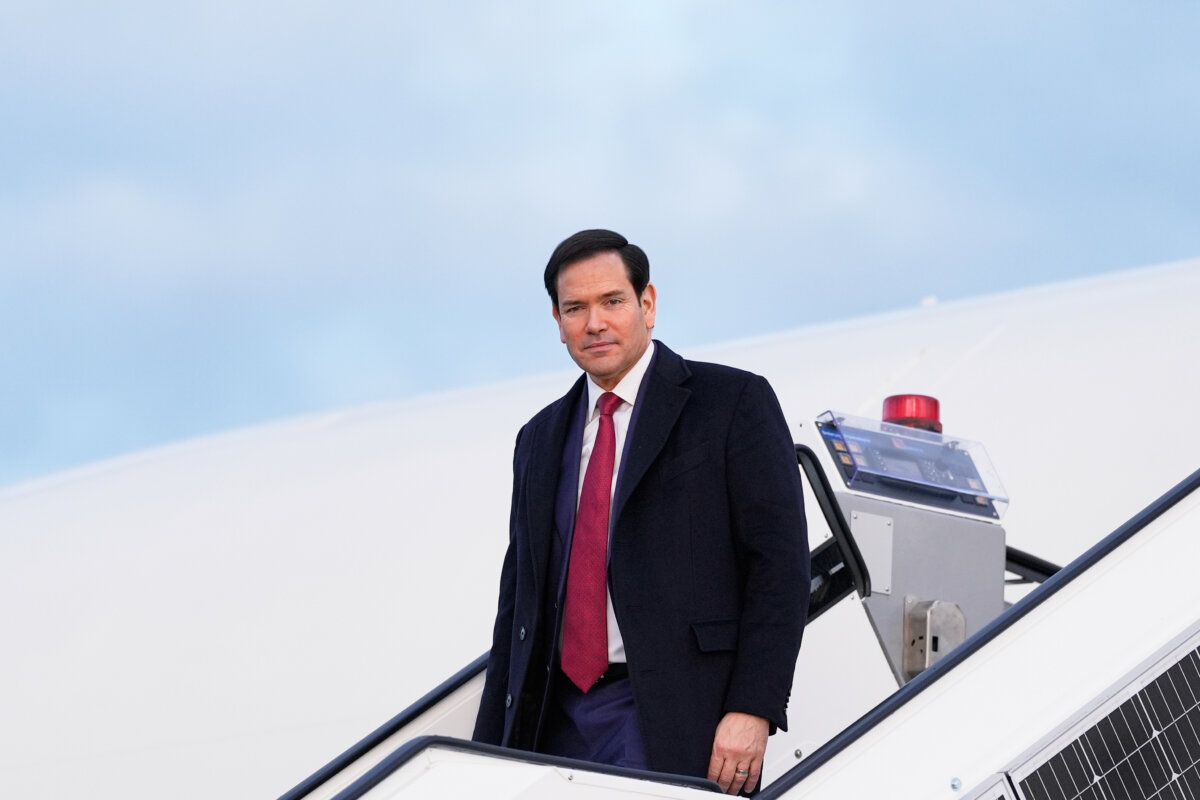
Secretary of State Marco Rubio has arrived in Germany for the Munich Security Conference after telling reporters on the evening of Feb. 12, “The old world is gone.”
“The world is changing very fast right in front of us,” Rubio said before he boarded his plane for Germany, in a video posted on X.
“The old world is gone, the world I grew up in. We live in a new era in geopolitics, and it’s going to require all of us to sort of re-examine what that looks like and what our role is going to be.”
In February 2025, Vice President JD Vance, in his speech to the same conference, criticized European countries for clamping down on free speech and allowing mass migration. He said the biggest threat to Europe was “the threat from within, the retreat of Europe from some of its most fundamental values, values shared with the United States of America.”
Before boarding his flight on Thursday, Rubio said, “Most people in this country can trace both, either their cultural or their personal heritage, back to Europe, so we’re deeply tied to Europe and our future.”
German Minister Speaks of ‘Alienation’
German Foreign Minister Johann Wadephul said on Friday that some NATO members resented recent comments made by U.S. representatives.
“This alliance is also under pressure,” Wadephil told German broadcaster ARD’s Tagesschau program.
“There is alienation, there is irritation about some of the things we hear from Washington. We need to talk about this here together. We want to define our common denominators and the meaning of NATO.”
Wolfgang Ischinger, the chairman of the Munich Security Conference, said: “Transatlantic relations have been the backbone of this conference since it was founded in 1963. Transatlantic relations are currently in a significant crisis of confidence and credibility.”
Rubio is also due to meet Chinese Foreign Minister Wang Yi on the sidelines of the conference.
German Chancellor Friedrich Merz will speak at the conference on Friday afternoon, followed by a debate on the international order featuring Mike Waltz, the U.S. ambassador to the United Nations; the EU’s foreign representative, Kaja Kallas; and Saudi Arabian Foreign Minister Prince Faisal bin Farhan al-Saud.
Rubio said he planned to meet Ukrainian President Volodymyr Zelenskyy during his two-day trip, which will also include visits to Slovakia and Hungary.
When asked about the Russian bombardment of Ukrainian cities this week, Rubio said: “It’s terrible. It’s a war. … That’s why wars are bad, and that’s why we have worked so hard for over a year now to try to bring this one to an end.”
Relations between the United States and other NATO members were strained during the recent showdown over Greenland, which ended on Jan. 21 with President Donald Trump agreeing on a framework for a deal with the alliance to improve security in the Arctic Circle.
On Thursday, U.S. Under Secretary of War Eldridge Colby delivered a speech at the NATO defense ministers’ meeting in Brussels, saying, “The world that shaped the habits, assumptions, and force posture of NATO during the so-called ‘unipolar moment’ following the Cold War no longer exists.”
“Power politics has returned, and military force is again being employed at a large scale,” said Colby, who was deputizing for Secretary of War Pete Hegseth.
“Under President Trump’s leadership, we are reprioritizing the defense of our homeland and the protection of our interests in our Hemisphere.
“We are grappling forthrightly with the fact that the Indo-Pacific is now a central arena of geopolitics.”
He said it was now up to European countries to “field the preponderance of the forces required to deter and, if necessary, defeat conventional aggression in Europe.”
The Associated Press and Reuters contributed to this report.
 Friends Read Free
Copy
Facebook
Tweet
Friends Read Free
Copy
Facebook
Tweet