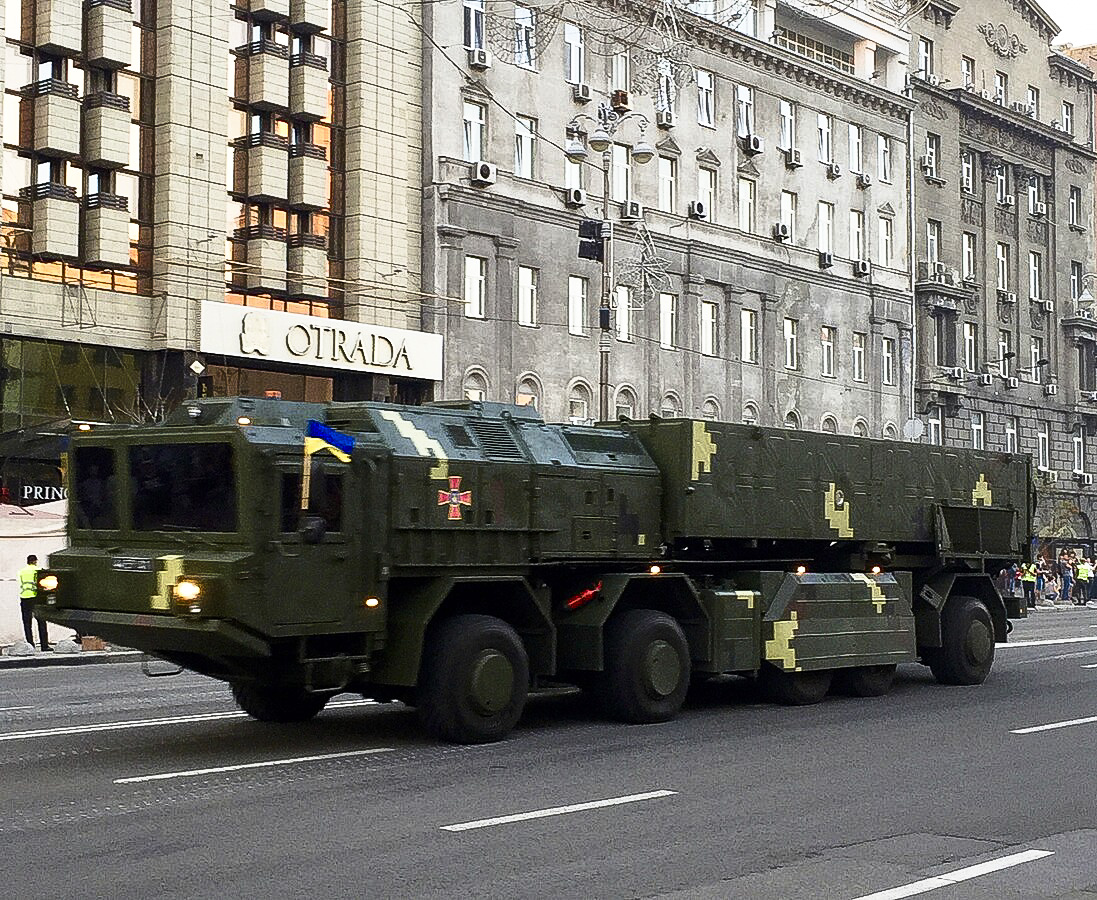

Russian forces have struck a storage site in Ukraine allegedly housing domestically produced Sapsan ballistic missiles, Moscow’s defense ministry claimed on Aug. 17.
“Operational-tactical aviation, attack drones, missile troops, and artillery … have inflicted damage on a storage area [for] Sapsan operational-tactical missiles and their components,” it said in a statement posted on its Telegram channel.
The ministry did not provide the location of the missile storage site it claims to have targeted.
Also known as the Hrim-2, the Sapsan is a Ukrainian-produced short-range ballistic missile system.
In mid-June, The Kyiv Independent reported that the Sapsan missile system was entering the mass-production phase as part of Ukraine’s effort to “domestically produce the weapons it needs to fight Russia’s full-scale invasion.”
The report states that the Sapsan missile system had already been successfully tested in combat and was “in the process of serial production.”
However, it was unclear when the system would be deployed for use on the battlefield, the news outlet stated.
4 Sites Hit Last Week, Moscow Claims
Last week, Russia’s Federal Security Service (FSB) claimed that four Sapsan missile production sites had been destroyed in a joint operation carried out in conjunction with Russia’s defense ministry.
Two of the targeted sites were located in Ukraine’s Dnipropetrovsk region and two were located in the Sumy region, the FSB said, according to Russia’s state-run TASS news agency.
The FSB went on to claim that the strikes had delivered a “colossal” blow to Ukraine’s military-industrial complex.
On Aug. 14, TASS quoted an FSB official as saying that Ukraine’s Sapsan missile system was capable of “striking deep” inside Russian territory.
On its Telegram channel, TASS published a map purporting to show areas that Sapsan missiles would be able to reach if launched successfully.
According to the map, most of western and central Russia—including Moscow—would have come within range, along with most of neighboring Belarus, a key Russian ally.
The FSB official cited by TASS also claimed that Ukraine’s Sapsan missile system was being developed with German financial support and with “the assistance of foreign specialists.”
Germany has yet to issue a statement in response to the FSB’s claims.
In June, Berlin ruled out the delivery of long-range Taurus missiles to Ukraine despite Kyiv’s repeated requests for the German-made weapons, which can strike targets more than 300 miles away.
A week later, Russian President Vladimir Putin warned that Moscow would regard Berlin as a direct participant in the war if it supplied Ukraine with Taurus missiles.
“What is this if not the involvement of the Federal Republic [of Germany] in a direct armed conflict with the Russian Federation?” Putin said at the time.
The FSB has also claimed to have intercepted Ukrainian communications suggesting that Kyiv had initially planned to produce 200 Sapsan missiles per month, according to TASS.
The Russian security agency said intercepted communications further suggested that foreign officials—it did not say from which country—were planning to visit the missile production sites before they were allegedly struck.
The Epoch Times could not independently verify any of the Russian claims.
On Aug. 14, the Interfax-Ukraine news agency reported that Kyiv’s Center for Countering Disinformation had denied Moscow’s claims regarding the alleged destruction of four Sapsan missile production sites.
“The FSB is spreading [false] information about the alleged destruction [of Sapsan missile production sites] … with which Ukraine allegedly planned to strike Moscow, [Belarusian capital] Minsk, and strategic objects deep inside the Russian Federation,” the anti-disinformation agency stated.
Reuters contributed to this report.
 Friends Read Free
Copy
Facebook
Tweet
Friends Read Free
Copy
Facebook
Tweet