
Russia has launched air strikes against gas stations and industrial areas in Kyiv as part of its wider strategy to target Ukraine’s infrastructure, prompting NATO to scramble fighter jets in Polish and Romanian airspace.
Ukrainian President Volodymyr Zelenskyy said in a Sept. 23 post on X that Russian forces had launched drone attacks against the capital that morning, with a significant number of the unmanned aerial vehicles (UAVs) being jet-powered.
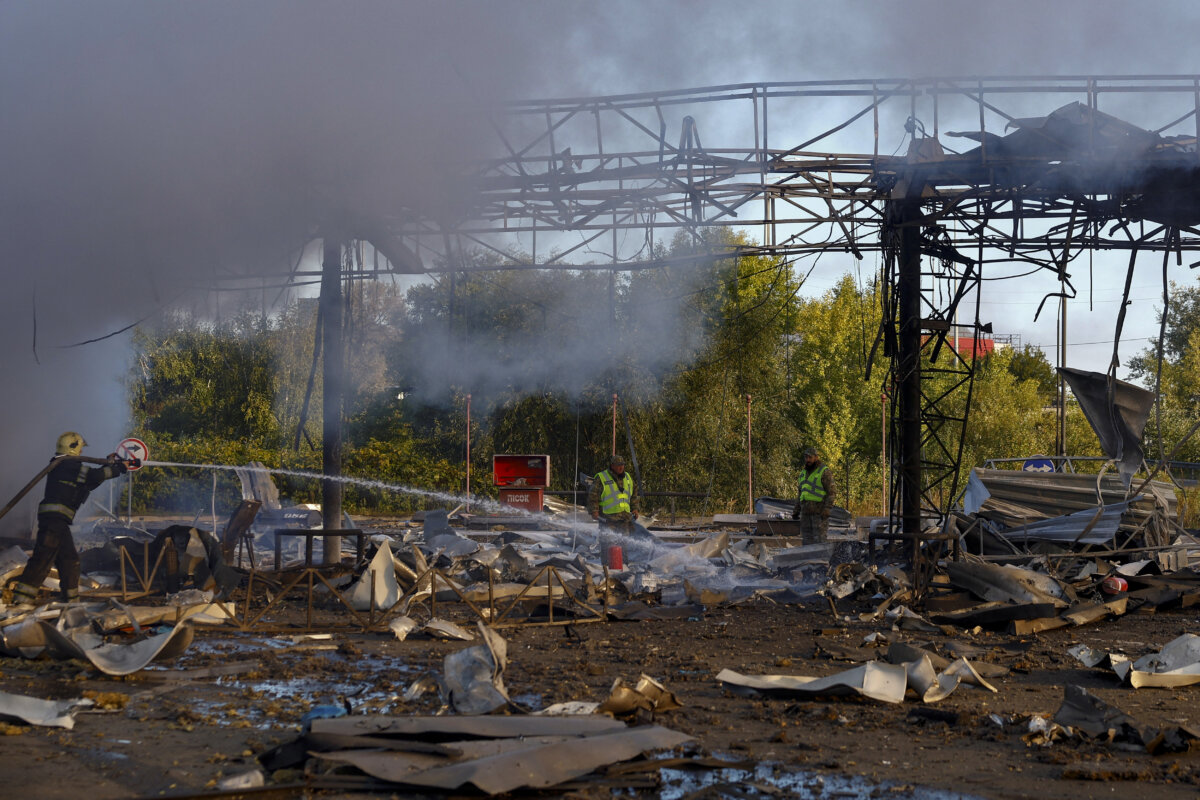
“Russia continues to turn civilian and critical infrastructure into targets: pharmaceutical facilities, gas stations, railways, communications infrastructure, and shopping malls,” Zelenskyy said, adding that at that time, two people had been reported killed and another 24 wounded.
The attacks mostly targeted the area near the main railway station, which railway operator Ukrzaliznytsia said had not been damaged.
Ukrainian oil company Ukrnafta said one of its gas stations in the capital was hit in the sixth attack on its infrastructure in the past few weeks. The company said in a statement there were no casualties or injuries, with staff having been in a shelter at the time.
In total, Ukrainian authorities said that two gas stations in Kyiv were targeted.
Kyiv Mayor Vitali Klitschko said a UAV had hit a business center, warehouses, and a nine-story non-residential building.
NATO Jets Scrambled
Meanwhile, NATO fighter jets were deployed in Polish and Romanian airspace overnight and into the morning on Wednesday, as a result of the bombardment in Ukraine. Poland and Romania are on NATO’s eastern flank, and both share borders with Ukraine.
Poland’s Operational Command of the Armed Forces said in a post on X that Polish fighter craft were scrambled “to ensure safety during Russian Federation strikes using jet-powered unmanned aerial vehicles on targets in western Ukraine.” They added that air defense was returned to normal and no violations of the airspace had been observed.
The Polish Army “continuously monitors the situation on Ukrainian territory and remains in constant readiness to ensure the safety of Polish airspace,” the command said.
The Romanian National Ministry of Defense said in a post on X that late on Sept. 22, it had detected an aerial target near Valkove, Ukraine, near the Romanian border. As a result, the Romanian Air Force scrambled two F-16s to monitor the situation.
In a follow-up message, the Romanian ministry said it ended its air alert at 12:36 a.m. on Sept. 23, adding that no incursions into its airspace had been reported.
Trump–Zelenskyy Meeting
U.S. President Donald Trump met with Zelenskyy on the sidelines of the United Nations General Assembly on Sept. 22. Both leaders are pushing for the war to end before winter.
During the bilateral press conference, Trump said that Russian President Vladimir Putin was willing to discuss a peace deal, and that his administration was working very closely with Moscow and Kyiv to resolve the ongoing war, which is now in its fifth year.
After the meeting, Zelenskyy said that the discussion with Trump was both “positive” and “productive.”
“Both the U.S. and Ukraine want to see this senseless Russian war ended before winter. We discussed potential de-escalatory steps that can open up the way to diplomacy,” the Ukrainian leader wrote on X.
One issue in the negotiation process may be the current attacks on energy infrastructure. While both Moscow and Kyiv had initially signaled support for Trump’s call for a pause on targeting each other’s fuel assets, strikes have continued.
On Sept. 23, Russian Foreign Minister Sergey Lavrov said during a meeting of the U.N. Security Council that Moscow will not be suspending its military activities against Ukraine for any negotiations.
“Having learned from bitter experience, we will not pause the special military operation for the duration of negotiations in any format,” Lavrov said, using Moscow’s term to describe the ongoing invasion of eastern Ukraine.
“Although this is precisely what Europe wants, all with the same simple goal: to gain a respite and replenish the depleted military arsenals of the Kiev regime, which, out of desperation, has long since resorted to openly terrorist methods,” he said, according to Russian state-run news agency TASS.
Reuters contributed to this report.
 Friends Read Free
Copy
Facebook
Tweet
Friends Read Free
Copy
Facebook
Tweet