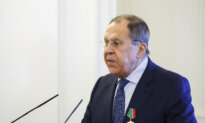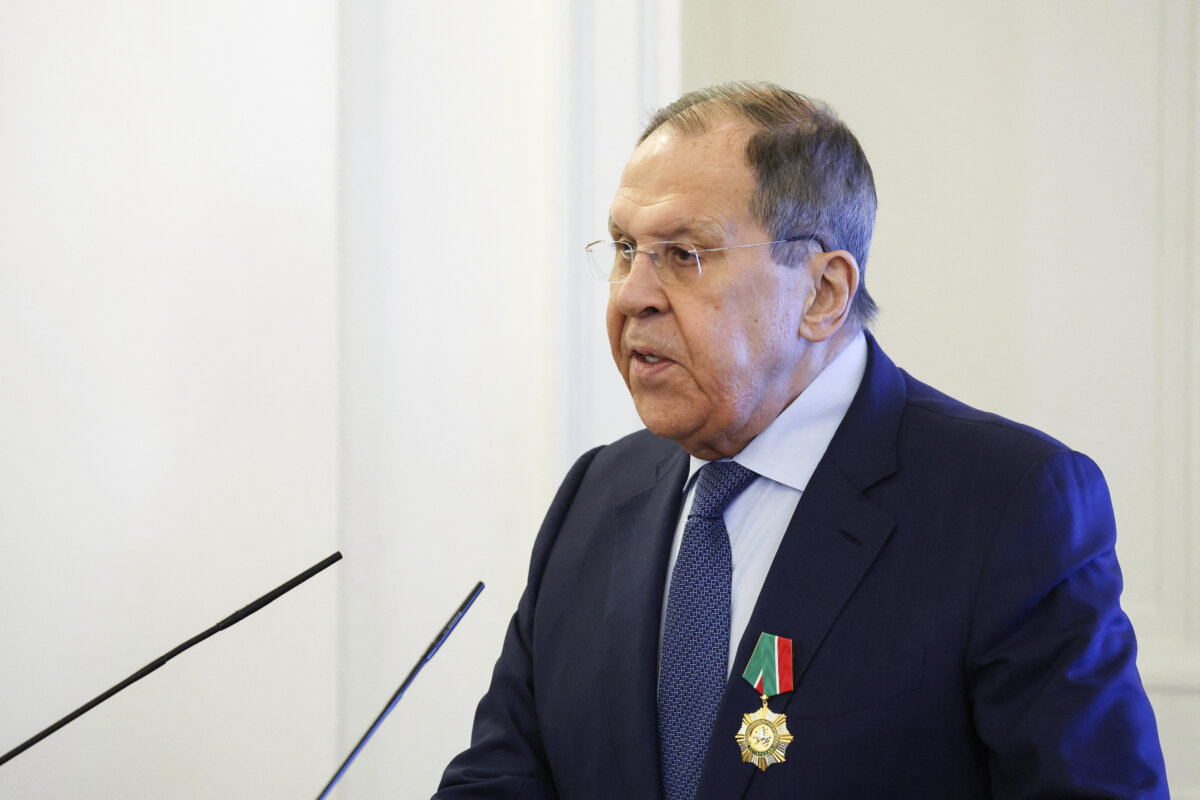

Moscow will close German cultural centers in Russia in response to Berlin’s decision to close similar Russian establishments in Germany, Russian Foreign Minister Sergey Lavrov said on Sept. 3.
Germany accused Russia on Sept. 1 of being behind an attempted attack on Leipzig/Halle Airport in August.
“The Germans have branches of the Goethe Institute here. In Moscow, St. Petersburg, Yekaterinburg. Well, of course, they’ll be closed after our cultural center was kicked out of there. Otherwise, we won’t respect ourselves,” Lavrov said while speaking at an event in Vladivostok, Russian state news agency TASS reported.
“They deliberately took a step—they couldn’t help but understand this—that signifies the end of their cultural presence in Russia, which remained despite all the Ukrainian twists and turns in our relations with the West.”
Named after the famed 18th-century writer and poet Johann Wolfgang von Goethe, the Goethe-Institut is a German nonprofit organization that promotes cultural exchange and has maintained a presence in Russia since 1992.
On Sept. 1, at a press conference at which Berlin officially laid the blame for the Leipzig incident at Moscow’s feet, German Foreign Minister Johann Wadephul announced that he had ordered the Russian Consulate General in Bonn to close as of Sept. 18 and that the lease for the Russian House in Berlin would be terminated.
The Russian House in Berlin is a Moscow-backed scientific and cultural center that has been in the city for more than 40 years.
Wadephul also confirmed that Germany would bolster its security and, in tandem with the European Union, push for further sanctions against Russia.
Lavrov was dismissive of Berlin’s allegations that Moscow was behind the Aug. 4 incident in Leipzig, saying the Germans “found a drone crashed at the airport in Leipzig, Germany, and decided that the drone was similar—they can’t confirm this, but this is a definitive conclusion—to those used by the Russian Federation.”
“Based on this assumption, this supposition, this conjecture, they decided to close the last remaining consulate general in Bonn and our Russian House in Berlin,” he said.
Leipzig/Halle Airport is a key cargo hub and military airport in the eastern German state of Saxony.
It is the main base for NATO’s Strategic Airlift International Solution. Among other functions, it delivers equipment to strengthen the defense pact’s eastern flank using a small fleet of Ukrainian-made Antonov cargo planes.
Lavrov’s comments build on earlier remarks from the Russian Embassy in Berlin and Russian President Vladimir Putin, who also denied the German government’s accusations.
The Russian Embassy in Berlin said in a Sept. 1 post on Telegram that the ambassador, who had been summoned by the German foreign ministry, “resolutely rejected Berlin’s accusations as unsubstantiated, absurd, and contrary to common sense.”
The post labeled the incident at the airport a “hastily concocted provocation” that “exclusively [supported] the goals of the Kyiv regime, the militaristic wing of the European political class, and the magnates of the military-industrial complex interested in fueling the Ukrainian conflict.”
Putin called Germany’s move a serious error, in comments to journalists on Sept. 1.
“The reasons for this behavior must be explained. Given the decline in ratings and the upcoming election campaigns, including in Saxony, for example, the question of the political future of Germany’s ruling elite naturally arises,” he said, according to TASS.
“I think this is primarily related to this. I think this is another mistake, a grave mistake. And it, in my view, clearly runs counter to the interests of the German people.”
European allies supported Germany after Berlin blamed Moscow for the drone incident; Russia’s ambassadors to the EU, the Netherlands, and Belgium all were summoned by their respective foreign ministers, while France summoned Moscow’s charge d’affaires in Paris.
In addition, on Sept. 2, both European Commission President Ursula von der Leyen and NATO Secretary-General Mark Rutte expressed their support for Germany.
Von der Leyen said that the EU “will not tolerate” such actions by Russia, vowing that Europe and NATO would “increase” pressure on Moscow.
Rutte said that Russia has grown “increasingly reckless” and that NATO stands in “full solidarity” with Germany.
 Friends Read Free
Copy
Facebook
Tweet
Friends Read Free
Copy
Facebook
Tweet