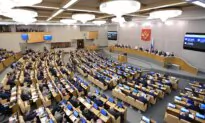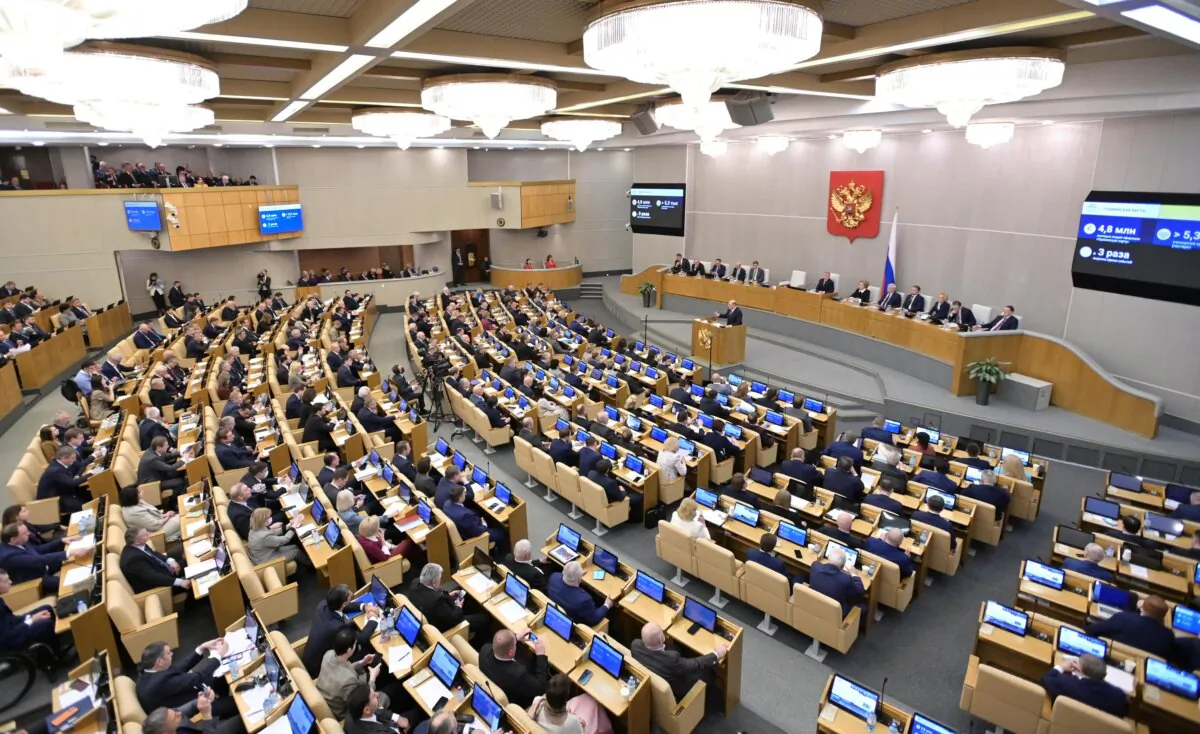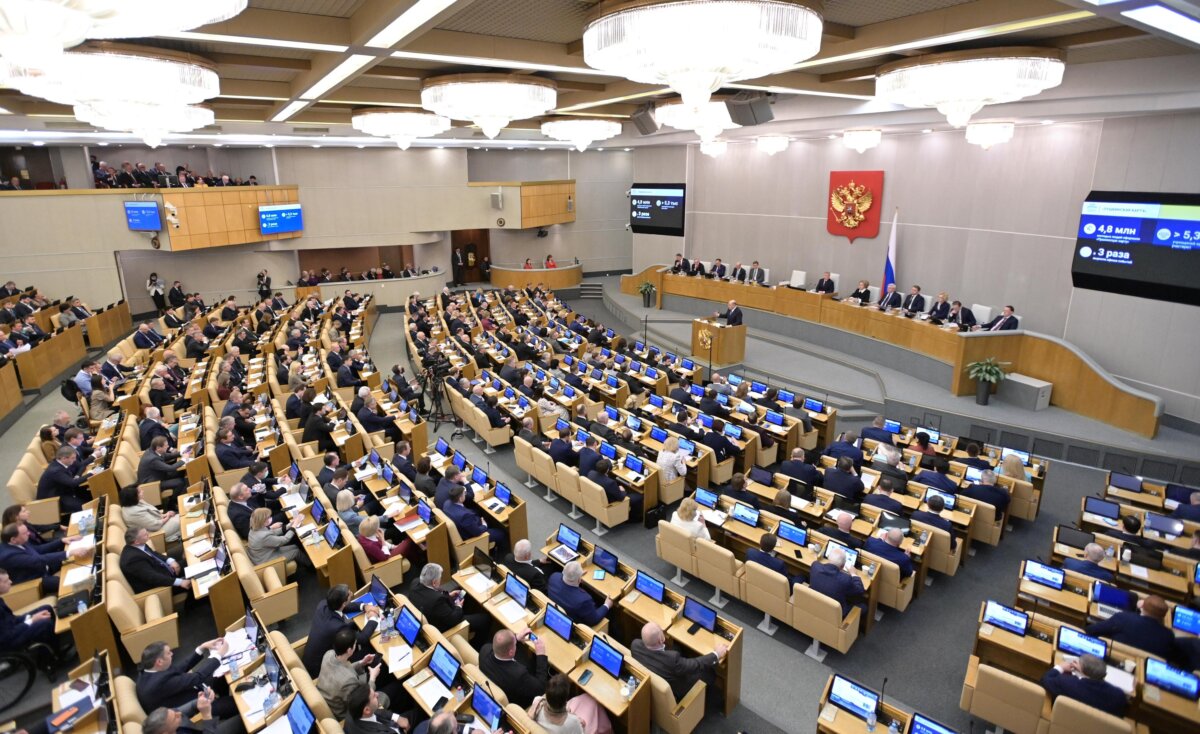

The Russian Duma passed a resolution on Nov. 20 calling for action against Belgium, Euroclear, and “unfriendly investors” should the European Union decide to use frozen Russian assets to fund a loan to Ukraine.
Belgium is home to Euroclear, a financial market infrastructure group that holds the majority of frozen Russian assets in the EU.
The lower house of Russia’s Parliament said that the EU proposal contravened the organization’s own laws, as “Article 17 of the Charter of Fundamental Rights of the European Union prohibits the deprivation of property except upon payment of fair compensation.”
As the EU has no plans to compensate those whose assets it intended to seize, the Duma said, the plan was “effectively an illegal seizure of property” and could be “regarded as outright theft.”
“Any attacks on Russian assets must be met with an appropriate legal response, beginning with claims for damages—with a demand for the seizure of assets as a security measure—against Euroclear and Belgium, where the bulk of the illegally frozen sovereign funds are held, in any jurisdiction,” the resolution reads.
“Assets of non-residents from unfriendly states may also be used as a source of compensation.”
The Duma passed the resolution unanimously and upped the ante on comments made last month by Deputy Finance Minister Alexey Moiseev.
Moiseev said Europe had so far avoided outright confiscation of the frozen assets and that Moscow would do likewise unless the situation changes.
“We are not confiscating anything yet,” he said. “The Europeans haven’t called for confiscation, so we won’t confiscate anything until they do. If they do end up confiscating, then we will consider it.”
Russian assets worth up to $250 billion have been frozen in the EU since the United States and its allies banned transactions with Moscow’s central bank and Ministry of Finance after Russia invaded Ukraine in February 2022.
Discussions within the EU are underway to find a way to use the frozen assets to further finance Kyiv’s defense and the country’s reconstruction without directly confiscating them, because of legal constraints.
Although many within the bloc have thrown support behind the idea, others, including Luxembourg, Belgium, and Hungary, as well as organizations such as the European Central Bank, have voiced concerns.
Last month, Belgian Prime Minister Bart De Wever said he would remain opposed to the loan until he secured three guarantees from the EU: full mutualization of risk; that every member state would help foot the bill if the money had to be repaid; and that every country that had immobilized Russian assets would move together.
Until now, the EU has taken only interest generated from the immobilized Russian assets.
The precise details of how the assets would be used have yet to be finalized, but German Chancellor Friedrich Merz set out his ideas for the plan in September. Merz suggested the EU give Ukraine an interest-free loan of almost 140 billion euros (approximately $160 billion).
“That loan would only be repaid once Russia has compensated Ukraine for the damage it has caused during this war. Until then, the Russian assets will remain frozen, as decided by the European Council,” he said.
He went on to say that the assistance “will require budgetary guarantees from member states” initially but that a collateralized EU guarantee should replace those bilateral guarantees once the bloc’s next Multiannual Financial Framework is in place in 2028.
European Commission President Ursula von der Leyen later said that the loan “would not be disbursed in one go, but in tranches, and with conditions attached,” adding that part of it would be earmarked to fund the EU’s defense industry.
In response to seizures of Russian assets, Moscow has seized assets worth about $50 billion since the start of the war in Ukraine, including the assets of Western companies leaving the country.
 Friends Read Free
Copy
Facebook
Tweet
Friends Read Free
Copy
Facebook
Tweet