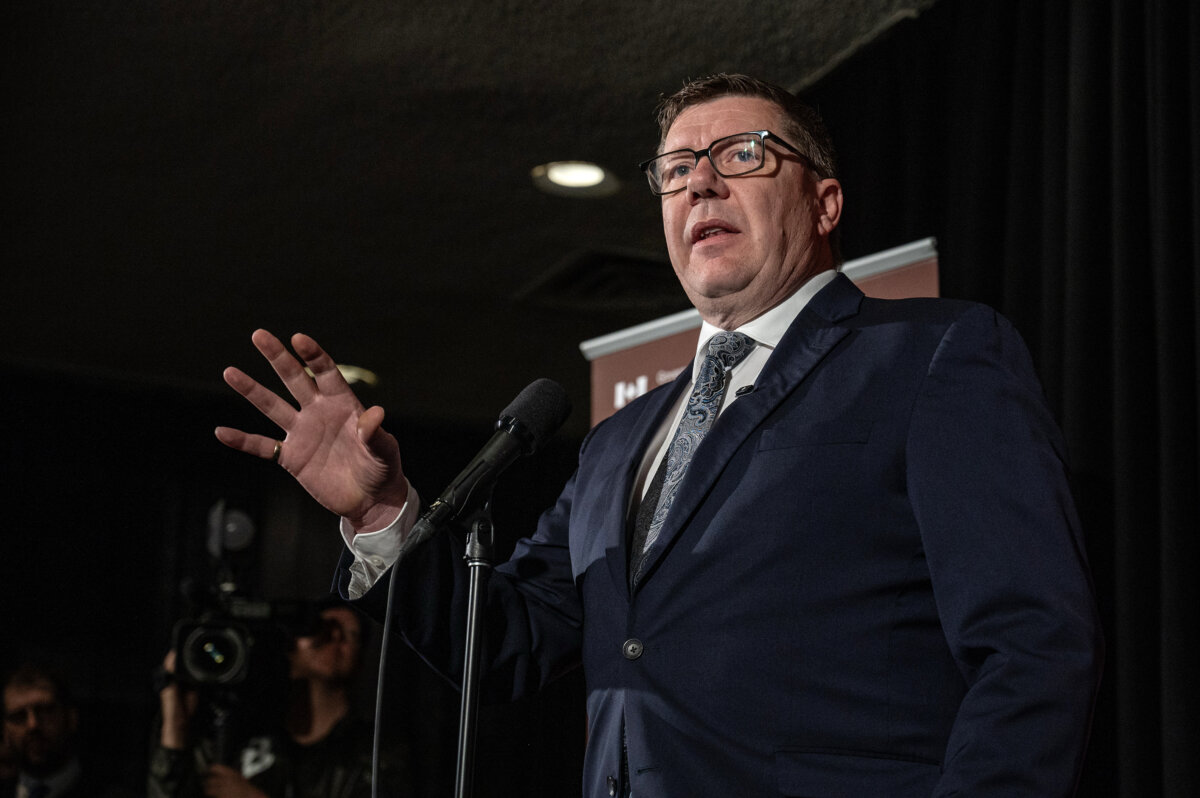

Saskatchewan’s premier and mayors are demanding stronger bail laws from Ottawa, saying repeat violent offenders are making their communities dangerous.
In addition to calling for bail reform at the July 9 press conference in North Battleford, Saskatchewan Premier Scott Moe said there needs to be stronger punishment for individuals trafficking meth and fentanyl in his province, especially those who are repeat offenders.
“We need to increase the consequences through the Criminal Code of Canada, but also through every opportunity that we have provincially,” Moe said.
North Battleford Mayor Kelli Hawtin echoed Moe’s comments, saying dangerous repeat criminals and drug traffickers in particular should be subject to stricter bail laws.
“We’re not asking for more people in prison. We’re asking for the right people to be in prison,” she said.
Saskatchewan’s health minister Jeremy Cockrill, who also serves as MLA for the Battlefords, said that repeat violent offenders who are getting out on bail are putting his community at risk and making residents feel unsafe.
Battleford Mayor Ames Leslie said “a few individuals” in the community that are repeat offenders have fuelled crime rates in the area and have given the town “a bad reputation,” echoing Cockrill’s calls for stricter bail conditions.
Hawtin, Cockrill and Leslie have sent a joint letter to federal Justice Minister Sean Fraser asking for changes to Canada’s Criminal Code in order to address crime in their communities.
A Statistics Canada report released last summer placed Saskatchewan at the top of Canada’s national crime severity index (CSI), a spot it has held for the past 25 years, with Saskatoon and Regina ranking eighth and ninth, respectively, among 41 major urban centres in Canada. The CSI measures the number of crimes reported by police per 100,000 people, combined with a scale of how severe the crimes were.
Conservative MP Larry Brock recently put forward a petition calling on Ottawa to bring back mandatory minimum sentencing and repeal legislation he characterized as “soft-on-crime,” such as Bill C-75, which enables easier bail access and less restrictive bail conditions.
Amid pressure to reform bail in 2023, the Liberal government under former Prime Minister Justin Trudeau introduced Bill C-48, which aimed to make it harder for repeat violent offenders and domestic abusers to get bail. The legislation went into effect in 2024, but was met with criticism from some provinces, including Ontario, who said the changes didn’t go far enough in curtailing violent repeat offenders.
According to Statistics Canada, violent crime in the country has risen 50 percent since 2015. Sexual assaults have jumped 74 percent, gun crimes are up 116 percent, and extortion cases have increased by 357 percent.
Last month Fraser said the federal government will table legislation to toughen sentencing and bail when Parliament resumes this fall. Fraser said it’s “obvious” that “reforms are in order” and that there are challenges with the bail system.
Fraser also criticized Conservative concerns about the bail system he says are based on “simplistic slogans,” saying the root causes of crime such as mental illness, addiction, unemployment, and difficulty in finding housing also need to be taken into account to prevent crime.
 Friends Read Free
Copy
Facebook
Tweet
Friends Read Free
Copy
Facebook
Tweet