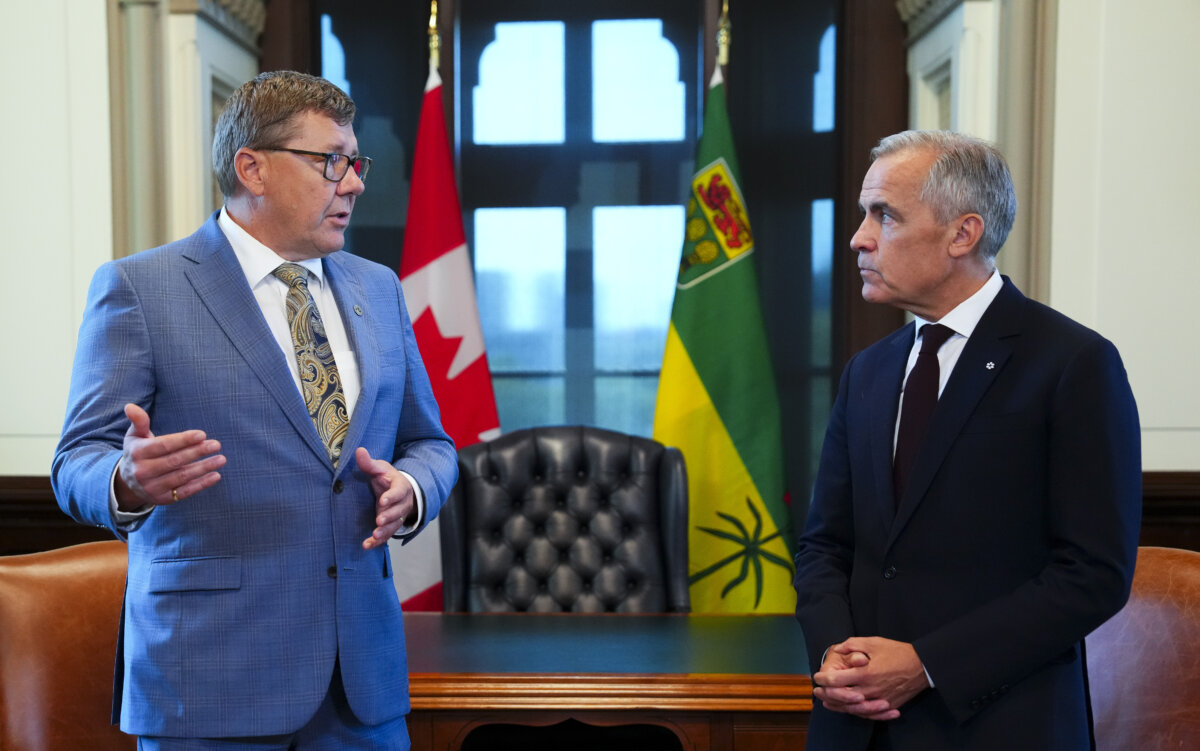

Saskatchewan Premier Scott Moe says he opposes Ottawa’s bid to limit provincial use of the notwithstanding clause, a section of the Canadian Charter of Rights and Freedoms that gives provinces the right to protect legislation from constitutional challenges under certain sections of the Charter for up to five years.
Moe’s comments came in response to a Sept. 18 announcement from Federal Justice Minister Sean Fraser that he filed a request with the Supreme Court to limit provincial use of the notwithstanding clause, saying that its use goes against Canada’s Constitution and is equivalent to “denying its very existence.”
“Saskatchewan will strongly oppose the federal government’s attempt to limit the provinces’ ability to use the notwithstanding clause,” Moe wrote in a Sept. 19 post on X. “This would mean a significant infringement on the autonomy of provinces and their elected legislatures. The common argument that using the notwithstanding clause is a violation of the Constitution is false.”
The notwithstanding clause is section 33 of the Canadian Charter of Rights and Freedoms, which itself is a part of the Constitution of Canada.
Moe wrote that he completely agrees with former Alberta Premier Peter Lougheed and former Saskatchewan Premier Allan Blakeney in their defences of the notwithstanding clause when the Constitution was patriated by former Prime Minister Pierre Trudeau in the 1980s. He noted that Lougheed and Blakeney said the clause ensures that in cases where compliance with a Charter right could produce undesirable outcomes for a province, elected governments, rather than courts, could prevail. Moe said he agrees with Blakeney’s description of this as an “elegant way” to manage conflicts between rights protected through legislative versus judicial action.
Alberta Premier Danielle Smith also stated opposition to Fraser’s move, writing on Sept. 18 that she is “extremely disappointed” in Ottawa’s attempt to limit usage of the clause and adding that “the notwithstanding clause is integral to the Canadian Charter of Rights and Freedoms and an unassailable provincial constitutional right.”
Defending his government’s move to seek limits to usage of the notwithstanding clause during question period in the House of Commons on Sept. 17, Prime Minister Mark Carney said it is up to the Supreme Court to decide on the matter.
“One of the most important responsibilities of the Government of Canada is to defend the Canadian Charter of Rights and Freedoms,” Carney said. “The decision will be made by the Supreme Court, not by the members of Parliament from Quebec or anywhere else in Canada.”
The notwithstanding clause is able to be used by the federal government as well, but this has never been done. However, Conservative Leader Pierre Poilievre said in April of this year that a Tory government might use it to impose consecutive life sentences on those convicted of multiple murders.
Saskatchewan used the notwithstanding clause in October 2023 to pass its Parents’ Bill of Rights, a law that requires parental consent for schools to use preferred names or gender identity terms for any student under 16 years old.
Quebec first used the clause in 1988 after the Supreme Court ruled that a law allowing only French on commercial signs violated Canada’s laws on freedom of expression. The province has continued its use on the issue.
More recently, Premier François Legault’s government invoked it in 2019 to pass Bill 21, which bans public employees from wearing religious symbols, and again in 2021 to pass Bill 96, which amended the Charter in order to make French the official language of Quebec along with various corresponding laws for signage, contracts, and businesses. Legault has said he may also use the clause to move forward Quebec’s plan to legislate a ban on public prayer in the province.
Ontario Premier Doug Ford used the clause in 2021 to limit third-party election spending, although the law was quickly challenged in court and later struck down. He also used it in 2022 during negotiations with 55,000 education workers to prevent a strike, although it was repealed only days later.
 Friends Read Free
Copy
Facebook
Tweet
Friends Read Free
Copy
Facebook
Tweet