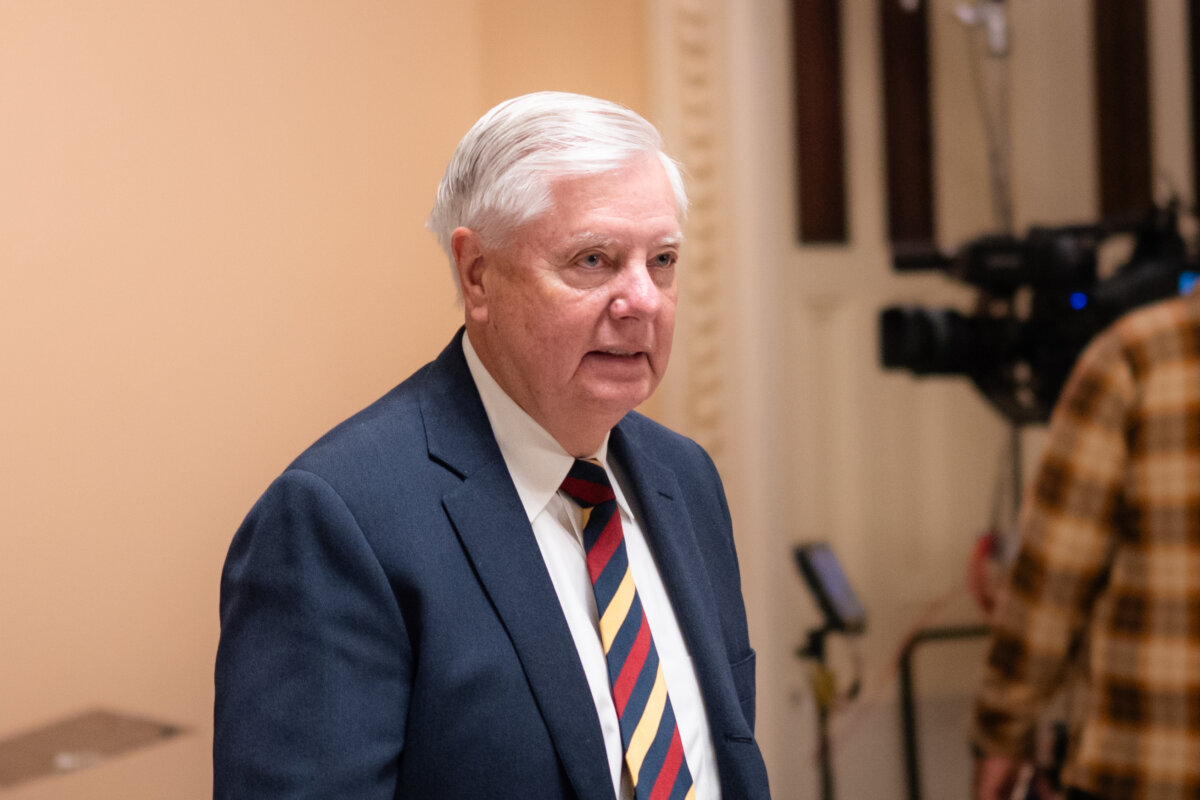

Sen. Lindsey Graham (R-S.C.), a longtime Iran hawk, said that he agrees with President Donald Trump’s assessment that Iran’s military has been significantly degraded by U.S. strikes against the country, rebuffing claims that Tehran has become stronger after a memorandum of understanding was hashed out between the two countries this week.
“Completely agree with President Trump’s analysis that Iran’s capability to generate another October 7 or continue to be the largest state sponsor of terrorism on the planet has been massively degraded,” Graham wrote in a statement posted to X on Friday.
He said that “those who say Iran is stronger now than before” are effectively insulting the U.S. military’s ability, adding that Iran’s economy is “in shambles.” He was responding to a social media post made by Trump in which he said that Iran lacks a navy, air force, and other necessary equipment needed to defend itself.
Graham called on Trump to reach a “diplomatic solution” to deal with Iran’s nuclear program, which Trump has said must be ended.
“The day diplomacy is off the table will present America and our allies with some very stark choices,” he wrote. “In the meantime, as we pursue diplomacy, make it crystal clear that Israel will not have to tolerate being attacked by Iranian proxies who cause parts of Israel to be uninhabitable.”
For years, Graham has been a prominent advocate of aggressive U.S. foreign policy toward Iran, primarily centered around preventing Tehran from obtaining nuclear weapons, and supporting regime change. In 2010, for example, he called for the U.S. military to launch preemptive strikes against Iran to weaken the regime, and he’s continued to call for military action against the country ever since.
Trump reposted a screenshot of Graham’s comment on his account, later writing in a separate post that he considers Graham a “wonderful friend” and praising his efforts in the Senate.
Earlier this week, the United States and Iran signed off on a memorandum of understanding, or MOU, that ends fighting between the two and reopens the Strait of Hormuz. The memorandum provides a 60-day window that will allow for the two sides to finalize an agreement, but the MOU also includes a demand that Iran give up or dilute its highly enriched uranium and end its nuclear program, which has long been a key source of tension between Iran and the West.
Senate Armed Services Committee Chair Roger Wicker (R-Miss.) said on Thursday that he is “concerned that the memorandum of understanding negotiates away the victories of Operation Epic Fury in ways that are completely out of step with the President’s goals.”
Some other Republicans, Democrats, and Israeli officials have also criticized the deal, saying that it gives too much to Iran, and likened it to the Obama administration’s 2015 Iran deal that Trump pulled the United States out of. One agreement under the MOU, a $300 billion fund to help investments into Iran as it rebuilds its infrastructure, has come under criticism.
Vice President JD Vance pushed back on the characterization, noting key differences between the two, such as the 2015 deal allowing some continued enrichment of uranium as well as accumulation of stockpiled weapons-grade material, whereas the MOU does not.
Iran has insisted that Israel must withdraw from the large swath of southern Lebanon it is occupying, but the wording of the interim deal does not explicitly require that and only ensures Lebanon’s “territorial integrity.”
Israeli Prime Minister Benjamin Netanyahu said Thursday that Israel’s military would stay in an area around southern Lebanon as long as his country’s “security needs require it.”
On Friday, a U.S. official confirmed that Israel and Hezbollah agreed to a ceasefire in Lebanon as an Israeli military spokesperson said that new instructions about a ceasefire had not yet reached Israeli forces operating in the southern part of the country.
The Associated Press contributed to this report.
 Friends Read Free
Copy
Facebook
Tweet
Friends Read Free
Copy
Facebook
Tweet