
A senior U.S. State Department official has accused the Chinese Communist Party (CCP) of bullying Pacific Island nations, pointing to a submarine-launched ballistic missile Beijing fired into the Pacific in July.
In a press briefing, Matt Murray, deputy assistant secretary of state for Australia, New Zealand, and the Pacific Islands, also welcomed steps by the current Solomon Islands government to align closer with democratic allies instead of Beijing.
Murray said the United States “certainly shares concerns with our Pacific Island partners related to China’s malign activities in the Pacific.”
He pointed to issues like IUU (Illegal, Unreported, and Unregulated) fishing, elite capture and corruption, economic coercion, environmental degradation, and “provocations like the recent SLBM (submarine-launched ballistic missile) launch.”
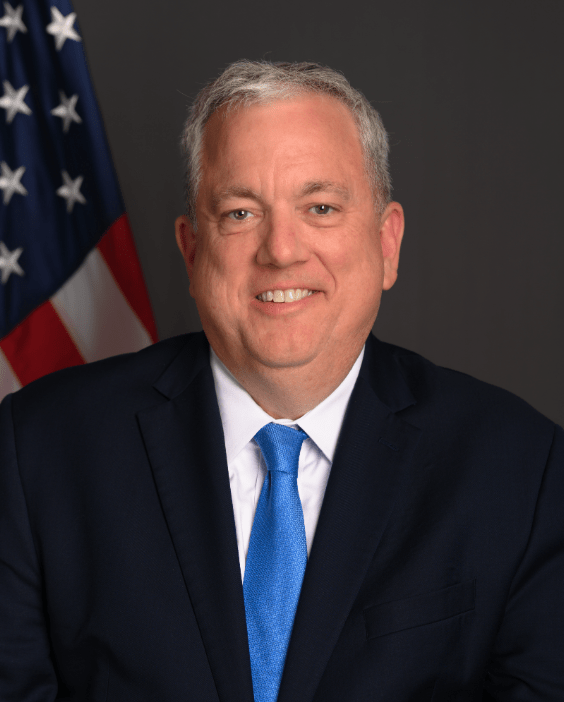 Matt Murray, Deputy Assistant Secretary for Australia, New Zealand, and the Pacific Islands in the State Department’s Bureau of East Asian and Pacific Affairs. (Courtesy of the U.S. State Department).
Australian Prime Minister Anthony Albanese called it a “provocative act” that undermined “the peace, security and stability of the Pacific,” while New Zealand Foreign Minister Winston Peters called it “an unwelcome and concerning development.”
Beijing said the launch was not directed against any particular country.
Secretary Delighted With Solomon’s Foreign Policy Shift
Murray also highlighted the 48-year diplomatic relationship between the United States and the Solomon Islands, forged through the Battle of Guadalcanal, noting Washington was among the first nations to recognise the country’s independence.
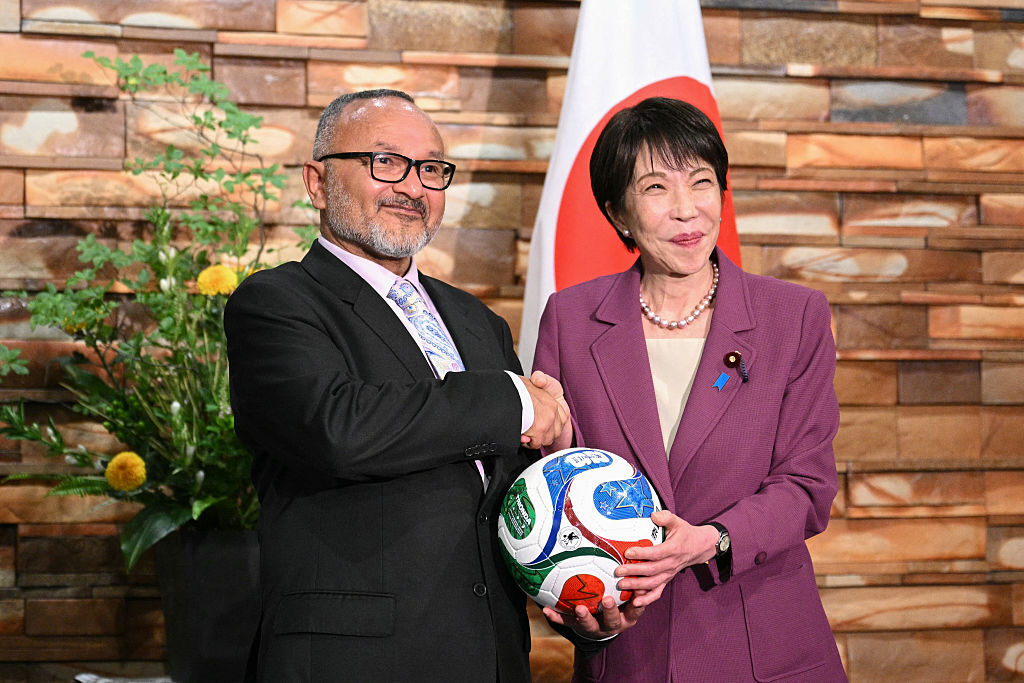
He said Washington was “delighted” to see Prime Minister Matthew Wale reprioritise the Solomon Islands’ foreign policy, noting Wale’s first six trips as prime minister were to Australia, New Zealand, Fiji, Papua New Guinea, the United States, and Japan.
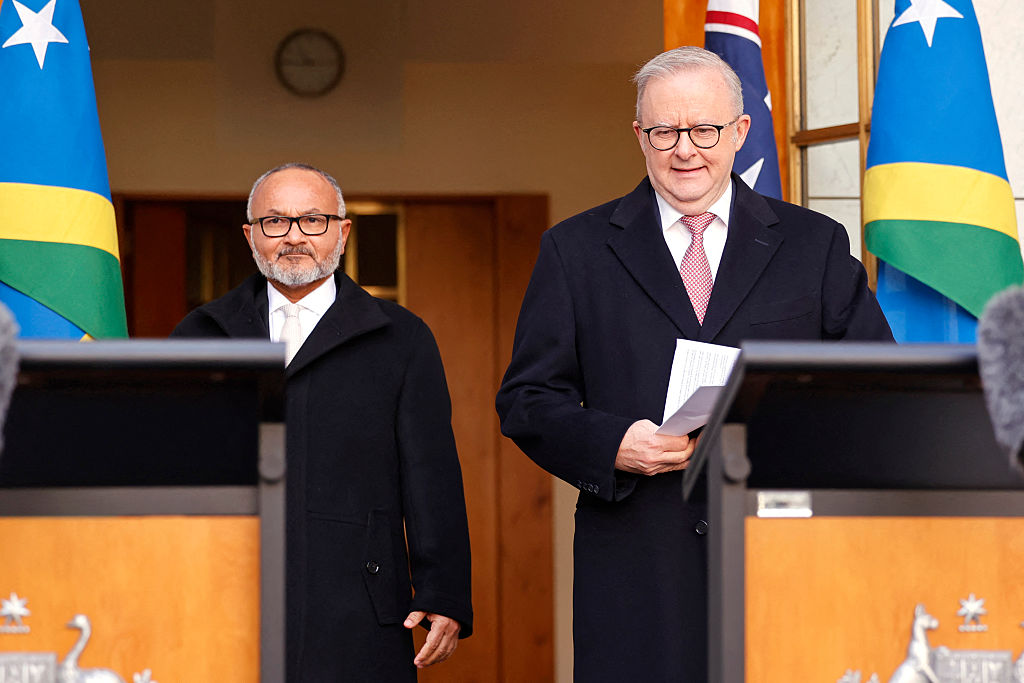 Solomon Islands Prime Minister Matthew Wale (L) and Australia’s Prime Minister Anthony Albanese attend a press conference at Parliament House in Canberra, Australia on June 3, 2026. (Hilary Wardhaugh/AFP via Getty Images)
Progress had been slow under former Prime Minister Manasseh Sogavare, described as Beijing-friendly, but has moved faster since Wale took office in May.
During Wale’s July visit to Washington, the two governments finalised an investment agreement with the U.S. Development Finance Corporation, signed a shiprider agreement with the U.S. Coast Guard (allowing Solomons’ officers to work on Coast Guard vessels), and signed a letter of intent to restore the Peace Corps programme after a 26-year absence.
Murray said Washington wants to engage the country “on the basis of transparency, collaboration, and in a spirit of equal partnership.”
Concerns About Taiwan
Murray also raised concerns about Beijing’s efforts to pressure Pacific nations to sever ties with Taiwan and to block its participation as a PIF development partner, a status Taiwan has held since 1992.
“Whereas China bullies PIF members to attempt to get its way, the United States approaches the PIF membership with respect and on an equal footing,” he said, adding Washington would keep backing Taiwan’s inclusion in forum activities.
He said he found it “unfortunate” that international coverage of the forum’s August summit in Palau focused heavily on China-Taiwan friction, arguing “the predominant story” was Pacific nations working together on shared economic and security challenges.
US Aid Across the Region
Murray’s briefing followed Deputy Secretary Christopher Landau’s trip from Aug. 31 to Sept. 11 to Palau, the Federated States of Micronesia (FSM), the Solomon Islands, and Kiribati—his third extended Pacific visit in a year.
At the Pacific Islands Forum in Palau, Landau held 11 bilateral meetings and announced more than $150 million in new support, covering energy security, infrastructure, digital connectivity, law enforcement, and maritime security.
The package includes $60 million to help Pacific nations cover short-term budget shortfalls from the global energy crisis and expand fuel storage and grid stability, and $17 million for a regional project targeting IUU fishing. Washington also announced an inaugural U.S. Pacific Islands Conference of Police Ministers, co-chaired with Palau and focused on maritime security, drug trafficking, cybercrime, and illicit finance.
In Micronesia, Landau announced more than $100 million for disaster relief and reconstruction in Chuuk following Typhoon Sinlaku, delivered under the Compact of Free Association.
The trip also included a stop on Kiritimati Island, Kiribati, for the Kiribati Development Partners Forum, where Landau affirmed U.S. support for the country’s 20-year development vision.
Murray also said Washington is “reorienting” its foreign assistance towards private-sector-led growth over direct aid, pointing to a joint push with Australia, Japan, New Zealand, and Taiwan to connect every Pacific Islands Forum country to a trusted undersea cable network.
Murray also mentioned plans for a second U.S. Pacific Investment Summit in early 2027, following an inaugural summit in Honolulu in February that drew more than 80 American companies.
“Strong U.S. ties with the Pacific make our country and the region safer, stronger, and more prosperous,” Murray said, adding that the United States would “continue to show up in the region.”
 Friends Read Free
Copy
Facebook
Tweet
Friends Read Free
Copy
Facebook
Tweet