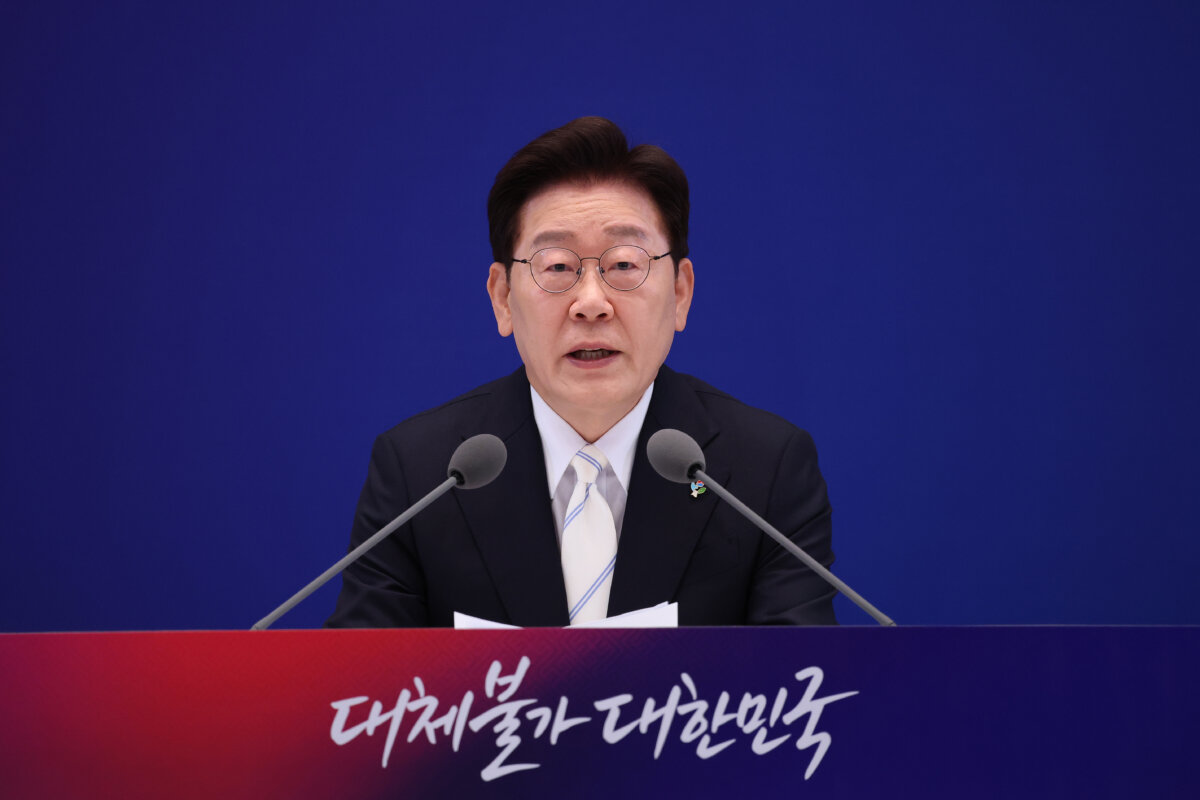

South Korean President Lee Jae Myung has said he is pushing for a step-by-step process to de-escalate North Korea’s nuclear program.
Seoul’s leader says that, given Pyongyang’s reluctance to engage in direct talks between the two capitals, he hopes that U.S. President Donald Trump’s stated ambition to revive talks between himself and North Korean leader Kim Jong Un could help make this happen.
“To change the direction of a moving vehicle, it must be brought to a halt first,” Lee told The Associated Press, saying a “phased approach of stopping, reduction and dismantlement” would be a practical way of resolving the issue.
He added that owing to the extent of the advancement North Korea has made in its nuclear and missile technology, achieving total denuclearization all at once is “not a realistic solution,” as Pyongyang will continue to progress with its capabilities in the interim.
Lee, who is set to speak at the U.N. General Assembly in New York on Sept. 22, hopes that rekindling relations between Trump and Kim will eventually lead the two Koreas to resume direct negotiations.
However, despite Lee’s outspoken support of Trump’s wish to re-engage with Pyongyang, relations between Seoul and Washington have come under strain recently, with South Korea ruling out involvement in the Iran war.
This prompted Trump to order the Pentagon to scale back joint military exercises with South Korea on Aug. 16, highlighting the expense of the exercises and suggesting they sent the wrong signal to North Korea.
In a Truth Social post announcing the decision, Trump also expressed frustration that Lee declined to lend a hand in the war.
“While somewhat unrelated (?), I recently asked the President of South Korea if they would like to join us in the Denuclearization of the Islamic Republic of Iran, and they said, ‘No thanks!’” Trump wrote.
Just over a week later, on Aug. 24, South Korea announced that another joint drill had been canceled by the U.S. Marine Corps in June, as their ability to deploy forces had been “constrained due to the situation in the Middle East.”
Lee, however, has termed the move by Trump as “a deliberate step to send a clear message that the United States has no hostile intent toward North Korea,” saying both Seoul and Washington “remain open to engaging in dialogue with North Korea without preconditions.”
He says what is needed is a “political decision at the leaders’ level” and that Trump and Kim should “work together to identify a common ground, face-to-face.”
North Korea has launched multiple missiles in recent weeks. On Sept. 20, Seoul said that it suspected its neighbor of having fired two short-range ballistic missiles off its coast.
The Ministry of National Defense of South Korea said that Pyongyang had fired a ballistic missile on the afternoon of Sept. 20 toward the East Sea, followed by what is suspected to be another ballistic missile three hours later.
It said the first projectile, believed to belong to the Hwasong-11 series of ballistic missiles, was fired from the Wonsan area at about 3 p.m. local time and flew 280 miles.
The second projectile was also fired from Wonsan, at about 5:50 p.m., and flew 373 miles.
Pyongyang confirmed it had launched several missiles and other weapons on Sept. 12, including tactical ballistic missiles, cruise missiles, and rockets, as well as attack drones, as part of a live-fire drill.
Experts said the drills were a demonstration of North Korea’s ability to coordinate multiple weapons through one command-and-control system.
The launches occurred the day after the United States, South Korea, and Japan concluded their five-day trilateral Freedom Edge 26 exercise.
The Associated Press and Victoria Friedman contributed to this report.
 Friends Read Free
Copy
Facebook
Tweet
Friends Read Free
Copy
Facebook
Tweet