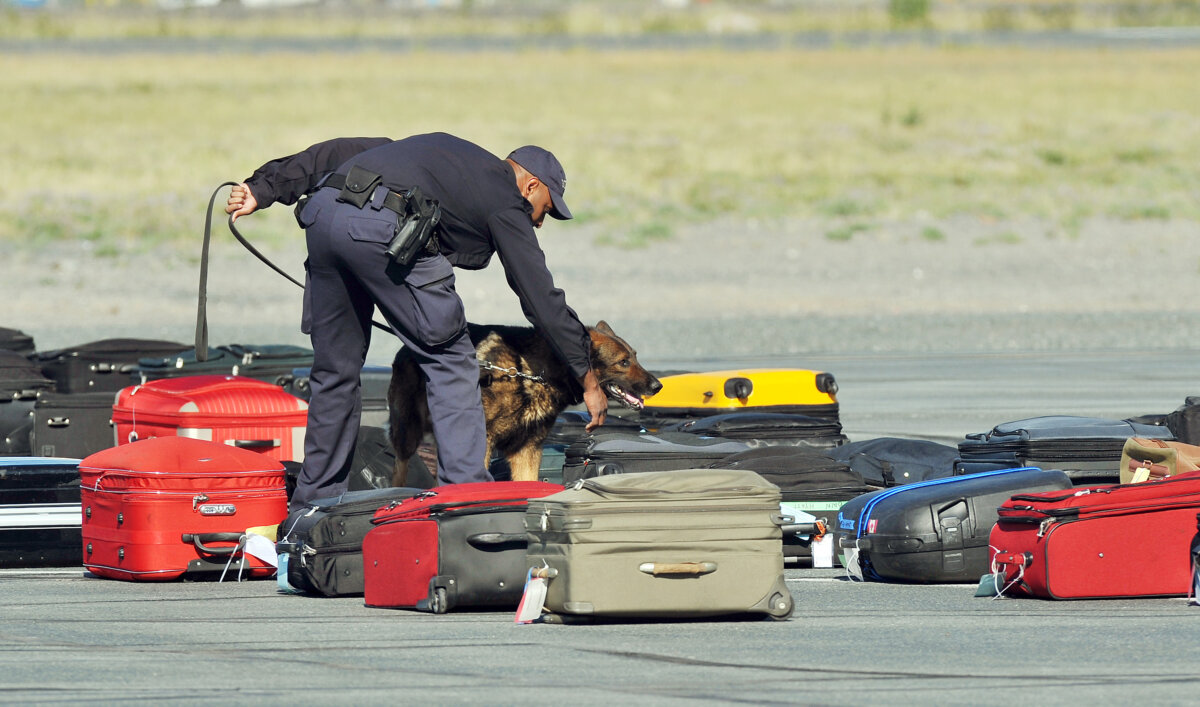

When heading out on vacation, many Canadians worry about lost bags, sunburn, and cancelled flights. Now, some may also fear arriving to find their baggage tag attached to a suitcase full of crystal meth.
Over the past year, at least 17 innocent Canadians have been accused of drug trafficking after their baggage tags were allegedly switched onto suitcases filled with illegal drugs, including one bag stuffed with 20 kilograms of methamphetamine, according to a recent investigation by CTV’s “W5″ investigative program.
The scheme is straightforward, according to W5: A corrupt airport worker takes the luggage tag off a checked bag and puts it on a suitcase containing drugs. The passenger’s luggage is then retagged as “rush,” noting it as delayed or mishandled.
If the suitcase containing drugs gets through customs at its destination, a tracking device put inside leads a waiting drug trafficker to the drugs. If the bag is flagged, the passenger whose tag is on it gets a visit from police.
At least six baggage and ramp workers at Pearson have been arrested in the past year in relation to the alleged tag switching incidents, according to Public Safety Minister Gary Anandasangaree.
The cases uncovered by W5 involved flights departing Canada for destinations including the Philippines, South Korea, France, Germany, Morocco, Bermuda, and the Dominican Republic. Several of the travellers were handcuffed, detained, or jailed while authorities investigated the drugs. All were eventually released.
Aviation and security experts say the incidents are alarming but extremely rare given the massive volume of international air travel through Canadian airports each year. Roughly 85,000 passengers fly into or out of Toronto Pearson International Airport every day, and this number surges to as much as 171,000 during peak travel season, according to the airport.
Gábor Lukács, founder of Air Passenger Rights, says baggage tag swapping is “very uncommon” but can have “catastrophic consequences” for passengers who are falsely accused.
“It poses a risk of significant harm to the public. Those criminals who engage in such activities are not simply breaking the law, but are also putting the health and reputation of peaceful and law-abiding citizens at risk,” he told The Epoch Times.
An Inside Threat
Experts say the cases likely involve airport insiders with access to baggage handling areas, where luggage is often moved through a complex system involving multiple contractors and workers.
“There’s still a lot of manual baggage handling that takes place,” said John Gradek, who teaches aviation management at McGill University and has worked in airport baggage handling. “Human interaction will always form part of the baggage handling process, so there’s always risk associated with that.”
Gradek said airport workers generally do not undergo the same level of security screening as passengers, opening up vulnerabilities that organized crime groups may seek to exploit.
Sheldon Jacobson, an aviation security researcher and a professor at the University of Illinois Urbana-Champaign, described airport workers as the “weak belly” of security.
“When you talk about the weak belly of airport security in general, it is not typically the passengers, it’s typically the insiders,” Jacobson told The Epoch Times. “The vetting process is not always as stringent as people may believe it is.”
The concerns about baggage-tag switching came following another scandal at Pearson airport: a major gold heist in April 2023, in which more than $22 million worth of gold and foreign currency was stolen from an airport cargo facility before a Brinks armoured truck arrived for pickup.
Police later said that the theft was carried out with the help of insiders, including airport cargo workers and Air Canada employees, along with a forged document used to release the shipment.
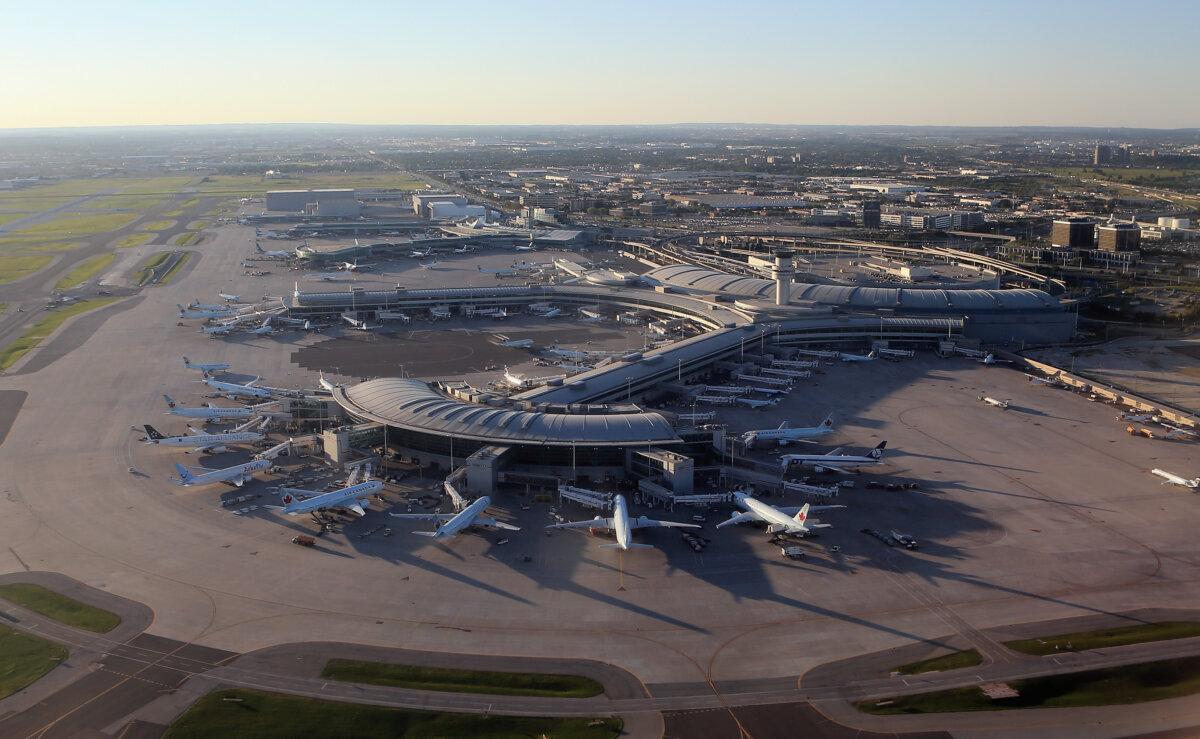 An aerial view of the Lester B. Pearson airport in Toronto in a file photo. (Bruce Bennett/Getty Images)
Travellers Targeted
Experts say organized crime groups may favour using unsuspecting travellers in trafficking schemes because they are less likely to attract attention from authorities than individuals already known to police or linked to criminal networks.
Security consultant Brian Higgins said the reported incidents may also represent “test runs” by traffickers trying to identify weak baggage screening systems at international destinations.
“That always happens initially. To see if their scheme works,” Higgins said.
Higgins also warned that future drug mules could try to exploit the publicity surrounding baggage-tag switching by falsely claiming the drugs found in their luggage do not belong to them.
Gradek said traffickers may also be trying to determine “how robust is that inbound baggage inspection process” at different airports.
“They’re trying different ways and means and practices to kind of diffuse the attention that the authorities would be giving those individuals that might be known to the authorities as being transporters of drugs,” he said.
Jacobson said the fact that the reported scheme continues suggests at least some shipments have successfully passed through airport screening systems undetected.
“My guess is they’ve already had some successes, or they wouldn’t be doing it,” he said.
In one case uncovered by W5, a 35-year-old paramedic from Toronto named Nicole was travelling to Auckland, New Zealand, with her family. The flight had a layover in Vancouver, where the plane was boarded by Canada Border Services Agency officers. They took her off the flight and informed her that illegal drugs had been found in her two checked bags.
The luggage held over 20 kilograms of suspected methamphetamine. Nicole was arrested and put into a holding cell for a few hours despite saying the bags were not hers. She was ultimately released and arrived in New Zealand, where her actual bags were found unclaimed in the luggage area with “rush tags” on them, indicating they had been delayed or mishandled.
Lukács said travellers falsely accused because of baggage-tag switching may still face serious consequences even if they are eventually cleared by authorities.
Passengers detained overseas could miss flights, lose hotel bookings, incur legal expenses, or spend hours or days attempting to prove the luggage does not belong to them.
“One might consider suing the airline involved in the handling of the baggage,” Lukács said, but airlines may argue that criminal actions by rogue employees fall outside the normal scope of their employment responsibilities.
Lukács said airlines might point to international aviation agreements such as the Montreal Convention, which came into force in 2003. The convention sets standard rules for airlines’ responsibilities toward passengers and liability for harm.
It limits the amount airlines can face in a lawsuit as well as their culpability for criminal acts done by rogue employees acting outside their defined job responsibilities.
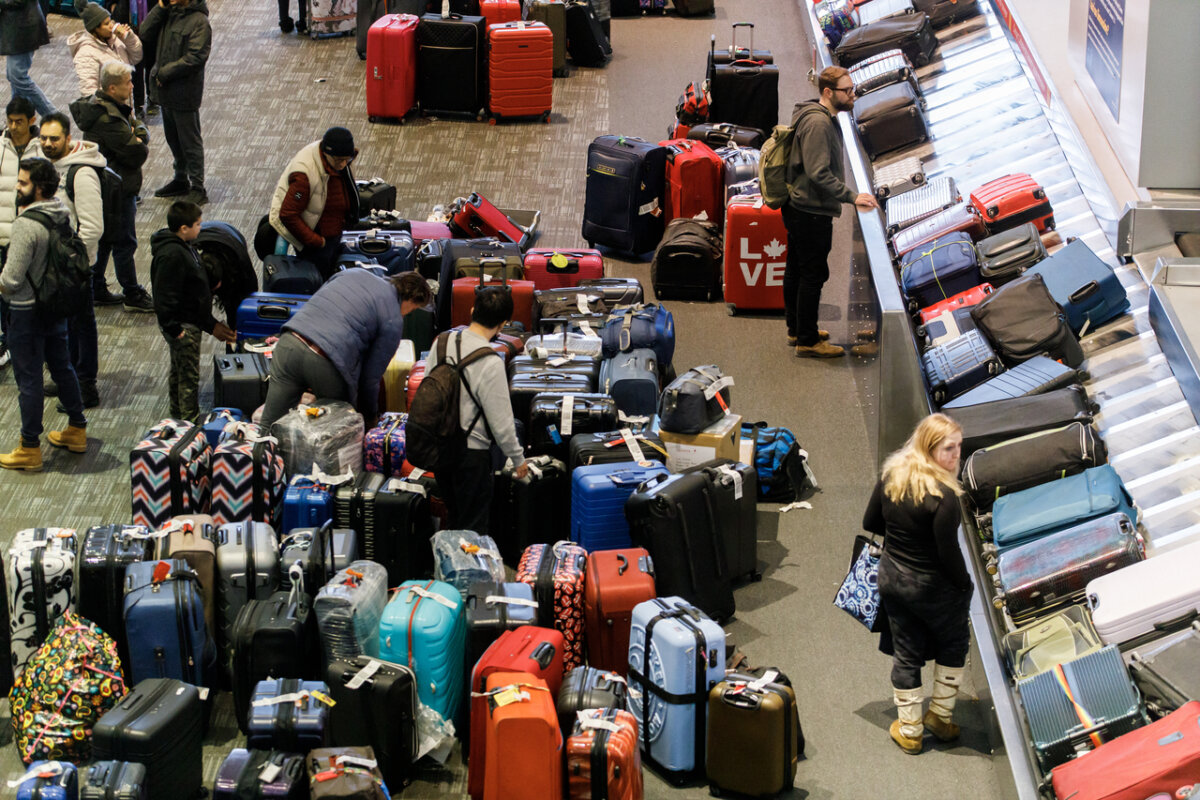 Luggage are amassed in the bag claim area at Toronto Pearson International Airport in a file photo. (The Canadian Press/Cole Burston)
Precautions for Travellers
Several experts contacted by The Epoch Times recommend that travellers photograph their luggage, baggage tags, and identifying serial numbers before checking bags in case they later need to prove a suitcase does not belong to them.
“Take a picture of the bag with the tag on it,” Gradek said. “So they see the tag and they see the bag.”
Experts also recommended using luggage tracking devices, keeping baggage receipts, and making suitcases visually distinctive so they are less likely to be confused with other luggage.
Jacobson said travellers may also want to avoid checking bags entirely when possible.
“If you can avoid checking your bags, it’s kind of a nice thing,” Jacobson said.
Transport Canada has pledged to take action in the wake of the W5 investigation.
In a May 25 statement, it said it will quickly look into the issues revealed in order “to ensure the highest standards are in place to protect passengers, workers, and airport operations.”
Conservative MP Dan Albas also raised the issue in the House of Commons on May 25, saying baggage-tag switching has been “happening for a very long time,” and asking for government action to address the issue.
Gradek said airports could reduce the risk of baggage-tag switching by making luggage tags more difficult to tamper with and increasing automation and surveillance inside baggage handling areas.
“There are things that can be done to the design of the baggage tag that would make it tamper-proof,” he said.
However, he noted that more advanced surveillance and automation systems would require significant investment by airports and airlines.
Some experts stress that while the cases expose real vulnerabilities within airport systems, the chances of an ordinary traveller unknowingly becoming part of a drug-smuggling operation remain extremely low.
Bruce Schneier, an adjunct professor at the University of Toronto’s Munk School of Global Affairs & Public Policy, said travellers should keep the incidents in perspective given the enormous number of passengers moving through Canadian airports every day.
“I’ll bet you anything you’re more likely to die on the taxi ride to the airport than you are to be a victim of this crime,” Schneier said in an interview.
Jennifer Cowan contributed to this report.
 Friends Read Free
Copy
Facebook
Tweet
Friends Read Free
Copy
Facebook
Tweet