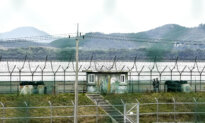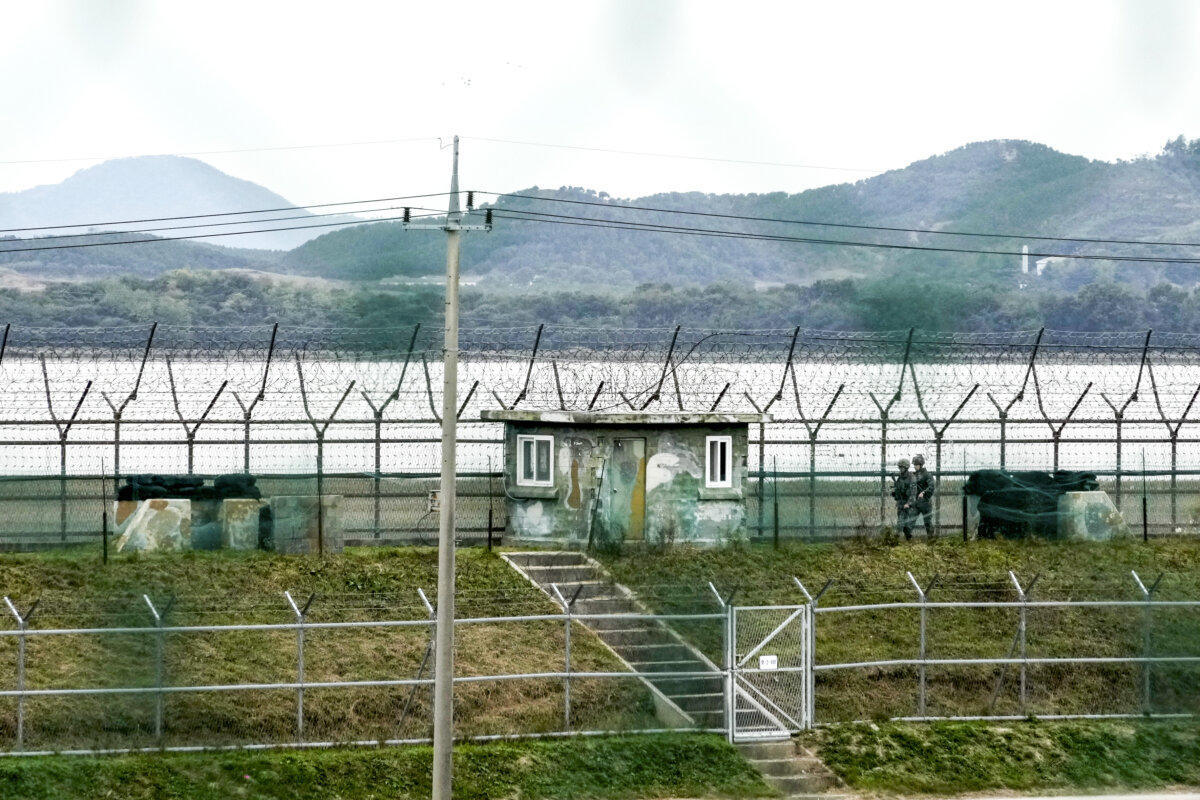

South Korea announced that mines allegedly planted by North Korea detonated in the Demilitarized Zone last week, injuring two of Seoul’s personnel in the buffer zone that divides the two Koreas.
South Korean Defense Minister Kang Shin-chul told a parliamentary committee on Sept. 29 that the mines appeared to have been planted in the area as part of Pyongyang’s fortification work near the Military Demarcation Line, which marks the internationally recognized border between the North and South.
“It is clearly a violation of the armistice agreement, and the responsibility lies with North Korea, so we will take corresponding measures,” Kang said, according to South Korean News Agency Yonhap, without describing what those measures would be.
The blast occurred during an operation to clear a path for a joint inspection between the South Korean military and the United Nations Command (UNC) to investigate suspicions in Seoul that North Korea has buried land mines across the border, in violation of the armistice that paused the Korean War in 1953.
Although not actively involved in open conflict, North Korea and South Korea technically remain at war.
Although Kang told the South Korean parliament that he is personally convinced that the mines were planted by North Korean forces in breach of the armistice, official confirmation has not yet been given by the UNC, which is the body that formally decides whether the armistice has been breached.
“If confirmed, we will cooperate with the UNC and the international community, and clearly hold those responsible to account,” Kang said.
The UNC has not yet issued a public statement on the incident. The Epoch Times contacted the UNC for comment and did not receive a response.
Despite Kang’s allegation that the land mines in question were planted by North Korea, he did urge caution in assuming the explosives had been planted recently. North Korea has not admitted to planting land mines since 1998.
“It does not appear to have been displaced from elsewhere,” he told the parliamentary committee; however, he said that soil and roots found over one of the mines indicated that it may have been buried for some time and could predate North Korean mine-laying detected by Seoul in the area in September 2025, the Korea Herald reports.
“We will strongly urge them to come to the table so that we can verify the facts together,” he said.
South Korea’s Joint Chiefs of Staff said a joint investigation with the UNC found an additional North Korean resin anti-personnel mine near the Sept. 21 blast site.
“Considering the blast crater, flame patterns and the extent of the injuries, the evidence strongly points to North Korean land mines, and based on these factors, we have concluded that North Korean land mines highly likely caused the explosion,” Lt. Gen. Kwon Dae-won, vice chairman of the Joint Chiefs of Staff, said in a press briefing on Sept. 28, according to Yonhap.
He said that if the final investigation confirms these initial findings, accountability for the incident “rests entirely with North Korea.”
The incident comes at a time when South Korean President Lee Jae-myung has thrown his weight behind U.S. President Donald Trump’s push to meet with North Korean leader Kim Jong Un.
Tensions have flared on the Korean Peninsula in recent weeks after the militaries of South Korea and its allies finished a number of annual security drills. Pyongyang has responded with its own drills and missile launches.
Recently, the United States, Japan, and South Korea wrapped up their five-day trilateral Freedom Edge 26 exercise. The earlier U.S.–South Korean Ulchi Freedom Shield exercises were scaled back on Trump’s orders; the president said that they sent the wrong message to Kim and were costly to the American taxpayer.
 Friends Read Free
Copy
Facebook
Tweet
Friends Read Free
Copy
Facebook
Tweet