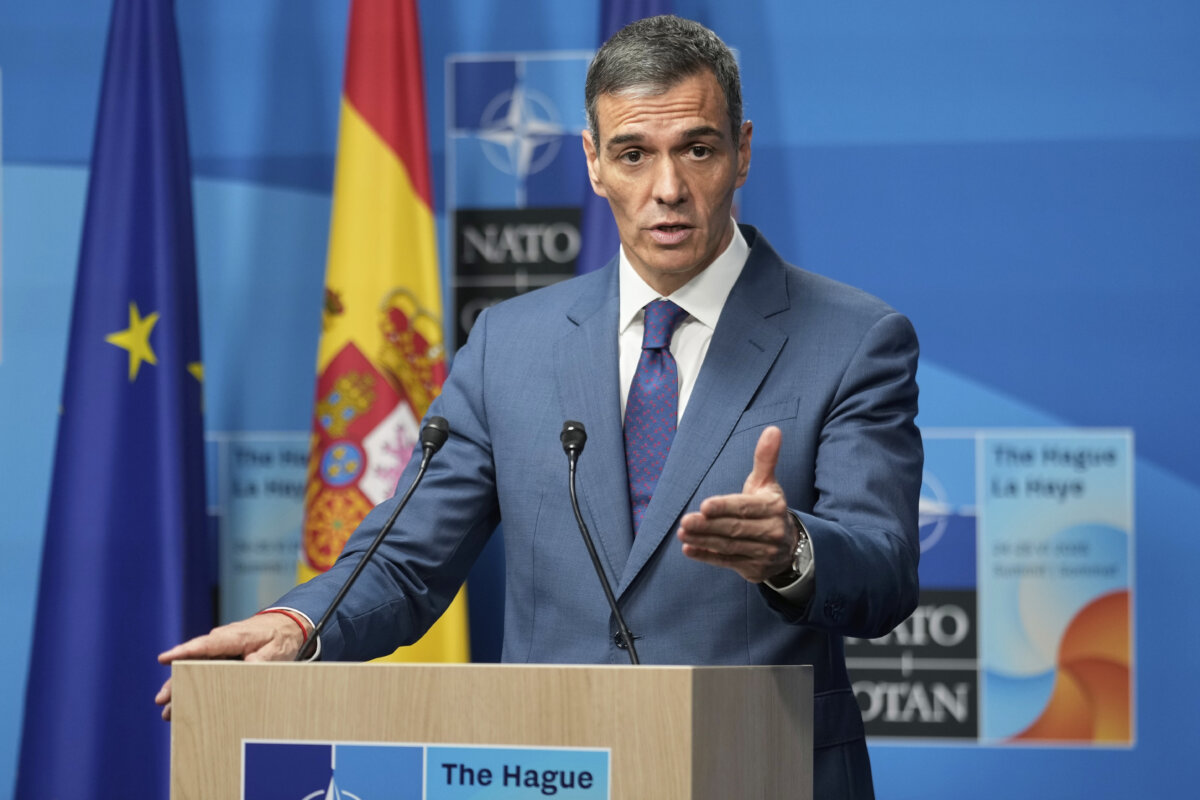
Spanish Prime Minister Pedro Sánchez has responded to U.S. President Donald Trump’s remarks about his country not meeting the target set on Wednesday for NATO members to spend 5 percent of gross domestic product (GDP) on defense.
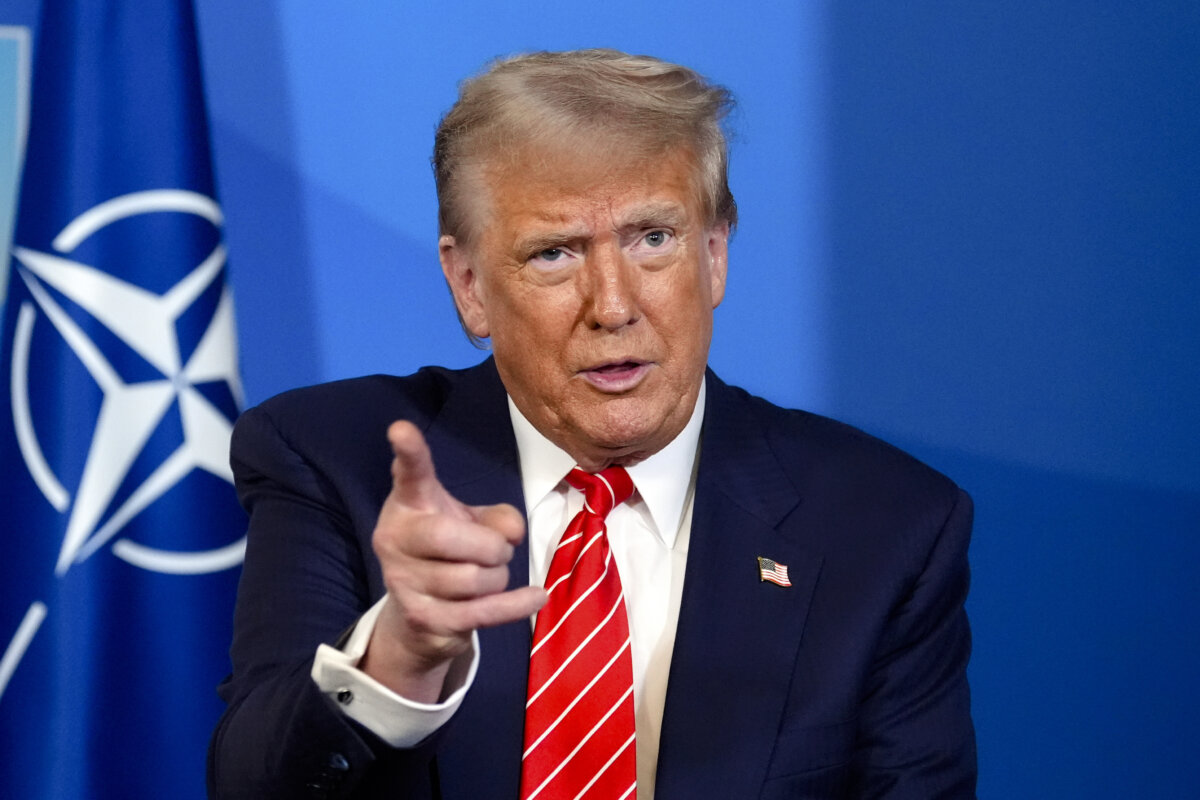
On Wednesday, Trump said Spain appeared to want a “free ride” from NATO after Madrid said it would only spend 2.1 percent of its GDP.
Trump said: “Spain is the only country, out of all of the countries, that refuses to pay; they want a little bit of a free ride, but they have to pay it back to us on trade because I’m not going to let that happen. It’s unfair.”
Sánchez said on June 22 that he had secured a last-minute exemption from NATO and taht the wording of the declaration would be altered from “all allies” to “allies” to reflect that.
The Hague Summit Declaration on June 25 stated, “Allies commit to invest 5 percent of GDP annually on core defence requirements as well as defence-and security-related spending by 2035 to ensure our individual and collective obligations.”
“Spain is a country, and this is what we agreed on yesterday: a country that is supportive and committed to the member states of the alliance, but also sovereign. And that is the balance we found in the declaration we agreed upon among the 32 member states of the Atlantic Alliance, including the United States,” Sánchez told reporters in Brussels on Thursday.
“We are going to fulfill this with our capabilities. The Spanish Armed Forces, the Ministry of Defense, tell us that the capabilities agreed upon 20 days ago, on June 5, with NATO, represent 2.1 percent of our gross domestic product, and that is what we’re going to do. And that commitment is absolutely compatible with the commitment to sustain and strengthen the welfare state in Spain.”
The prime minister added, “We are going to honor that declaration and what was agreed upon.”
On Wednesday, Trump said Spain is “the only country that won’t pay the full amount.”
“They want to stay at 2 percent,” Trump said. “I think it’s terrible.”
He told a Spanish journalist: “You know what we’re going to do? We’re negotiating with Spain on a trade deal, we’re going to make them pay twice as much, and I’m actually serious about that.”
Trump added, “I’m going to negotiate directly with Spain. I’m going to do it myself. They’re going to pay, they’ll pay more money this way.”
On Thursday, Sánchez said Spaniards should know that Spain has “a trade deficit, we do not have a trade surplus. We have a trade deficit with the United States.”
He said it was the European Commission and not Spain that decided the bloc’s trade policy.
Sánchez added: “What’s clear is that trade policy is a policy that is managed from here, from Brussels. We are part of a customs union, that too is the European Union, and a single market, and trade policy is obviously negotiated by Brussels on behalf of all the member states.”
US Is ‘Friend of Spain’
In April 2025, the Trump administration imposed reciprocal tariffs of 20 percent on imports from Spain and all the other EU countries. That figure was later reduced to 10 percent, pending negotiations.
Sánchez said, “Spain is an open country. It is a country that is friendly to its friends, and we consider the United States a friend of Spain.”
Following the U.S. president’s remarks about Spain, Belgian Prime Minister Bart De Wever told reporters: “It is not always easy to interpret exactly what Mr. Trump means.
“How he wants to impose import tariffs on Spain separately is a mystery to everyone. Could this perhaps concern specific products from Spain? We will have to wait and see.”
In 2014, NATO set a target for all members to spend 2 percent of GDP on military expenditure by 2024. Last year, Spain spent 1.28 percent, according to NATO estimates, making it the alliance’s lowest spender.
Antonio Garamendi, president of the Spanish Confederation of Business Organizations, criticized Sánchez on Thursday.
He said, “We have to stick with our allies and not going along with the other Europeans is an error, and even more so if that increases the chance we will be punished.”
Garamendi said that although the EU was negotiating a trade deal with the United States on behalf of all 27 member countries, certain industries, such as olive oil production, were particularly vulnerable.
He said, “There are industries that can be impacted, and that has to concern us.”
The Associated Press contributed to this report.
 Friends Read Free
Copy
Facebook
Tweet
Friends Read Free
Copy
Facebook
Tweet